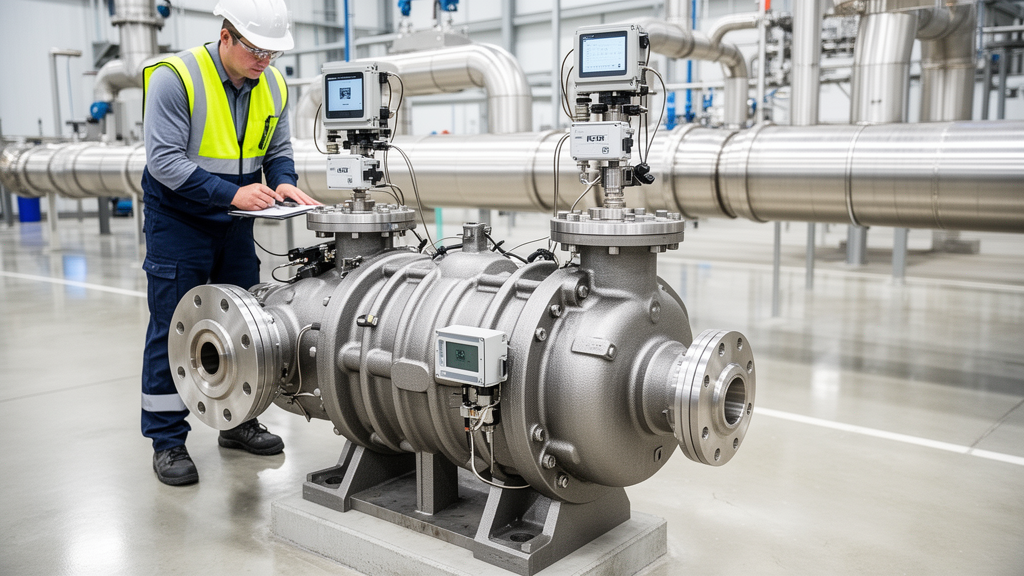
Researchers have developed a sophisticated new approach to managing displacement pumps that replaces the need for expensive and slow external flow rate sensors with a novel “Smart Pump Maintenance” workflow. By leveraging internal sensors already present within the pump—specifically those measuring pressure, temperature, and rotational speed—the team has created a system that can accurately control volume flow while simultaneously identifying and addressing common industrial failures such as clogging, leakage, and pump abrasion. This method, which utilizes a hybrid grey-box model combining analytical white-box modeling and machine learning, offers a pathway to more reliable and persistent operation of fluid dosing systems in a wide range of industrial applications. The findings demonstrate that by mapping the precise characteristic behavior of the pump and the hydraulic system, operators can maintain desired dosing rates even as individual components begin to degrade over time.
Displacement pumps are fundamental to numerous industrial processes where fluids must be transported at precise volumes over specific durations, a process known as dosing. Traditionally, ensuring the accuracy of these systems has presented a significant technical challenge, often requiring the integration of external volume flow sensors to monitor output. These external devices, however, introduce several complications, including increased measurement uncertainty, higher implementation expenses, and added mechanical complexity. Furthermore, standard dosing systems are often not intelligent enough to detect long-term degradation issues like abrasion or the subtle onset of clogging in pipes and filters. While existing literature has proposed various machine learning techniques to monitor pump degradation—often relying on acoustic sensors or external simulations—these methods frequently struggle with the slow, unperceived nature of long-term failure modes in industrial environments.
The newly proposed framework addresses these challenges by utilizing a hybrid grey-box model that synthesizes the physical understanding of fluid mechanics with data-driven machine learning. Instead of relying on an external flow meter, the research team demonstrated that they could extract the actual volume flow rate using only data from the pump’s internal sensors. By recording the differential pressure between the pump inlet and outlet, the fluid temperature, and the motor’s rotational speed, the system can calculate precise flow characteristics. This approach relies on the fact that the relationship between pressure loss and volume flow in gear pumps follows a predictable, parabolic characteristic curve. By performing a regression analysis on these variables during the final stages of pump fabrication, manufacturers can provide a baseline model that allows the pump to act as its own intelligent monitor.
Implementing this system begins with a critical procedure the researchers define as the “Teach-In” process, which must be performed during the initial installation of the pump into a specific plant configuration. Because the hydraulic resistance of the entire system—including pipes, filters, and connected fluidic environments—influences the performance, it is essential to establish the plant’s unique characteristic curve. This is achieved by measuring the pressure loss across various rotational speeds and calculating the resulting volume flow based on the pump’s pre-calibrated baseline parameters. The hydraulic pressure loss in the plant is modeled as a parabola, and the parameters derived from this regression are subsequently stored in the pump’s internal firmware. This calibration ensures that the control system understands the specific operational environment in which it is functioning, allowing for highly precise adjustments during regular operation.
Once the Teach-In process is complete, the firmware can automatically adjust the pump’s rotational speed to maintain the desired volume flow without human intervention. The system works by solving the quadratic relationship between the pump’s output curve and the plant’s resistance curve. If an operator requires a specific flow rate, the system calculates the necessary pressure loss and, subsequently, the exact rotational speed required. This operation requires minimal computational effort, making it ideal for integration into standard microcontrollers. However, the true strength of this approach lies in its ability to continuously verify this balance, using deviations between the measured pressure and the calculated expected pressure to identify system failures, which are fundamentally characterized by changes in the parabolic behavior of either the pump or the plant.
The system distinguishes between three distinct failure modes: clogging of the plant, leakage within the system, and abrasion of the pump itself. Clogging is identified by an increase in hydraulic resistance, which manifests as a steeper characteristic curve in the plant’s parabolic model; conversely, a leakage leads to a flatter plant curve, representing a decrease in pressure loss at a given rotational speed. Because clogging and leakage usually occur in the pipes or filters of the installation, they are treated as plant failures. Abrasion, on the other hand, is a long-term failure specific to the pump, caused by the wear of gear teeth which increases internal pump gaps. This wear leads to a reduction in volume flow at a fixed rotational speed, forcing the pump to work harder to achieve the same output. By monitoring these sensor data over time, the system can pinpoint the specific failure condition and suggest the appropriate corrective action.
To evaluate the effectiveness of this maintenance strategy, researchers conducted experiments with seven gear pumps of the type SDU2876, artificially inducing abrasion using an aqueous solution containing abrasive particles over a period of several weeks. Working with Scherzinger Pumpen in Furtwangen, Germany, the team meticulously mapped the pumps’ ageing states—quantified as the reduction in theoretical volume flow relative to a new pump—at various plant configurations. These experiments highlighted that abrasion significantly accelerates in high-pressure environments compared to low-pressure ones, demonstrating why a robust, self-correcting maintenance workflow is essential for longevity. The study defined the “ageing state” as a ratio of current volume flow to the original capacity, providing a quantitative metric that the firmware uses to decide whether a failure can be corrected by increasing the rotational speed or if the pump has reached the end of its operational life.
The validation of the “Smart Pump Maintenance” workflow showed that it is highly capable of maintaining dosing precision even as the pump ages. For pump specimen #04, for example, the algorithm was able to keep the dosing error within a band of approximately ±5% for ageing states greater than 0.8. When the pump performance fell below this threshold, the correction algorithm became less effective, suggesting that such levels of degradation necessitate component replacement. Data across all seven pumps confirmed this observation; the standard deviation of relative errors remained between 1.7% and 3.7% for pumps with ageing states above 0.9, increasing slightly as the pumps experienced further wear. This level of precision is remarkable considering the inherent inaccuracies in the experimental pressure measurements, which typically exhibit deviations of ±2–3% under normal conditions.
The research emphasizes that while the correction process is highly effective, it does not remove the need for periodic maintenance checks. The system requires that the Teach-In process be repeated at regular intervals to account for slow changes in the plant configuration that might otherwise be misidentified as pump ageing. By establishing these regular intervals, operators can ensure that any simultaneous failures—such as a small leakage occurring alongside natural pump wear—are correctly identified and resolved. This repeatability is a crucial part of the workflow, as it allows the system to remain adaptive to the gradual physical changes that are inevitable in industrial fluid transport systems, thereby preventing the accumulation of errors that would eventually compromise process quality.
A notable limitation of the current study is its focus on aqueous solutions. While the parabolic fluid behavior observed in the tests is consistent with physical expectations for low-viscosity Newtonian fluids, the researchers acknowledge that the workflow should be validated for higher-viscosity or non-Newtonian fluids before it is applied in those environments. Despite this scope, the study asserts that the method is largely independent of the specific type of gear pump or fluid design, provided that the physical characteristics are measured during production and properly compensated for temperature fluctuations. The authors suggest that for industry, the effort required for a precise initial Teach-In is a worthwhile investment that pays off through vastly improved system reliability and extended pump service life.
In conclusion, the “Smart Pump Maintenance” workflow represents a significant advancement in the automated control of displacement pumps, transforming the pump from a passive component into an active, diagnostic participant in the industrial process. By utilizing internal sensors to model the complex interactions between the pump and its installation, this approach removes the dependency on external flow meters, effectively reducing costs and eliminating a common point of failure. The capacity to distinguish between clogging, leakage, and mechanical abrasion allows for targeted maintenance, minimizing downtime and potentially saving substantial resources. As industry continues to move toward more autonomous and intelligent operational frameworks, this study provides a scalable and robust method for increasing the efficiency and longevity of critical fluid-transport systems.
Subject of Research: A hybrid grey-box model for intelligent failure detection and maintenance in displacement pumps.
Article Title: Comprehensive failure detection and correction of displacement pumps
Article References: Engler, M., Peric, B., Gutsche, K., & Woias, P. (2026). Comprehensive failure detection and correction of displacement pumps. Frontiers in Artificial Intelligence, 9, Article 1923762. https://doi.org/10.3389/frai.2026.1923762
Image Credits: AI Generated
DOI: 10.3389/frai.2026.1923762
Keywords: displacement pumps, Smart Pump Maintenance, failure detection, industrial automation, fluid dynamics, gear pumps, predictive maintenance, grey-box modeling, machine learning, pressure sensor, pump abrasion, clogging detection, leakage monitoring, system diagnostics, dosing process, sensor fusion
News Source: Denise Maddox. (November 19, 2026). Smart Maintenance Method Enables Automatic Failure Detection in Displacement Pumps. Scienmag.