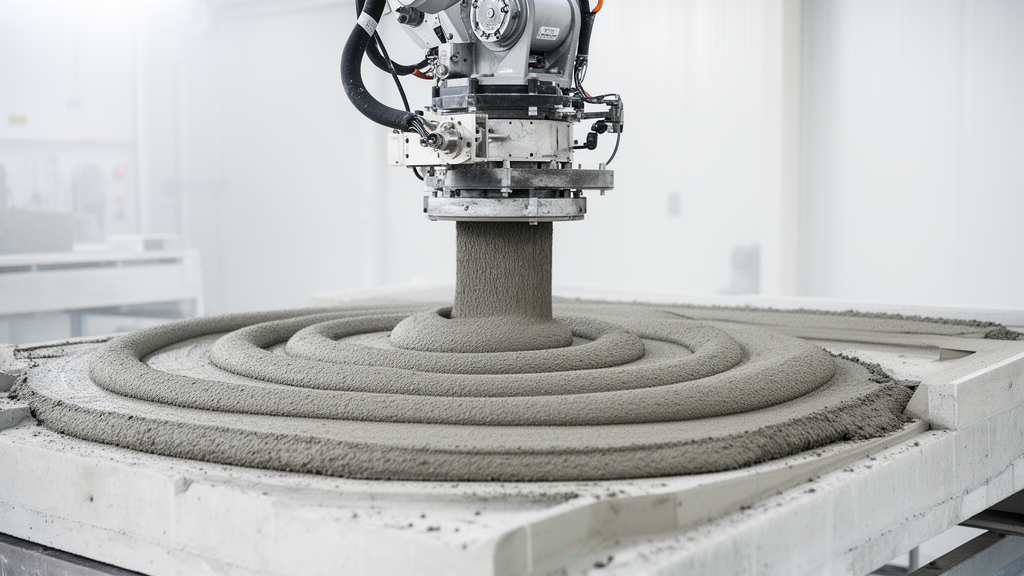
Extrusion-based construction technologies using 3D-printed mortar demand substantial quantities of Portland cement, consuming between one and a half to two times more cement than traditional cast concrete and contributing significantly to greenhouse gas emissions. In an effort to mitigate this environmental footprint while maintaining structural viability, a research team investigated the reuse of sugarcane bagasse ash as a sustainable supplementary cementitious material. Derived as an industrial by-product from cogeneration boilers in sugar mills, the raw agricultural ash is typically landfilled or discarded inappropriately, creating severe local soil degradation and pollution challenges. By incorporating processed sugarcane bagasse ash into printable mortar formulations, researchers evaluated whether this high-silica industrial residue could replace a meaningful portion of ordinary Portland cement without sacrificing critical fresh and hardened engineering properties. The systematic experimental investigation assessed five specific replacement levels ranging from zero to twenty percent by mass, focusing specifically on fresh mixture rheology, early hydration kinetics, penetration setting resistance, directional compressive strength, microstructural pore development, and embodied carbon indices.
To prepare the raw agricultural waste for technical incorporation into printable mixes, the researchers obtained bagasse ash from Guangxi Rural Sugar Industry in Nanning, China, where combustion had occurred between 800 and 1000 degrees Celsius. The raw material underwent a dedicated two-stage treatment consisting of oven drying at 120 degrees Celsius for two hours to eliminate residual absorbed moisture, followed by intensive grinding in a vibratory ball mill for sixty minutes. This mechanical grinding process completely broke down the native cellular structure of the ash particles, shifting their morphology from coarse, irregular, and porous shapes toward finer, more spherical configurations. Particle size analysis via laser diffractometry demonstrated that while raw bagasse ash exhibited a median diameter of approximately 0.210 millimeters, mechanical grinding reduced this median size dramatically to 0.028 millimeters. Consequently, the ground ash became considerably finer than the ordinary Portland cement used in the investigation, which featured a median diameter of 0.040 millimeters, while standard sand possessed a median diameter of approximately 0.24 millimeters.
Mineralogical and chemical characterization confirmed the strong pozzolanic potential of the pulverized bagasse ash. Quantitative X-ray diffraction combined with Rietveld refinement identified quartz at 14.29 percent, anorthite at 6.8 percent, and cristobalite at 1.06 percent, alongside minor occurrences of calcite, corundum, and hematite. Pronounced humps in the low-angle diffraction region indicated a substantial fraction of reactive amorphous silica. Scanning electron microscopy confirmed that the mechanical milling process converted large, porous, tube-like organic residual fragments into fine, dense particles capable of serving both as physical nucleation sites and active pozzolanic contributors. The chemical composition determined through X-ray fluorescence reinforced that the ash possessed a high silicon dioxide content, satisfying established criteria for active supplementary cementitious materials. By breaking down porous cellular channels and increasing the specific surface area, the preliminary physical conditioning ensured rapid chemical reactivity when combined with water, superplasticizer, viscosity-modifying agent, and hydrating Portland cement.
Five distinct mortar mixtures, designated CM, M-5, M-10, M-15, and M-20, were produced by replacing cement by mass with ground ash at zero, five, ten, fifteen, and twenty percent, respectively. In parallel, corresponding paste mixtures designated CB, B-5, B-10, B-15, and B-20 were prepared at an identical water-to-binder ratio of 0.35 to isolate hydration kinetics and setting behavior. Mortar mixing was performed in a five-liter static mixer with programmed rotational speeds and controlled rest stages over a total sequence of 240 seconds, ensuring uniform homogenization of admixtures, binder grains, and aggregate particles prior to fresh state characterization and specimen fabrication.
Testing of fresh properties revealed that increasing bagasse ash content systematically reduced workability and spread diameter across all formulations. In standard flow table tests conducted in accordance with ASTM C1437-07, replacing twenty percent of the cement reduced the initial mortar spread diameter by 19 percent relative to the control mix. Even with this reduction, all five mix designs maintained initial flow diameters between 152 and 187 millimeters, placing them well within the recommended target window of 150 to 190 millimeters required for extrusion pumping. The decline in flowability stemmed from the inherent porosity and irregular particle geometry of the ash, which elevated specific surface area, increased physical interparticle friction, and absorbed both free mixing water and liquid superplasticizer. Tracking spread retention over thirty minutes indicated that while the control mortar lost approximately 14.4 percent of its spread diameter, the twenty percent replacement mixture saw its spread decline from 152 to 130 millimeters within fifteen minutes, underscoring that mixes with higher ash fractions possess a narrower workable window and require prompt deposition.
Yield stress determinations derived from the spread diameter measurements confirmed a continuous structural build-up over resting time for all mixes, driven by progressive particle flocculation and early chemical hydration. The bagasse ash mortars exhibited consistently higher initial yield stress and steeper stress accumulation rates over time than the unblended control. The mixture with twenty percent ash reached the highest overall yield stress across the thirty-minute evaluation period, reflecting accelerated flocculation prompted by fine, angular particles and enhanced moisture uptake. While high yield stress and rapid thixotropic stiffening benefit 3D printing by improving buildability and preventing excessive vertical layer deformation under self-weight, researchers noted that excessively stiff mixtures could increase extrusion pump pressures, elevate the danger of nozzle blockage, and potentially weaken interlayer adhesion if printing passes are delayed.
Isothermal calorimetry tests carried out at 20 degrees Celsius for 72 hours provided direct physical evidence that sugarcane bagasse ash actively accelerates cement hydration kinetics. Normalized heat flow curves demonstrated that although initial heat detection was slightly delayed as ash proportions increased, the subsequent main hydration peak arrived significantly earlier in ash-modified blends than in pure cement paste. At moderate replacement levels of ten and fifteen percent, the peak heat flow intensity slightly surpassed that of the twenty percent mixture, reflecting a synergistic balance between the physical nucleation effect of fine particles and chemical dilution. The dormant period ended earlier as the ash proportion rose, with heat evolution curves reversing sooner in the twenty percent blend. Cumulative heat measurements over the first fifteen hours confirmed greater heat release per unit binder mass at higher ash dosages, proving that the fine particulate surfaces provided abundant nucleation sites that accelerated calcium silicate hydrate precipitation and counterbalanced the reduction in total clinker content.
Consistent with the accelerated hydration kinetics, penetration tests documented a dramatic reduction in initial setting times as bagasse ash content increased. For binder pastes, the unblended control exhibited an initial setting time of approximately 278 minutes, whereas the paste containing twenty percent ash set in approximately 145 minutes. An even more pronounced reduction occurred in the full mortar mixtures evaluated under standard penetration resistance criteria: the initial setting time fell from 207.5 minutes in the control mixture to just 49.5 minutes in the mortar containing twenty percent ash. This accelerated stiffening contradicts some older studies reporting setting retardation from unprocessed ash, an inconsistency explained by the high water absorption and high specific surface area of finely pulverized particles that reduce effective interparticle spacing and promote rapid skeletal percolation. In 3D printing environments, this shortened setting response represents an operational advantage, reducing the need for costly chemical accelerators while facilitating rapid layer stacking without structural slumping.
Mechanical performance evaluations demonstrated that ground bagasse ash substantially enhanced compressive strength at both early and mature curing intervals. Test specimens were extracted from three-layer wall elements printed manually using a grout gun with a 55-by-15-millimeter nozzle at an estimated linear velocity of 30 millimeters per second. Cubic samples cut from printed walls were tested at 3, 6, 9, 12, and 24 hours, as well as 3, 7, 14, and 28 days under three perpendicular loading directions. At three hours, the control and five percent mixes showed no measurable load capacity, whereas the twenty percent ash mortar reached a compressive strength of 0.55 megapascals. By six hours, the control mortar reached only 12.7 percent of the strength achieved by the twenty percent mix. At 24 hours, the twenty percent replacement mortar reached 10.66 megapascals, outperforming the control value of 6.79 megapascals by 57 percent. Long-term testing revealed continued strength gains, culminating at 28 days with the twenty percent ash mix reaching 29.56 megapascals in the vertical loading direction.
Mechanical testing also revealed clear directional anisotropy in printed specimens, where compressive strength consistently followed the hierarchy of the perpendicular z-axis yielding the highest values, followed by the longitudinal x-axis, and lastly the transverse y-axis. This mechanical orientation stems from flat ellipsoidal pore defects that form along the extrusion axis during deposition, where pore dimensions span largest along the y-axis and smallest along the z-axis. Microstructural scanning electron microscopy of 28-day fractured surfaces confirmed that higher ash dosages created a denser cementitious matrix through micro-filler packing and secondary calcium silicate hydrate formation from pozzolanic reactions with liberated calcium hydroxide, alongside scattered ettringite needles and occasional unreacted ash particles. An embodied carbon analysis accounting for electrical ball milling emissions determined that the twenty percent replacement formulation reduced total embodied carbon dioxide emissions by 13.5 percent while improving the carbon efficiency index by 23.7 percent, confirming that processed sugarcane bagasse ash functions as an effective, eco-friendly supplementary binder for additive construction.
Subject of Research: Evaluating sugarcane bagasse ash as a cement replacement in 3D-printed mortar
Article Title: Influence of sugarcane bagasse ash on the workability and mechanical behaviour of 3D-printed mortar
Article References: Zia, S. M. M., Yuan, Y., Irfan-ul-Hassan, M., Sheng, R., Fatoyinbo, I. O., Wang, Q., & Zhang, J.-L. (2026). Influence of sugarcane bagasse ash on the workability and mechanical behaviour of 3D-printed mortar. Low-carbon Materials and Green Construction, 4(1), Article 4. https://doi.org/10.1007/s44242-026-00100-5
Image Credits: AI Generated
DOI: 10.1007/s44242-026-00100-5
Keywords: 3D-printed mortar, sugarcane bagasse ash, cement replacement, supplementary cementitious materials, hydration kinetics, compressive strength, setting time, flowability, yield stress, carbon emissions, isothermal calorimetry, pozzolanic reaction, calcium silicate hydrate, extrusion 3D printing, buildability, material characterization, microstructure, scanning electron microscopy
News Source: Denise Maddox. (November 18, 2026). Sugarcane Bagasse Ash Accelerates Setting and Increases Strength in 3D-Printed Mortar. Scienmag.