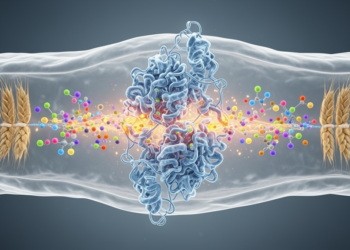
A research team evaluating altered-gravity experimental techniques has demonstrated that a four-seat light aircraft performing parabolic flight maneuvers can serve as a functional screening platform for water electrolysis and electrochemical gas evolution. Sustainable human presence on the Moon and Mars depends heavily on in situ resource utilization technologies capable of synthesizing propellants and life-support consumables from extraterrestrial water ice deposits. Water electrolysis represents a pivotal electrochemical pathway for generating hydrogen and oxygen, where hydrogen can further drive the Sabatier reduction of carbon dioxide into methane and water. However, the efficiency and practical stability of electrolysis cells are strongly governed by gas bubble dynamics at the electrode surface. Attached bubbles create surface coverage that restricts active interfacial reaction areas, increases mass-transfer and ohmic transport resistances, and induces localized current density increases. While terrestrial buoyancy continuously detaches gas bubbles to renew the electrolyte, altered-gravity environments disrupt these mechanisms. The authors showed that manually flown light aircraft maneuvers can generate repeatable altered-gravity intervals sufficient to observe oxygen bubble behavior and electrochemical response changes.
The experimental campaign was conducted aboard a four-seat single-piston-engine general aviation aircraft with a maximum certified take-off mass of 1160 kilograms, operating at an actual take-off mass of 1143 kilograms from a paved aerodrome at approximately 900 feet mean sea level. After climbing at 82 knots under full power to 6500 feet, the aircraft leveled off with reduced engine power to permit engine cooling without thermal shock, descending gradually at roughly 300 feet per minute toward an operational altitude of approximately 6000 feet. Parabolic maneuvers were executed with the engine throttled to idle to minimize inadvertent engine-induced moments and reduce mechanical wear. The pilot pitched down to establish an entry airspeed of approximately 140 knots, followed by a gentle stick pull-up to an attitude of positive 30 degrees pitch, whereupon the flight control stick was pushed forward to trace a parabolic trajectory achieving near-zero gravity. At speeds above 120 knots during the recovery phase, the aircraft performed a pull-up maneuver generating hypergravity conditions of approximately 2.1 g. Across six flight sets lasting approximately 1.5 hours, the aircraft completed around 30 parabolas between 6000 and 3000 feet before returning to climb altitude.
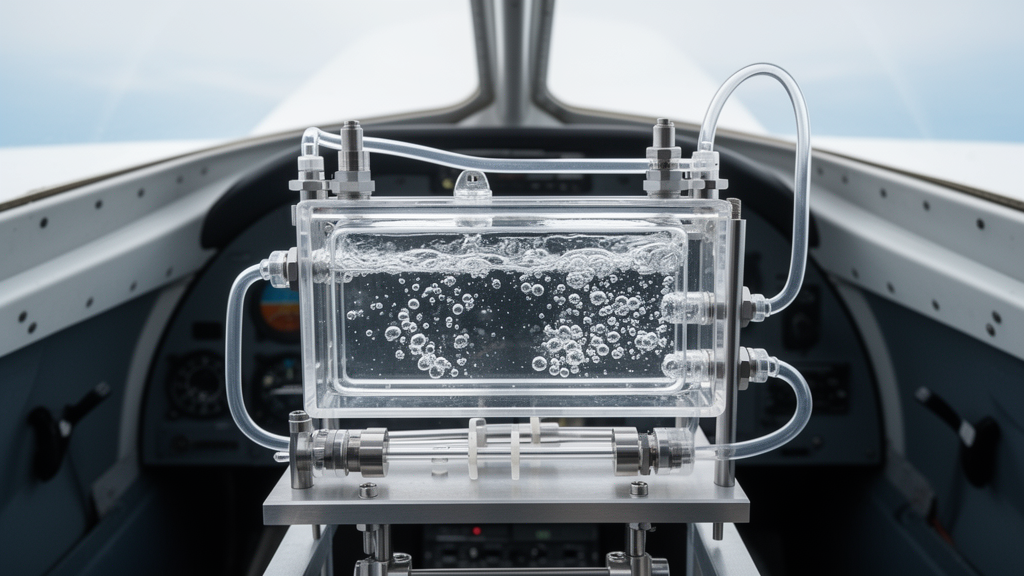
To capture accurate multi-sensor data within the baggage compartment, the experimental equipment was integrated into a rigid aluminum support frame secured against changing gravitational loads. The core setup featured a custom-built polyether ether ketone electrochemical cell with external dimensions of 50 by 50 by 50 millimeters, filled completely with 0.5 mole per liter sulfuric acid electrolyte to suppress fluid sloshing during dynamic maneuvers. Electrical power was supplied independently by a portable battery station located beside the acquisition computer outside the main framework. Electrochemical potential and current were controlled and recorded in potentiostatic mode at 10 hertz using an Ossila potentiostat. Triaxial acceleration, trigger pulses, temperature, and electrical potential signals were digitized via Dewesoft acquisition modules preprocessed to 200 hertz. Optical observation of working electrode phenomena was conducted through cell windows using a Photron Mini AX100 high-speed camera recording at 125 frames per second with an optical calibration of 6.9 micrometers per pixel. Multi-instrument temporal alignment was established using synchronized trigger pulses and confirmed through identified voltage and acceleration transitions, showing segment duration alignment within 0.103 seconds across evaluated records.
The electrochemical cell employed a three-electrode arrangement designed to isolate anodic oxygen gas evolution at a vertically mounted platinum microelectrode. The working microelectrode exposed only its circular cross-section with a nominal diameter of 200 micrometers and a projected geometric surface area of 3.14 times 10 to the minus four square centimeters to the acid solution. A platinum wire with a diameter of 0.5 millimeters and an exposed length of approximately 25 millimeters served as the counter electrode, where cathodic hydrogen generation occurred simultaneously, while a silver and silver chloride reference electrode in 3 moles per liter potassium chloride was fixed approximately 5 millimeters from the working electrode to minimize uncompensated solution resistance. Positive applied potentials ranging from 2.5 to 6.0 volts relative to the reference electrode were examined without explicit uncompensated ohmic resistance correction. Two distinct electrode surface configurations were evaluated: a standard non-textured platinum microelectrode and a laser-textured platinum microelectrode. Independent roughness characterization performed on re-prepared wire end faces showed an arithmetic average roughness of 0.711 micrometers for non-textured specimens compared to 3.927 micrometers for laser-textured surfaces, alongside distinct static contact angles below 5 degrees on laser-textured platinum foil.
Quantitative acceleration analysis based on resultant acceleration vector magnitudes demonstrated that the general aviation aircraft achieved mean values of 0.999 g during steady level flight, 0.109 g during core reduced-gravity evaluation intervals below 0.2 g, and 2.129 g during hypergravity intervals exceeding 1.8 g. Individual reduced-gravity core windows exhibited a mean duration of 2.15 seconds with a standard deviation of 1.19 seconds, spanning a range between 0.51 and 4.89 seconds, whereas hypergravity recovery phases averaged 4.71 seconds. Across the complete campaign, the cumulative exposure below 0.2 g reached approximately 215 seconds, including 185 seconds below lunar gravity of 0.165 g, 100 seconds below 0.1 g, and more than 20 seconds below 0.05 g. Normal and tangential components relative to the working electrode surface showed that while acceleration was predominantly normal during steady flight at 0.995 g and hypergravity at 2.127 g, the reduced-gravity phase exhibited normal and tangential components of 0.081 g and 0.061 g, respectively. These measured values verify that although the aircraft does not reproduce the microgravity quality of orbital laboratories, it reliably provides partial-gravity environments relevant to lunar-surface electrochemical processes.
When placed in the context of established microgravity facilities, the light aircraft occupies a complementary operational niche defined by rapid experimental turnaround and direct user intervention. Specialized drop tower facilities routinely deliver high microgravity quality reaching 10 to the minus six g for 4.7 to 9.3 seconds, while suborbital sounding rockets provide microgravity near 10 to the minus four g for up to 15 minutes, and the International Space Station sustains long-term microgravity environments. However, accessing such dedicated facilities involves extensive qualification processes, competitive project proposals, and lead times extending from months to years. In contrast, the tested aircraft platform permitted researchers to execute real-time experimental monitoring, interact directly with acquisition systems from the passenger seats, and adjust hardware configurations within an operational turnaround of approximately one week. While the achieved residual acceleration of 0.109 g remains higher than the 10 to the minus two g typical of large commercial parabolic jet transports, the low operational cost and flexible scheduling facilitate early-stage screening of electrochemical concepts before committing to more resource-intensive testing campaigns.
Airborne electrochemical measurements on the non-textured electrode revealed consistent associations between gravitational acceleration and geometric current density across the investigated applied potentials. In constant-potential records, reduced-gravity intervals were generally characterized by reduced current densities, whereas hypergravity phases exhibited partial current recovery and higher overall values. This divergence expanded substantially as the applied potential increased: differences between gravity states were modest at 2.5 and 3.0 volts but became pronounced at 4.0 and 6.0 volts, where elevated gas generation rates generated substantial bubble accumulation. At 3.0 volts, synchronized real-time traces showed immediate current density drops as the aircraft entered reduced gravity, accompanied by current increases during pull-up hypergravity. These observations match physical expectations where reduced buoyancy diminishes natural convective electrolyte circulation, prolongs bubble residence times, and increases electrode coverage. Conversely, elevated hypergravity accelerates buoyancy-driven bubble removal, lowering interfacial mass-transport resistance. However, because neither uncompensated electrolyte resistance nor fractional bubble coverage was independently quantified during flight, current fluctuations must be interpreted as broad associations reflecting combined bubble dynamics, mass transport, and electrical transients.
Synchronized high-speed imaging provided detailed quantitative observations of oxygen bubble detachment dynamics across 1,214 annotated events, including 1,213 individual bubble diameter measurements at potentials of 3.5, 4.0, and 6.0 volts. Video recordings confirmed that oxygen bubbles grown under reduced gravity generally attained larger detachment diameters and exhibited lower departure frequencies than bubbles produced during hypergravity phases. When evaluated using dimensionless hydrodynamic numbers, median Bond numbers based on resultant acceleration remained below unity but varied widely across operating conditions, showing no single critical Bond number governing bubble release. Similarly, plotting detachment diameters against the descriptive inverse square root of normalized acceleration illustrated data spread rather than a universal scaling law. At an applied potential of 6.0 volts, integrating measured current over gravity intervals yielded theoretical oxygen volumes based on Faraday’s law assuming complete Faradaic efficiency; comparing these with optically measured bubble volumes yielded volume ratios between 68.6 percent and 100.5 percent across nine qualifying segments, an informative consistency check that nonetheless does not constitute a closed oxygen mass balance.
Electrochemical comparison between the non-textured and laser-textured microelectrodes demonstrated distinct behavior, although the authors highlighted important methodological boundaries. Under several matching flight conditions, the laser-textured electrode produced geometric current densities more than an order of magnitude higher than the non-textured surface, alongside smaller apparent variations across gravity transitions at lower applied potentials between 2.5 and 3.5 volts. An exploratory repeated-measures analysis of variance evaluating paired hypergravity-to-reduced-gravity transitions indicated a mean current decrease of 59.6 percent for the non-textured electrode, with a 95 percent confidence interval from minus 84.6 to positive 5.9 percent, compared to a 23.4 percent decrease for the laser-textured electrode, with a 95 percent confidence interval from minus 32.3 to minus 13.2 percent. However, the authors emphasized that because only one physical electrode of each design was tested during separate flights on the same day, electrode identity, fabrication differences, and flight conditions were completely confounded. Furthermore, electrochemically active surface area was not measured during flight, meaning the elevated geometric current densities cannot be attributed directly to altered bubble kinetics or intrinsic catalytic improvements.
The study documented multiple experimental limitations and confounding factors that prevent assigning observed performance differences solely to gravitational changes. Frequency-domain analysis of triaxial acceleration records revealed that median root-mean-square vibration in the 5 to 40 hertz band increased from 0.00033 g with the engine off on the ground to 0.049 g during engine operation. During flight, vibration levels varied between maneuvers; median reduced-gravity to hypergravity vibration ratios reached 1.7 in the 5 to 40 hertz range and 1.61 across 5 to 500 hertz, while the 200 to 500 hertz ratio dropped to 0.59, meaning hypergravity currents were not accompanied by uniformly higher vibration across all bands. Additionally, unexpected instrument interruptions during non-textured flights required manual restarts that introduced transient current spikes during data acquisition resumption. Because the current was sampled at 10 hertz, direct spectral coherence with mechanical acceleration above 5 hertz could not be evaluated. The researchers concluded that future campaigns require independently replicated electrodes, active surface area measurements, and refined vibration isolation to separate gravitational influence from mechanical excitation and surface morphology.
Subject of Research: Water electrolysis and oxygen bubble dynamics aboard a general aviation altered-gravity platform
Article Title: General aviation aircraft as a low-cost altered-gravity platform for water electrolysis research
Article References: Arhar, K., Dečko, V., Zupančič, M., Može, M., & Golobič, I. (2026). General aviation aircraft as a low-cost altered-gravity platform for water electrolysis research. Results in Engineering, 32, Article 114163. https://doi.org/10.1016/j.rineng.2026.114163
Image Credits: AI Generated
DOI: 10.1016/j.rineng.2026.114163
Keywords: water electrolysis, altered gravity, parabolic flight, general aviation, oxygen bubble dynamics, platinum microelectrodes, laser surface texturing, buoyancy driven convection, in situ resource utilization, bubble detachment diameter, hypergravity, reduced gravity, electrochemical cell, high speed imaging, space technology testing, oxygen evolution reaction
News Source: Denise Maddox. (November 18, 2026). Light Aircraft Testing Validates Water Electrolysis Dynamics Under Brief Reduced Gravity. Scienmag.