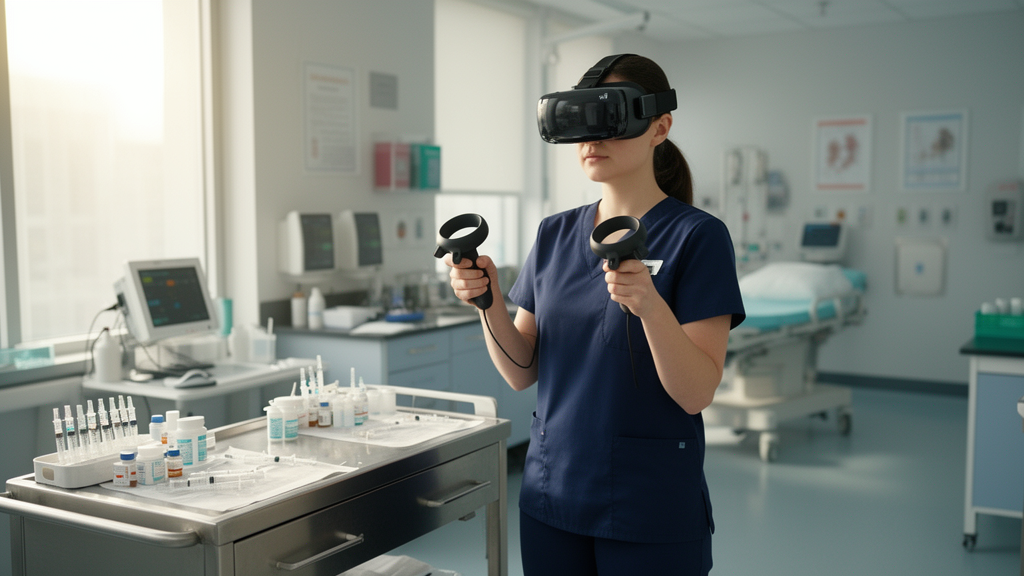
A virtual reality training program increased confidence in medication administration among undergraduate nursing students participating in a randomized wait-list crossover trial. Researchers evaluating the educational simulation observed that while student participants experienced meaningful gains in their personal confidence, corresponding shifts in self-reported safe medication practice scores were noticeably smaller. Furthermore, statistical analysis showed that changes in self-reported safe medication practices did not demonstrate a significant time-by-group interaction effect across the investigated cohorts.
Medication administration is widely recognized as a core clinical competency in nursing education, yet undergraduate students frequently face limited opportunities to practise medication safety scenarios repeatedly without introducing unacceptable safety risks to patients. Although virtual reality environments offer a safe, interactive setting where learners can encounter clinical tasks without endangering human subjects, empirical evidence evaluating these immersive digital tools within low- and middle-income educational settings has remained limited.
To address this educational challenge, researchers conducted a randomized wait-list crossover trial among third-year and fourth-year undergraduate nursing students attending a healthcare university in Ho Chi Minh City, Vietnam. The final analytic sample comprised 59 students, who were randomly allocated into two instructional cohorts: Group A, which enrolled 29 students, and Group B, which enrolled 30 students. Group A received the virtual reality training program first, while Group B was assigned to delayed training as a comparison group.
The educational intervention incorporated three structured 90-minute training sessions that exposed participants to three distinct clinical simulation contexts: routine medication administration, high-alert medication scenarios, and semi-emergency medication administration tasks. Student outcomes were formally tracked across three predefined evaluation phases: baseline testing at T0, an interim assessment at T1 conducted one week after Group A completed training, and a final assessment at T2 conducted one week after Group B completed its delayed training sessions.
To analyze longitudinal changes across the study timeline, the investigators utilized repeated-measures analysis of variance to track participant metrics. The statistical evaluation revealed that confidence scores changed significantly over time, registering a p-value below 0.001 and a partial eta-squared of 0.311, alongside a statistically significant time-by-group interaction yielding a p-value of 0.005 and a partial eta-squared of 0.094. Although self-reported safe medication practice scores also changed significantly over time with a p-value of 0.026 and a partial eta-squared of 0.065, the time-by-group interaction for safe practice was not statistically significant.
Beyond educational performance metrics, the investigators assessed technical feasibility, usability, and physical tolerance using the System Usability Scale and the Simulator Sickness Questionnaire. The virtual reality system registered a mean System Usability Scale score of 61.48 with a standard deviation of 9.26, a result that falls below the commonly cited threshold for acceptable usability. Concurrently, self-reported cybersickness emerged as a notable issue, with 26 participating students, or 44.1 percent of the study sample, reporting simulator sickness symptoms during the trial.
In their research conclusions, the authors noted that virtual reality training was associated with increased confidence in medication administration among undergraduate nursing students, though they emphasized that changes in self-reported safe medication practice must be interpreted cautiously. The study team highlighted that future investigations must incorporate objective performance assessments and longer follow-up periods, while educators and software developers work to refine system usability and learner orientation protocols prior to broader institutional adoption.
Administrative records confirm that the clinical investigation was retrospectively registered on ClinicalTrials.gov under the registry identifier NCT07711873 on 17 July 2026. At the time of publication, formal trial results had not yet been posted to the registry database, reflecting early peer-reviewed dissemination through BMC Medical Education.
Subject of Research: Virtual reality simulation training for nursing student medication administration
Article Title: Virtual reality-based training for safe medication administration among nursing students: a randomized wait-list crossover trial
Article References: Nguyen, T. P. L., Tran, L. T. K., Van Nguyen, C., Lee, I. R., & Huynh, H. T. P. (2026). Virtual reality-based training for safe medication administration among nursing students: a randomized wait-list crossover trial. BMC Medical Education. https://doi.org/10.1186/s12909-026-10866-8
Image Credits: AI Generated
DOI: 10.1186/s12909-026-10866-8
Keywords: virtual reality, nursing education, medication administration, medication safety, crossover trial, wait-list design, undergraduate nursing students, Ho Chi Minh City, System Usability Scale, Simulator Sickness Questionnaire, cybersickness, repeated-measures ANOVA, high-alert medication, semi-emergency scenarios, clinical simulation, BMC Medical Education
News Source: Courtney Benton. (November 18, 2026). Virtual Reality Training Boosts Nursing Student Medication Administration Confidence in Trial. Scienmag.