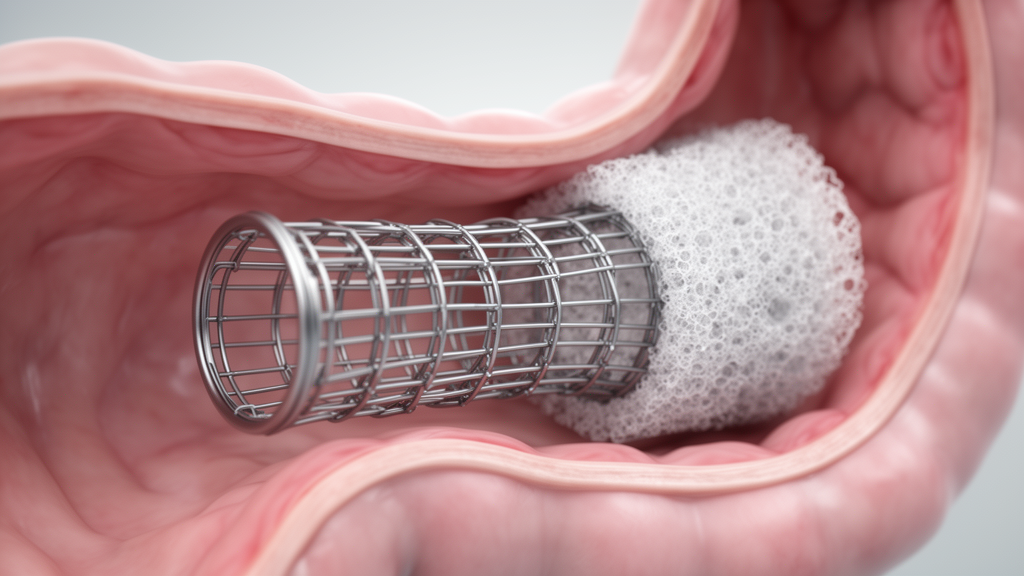
A newly published clinical report documents the successful management of complex colorectal anastomotic leaks using the VACStent system without requiring surgical proximal diversion. The hybrid device combines a covered self-expanding stent with endoluminal vacuum therapy, an approach designed to evacuate secretions through negative pressure while maintaining an open central intestinal lumen. Published in the International Journal of Colorectal Disease, the report details how clinicians applied the technology to avoid repeated major abdominal operations in patients facing severe operative risks.
The descriptive study evaluated two consecutive patients treated between June and September 2025, who represented the only individuals receiving the specialized stent intervention at the reporting center during that timeframe. Both individuals were assessed as clinically stable, showed no indications of diffuse peritonitis, and were considered at particularly high risk from undergoing further abdominal surgical procedures. Clinical teams systematically recorded detailed anatomical characteristics, procedural cycles, suction pressure parameters, observed complications, and subsequent anatomical healing.
The first case involved a contained anastomotic leak diagnosed thirty days after the patient underwent a Hartmann reversal operation. Clinicians managed this contained defect using a single therapeutic cycle lasting seven days. Throughout this single application, the device operated under a continuous negative pressure setting of –100 mmHg, which proved sufficient to achieve complete defect resolution without requiring diversion or additional intervention cycles.
The second case presented a substantially more complicated clinical scenario involving a late-presenting fistula that possessed an epithelialized internal opening and extended into the abdominal wall. Because evidence guiding intervention in chronic epithelialized tracts remains limited, medical teams applied an individualized protocol involving four separate treatment cycles lasting three, six, five, and five days, spanning twenty-three elapsed days of total care.
During the management of the second patient, procedural challenges provided key insights into device behavior under mechanical failure. A single initial stent migration was associated with vacuum loss and absent stool passage. When clinicians escalated the vacuum level to –300 mmHg, the measured suction was restored, yet the mechanical function of the device remained uncorrected. A subsequent early endoscopic examination revealed a small mucosal ulcer.
To resolve the complication, clinicians replaced the migrated unit with subsequent VACStent devices set at a milder negative pressure of –120 mmHg, which successfully restored and maintained regular stool passage through the central canal. To address the extensive abdominal wall tract, medical staff also added external negative-pressure wound therapy during the final two treatment cycles, combining internal endoluminal drainage with external wound vacuum therapy to promote tissue closure.
Both patients achieved complete defect closure following their individualized treatment courses, and follow-up assessments confirmed no documented leak recurrence at twelve months. The authors concluded that these cases illustrate individualized VACStent treatment without diversion, including combined internal–external drainage for a chronic fistula. Crucial technical recommendations include maintaining continuous suction during patient transport, evaluating stool transit alongside vacuum monitors, and actively repositioning or replacing malfunctioning hardware rather than compensating with excessive negative suction.
Subject of Research: VACStent therapy for complex colorectal anastomotic leaks without proximal diversion
Article Title: VACStent for complex colorectal anastomotic leaks without proximal diversion: A report of two cases and practical technical insights
Article References: Barambio Buendía, J. J., Garrido Gallego, F., Gadea Uría, P., Sánchez Egido, I., Arroyo Argüelles, J. M., Prieto Doblado, M., Martínez-Alcalá García, Á., García Nebreda, M., De Fuenmayor Valera, M. L., & Paseiro Crespo, G. (2026). VACStent for complex colorectal anastomotic leaks without proximal diversion: A report of two cases and practical technical insights. International Journal of Colorectal Disease. https://doi.org/10.1007/s00384-026-05275-8
Image Credits: AI Generated
DOI: 10.1007/s00384-026-05275-8
Keywords: VACStent, colorectal anastomotic leak, endoluminal vacuum therapy, covered self-expanding stent, proximal diversion, Hartmann reversal, epithelialized fistula, negative-pressure wound therapy, endoscopy, mucosal ulcer, stent migration, luminal drainage, stool passage, colorectal surgery, suction settings, vacuum therapy, case report
News Source: Ophelia Keating. (November 18, 2026). VACStent Achieved Closure in Two Complex Colorectal Anastomotic Leak Cases. Scienmag.