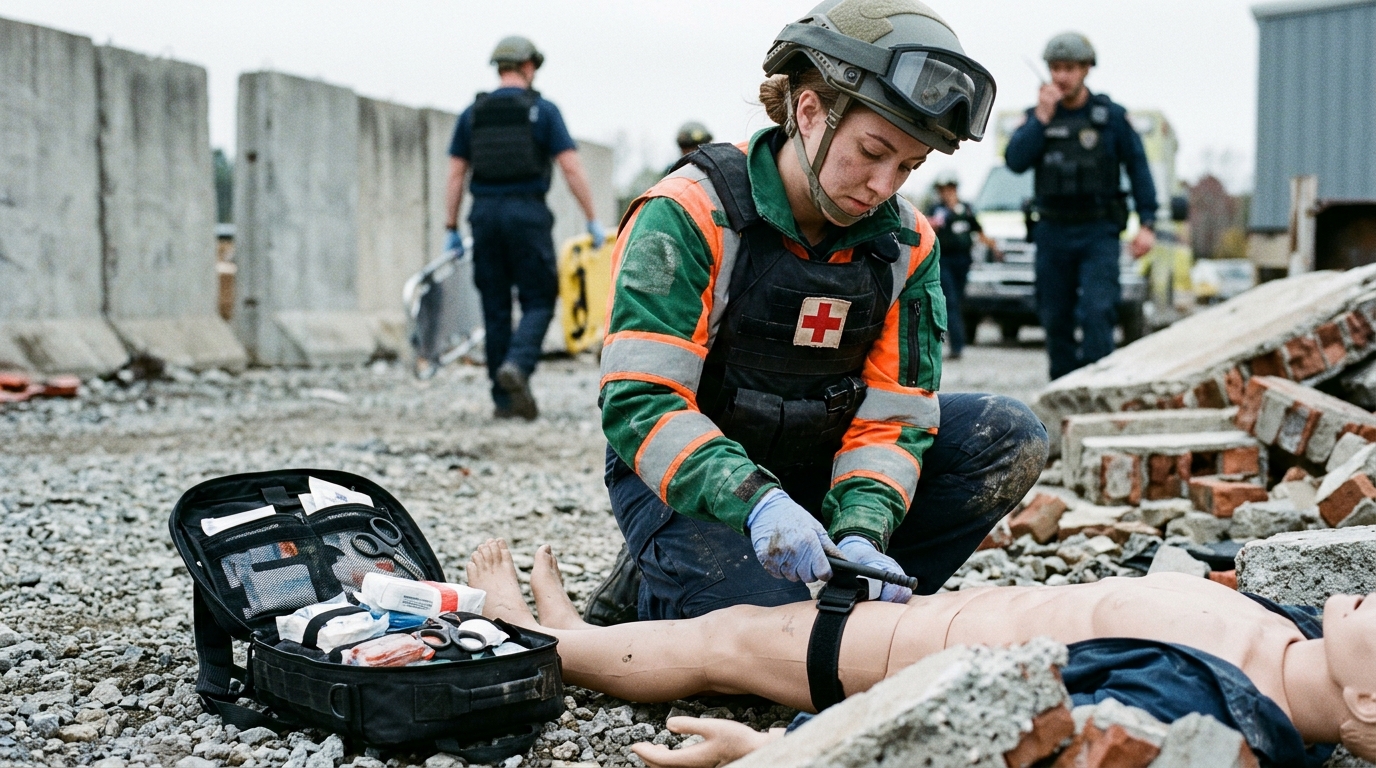
A quasi-longitudinal study evaluating an organizational resilience intervention within an emergency medical service in southern Israel has demonstrated measurable improvements in institutional coping capacity during active armed conflict. Publishing in the Israel Journal of Health Policy Research, researchers Tamir Velner, Zohar Rubinstein, and Bruria Adini tracked organizational resilience across three measurement waves from January 2024 through February 2026. The investigation examined emergency rescue professionals and administrative staff facing compounding operational demands and acute clinical pressures intensified by conflict escalation following the October 7, 2023 attacks. The service implemented a structured seventy-hour intervention delivered by internally appointed change agents termed Resilience Trustees. Composite organizational resilience scores rose significantly from a pre-intervention baseline mean of 3.86 on a five-point scale to 4.06 immediately post-intervention, consolidating further to 4.09 at six-month follow-up. These gains were accompanied by prominent enhancements in situational awareness, adaptive capacity, and organizational learning. While the design precludes causal claims, findings indicate that structured organizational programs can foster institutional endurance amid disruption.
Emergency medical services operate at the critical intersection of acute clinical demand and public security mandates. In Israel, pre-hospital systems have functioned under persistent security pressures for decades, governed by statutory frameworks including the 1940 Public Health Ordinance and the 1951 Civil Defense Law, with national readiness coordinated by the Ministry of Health’s Supreme Health Authority. Despite the necessity of institutional robustness, earlier crisis research has overwhelmingly targeted individual psychological stamina rather than modifiable organizational capacities. Organizational resilience represents an institution’s capacity to anticipate, prepare for, absorb, and adapt to evolving environments, coping effectively with adverse events while sustaining functional continuity and recovering efficiently. This framework synthesizes anticipatory, absorptive, adaptive, and recovery dimensions into an institutional property amenable to structured measurement and intervention. While systematic reviews identify over thirty resilience measurement tools across healthcare settings, longitudinal interventional evidence within pre-hospital emergency services confronting chronic operational adversity has remained sparse, highlighting an important empirical gap.
To quantify resilience and evaluate programmatic progress, investigators utilized the Organizational Resilience Questionnaire, a validated twenty-nine-item instrument operationalizing resilience across seven domains: Leadership and Human Capital, Organizational Culture, Situational Awareness, Adaptive Capacity, Learning Processes, Ethos, and Organizational Performance. Validated prior to the intervention using a healthcare cohort of 602 participants in southern Israel, the instrument incorporated exploratory and confirmatory factor analyses alongside an adapted Delphi consensus process with nineteen experts in the first round and sixteen in the second. This process established a validated domain-weight hierarchy: Leadership and Human Capital received nineteen percent, Adaptive Capacity eighteen percent, Organizational Culture sixteen percent, Situational Awareness and Learning Processes thirteen percent each, and Ethos and Organizational Performance eleven percent each. The questionnaire demonstrated high composite internal consistency across all measurement time points, with Cronbach’s alpha values ranging from 0.965 to 0.969, while domain-level reliability coefficients ranged between 0.648 and 0.916 across survey administrations.
The intervention curriculum was constructed through four complementary development phases aligning programmatic content with operational realities prior to deployment. The process integrated empirical baseline findings from a 2022 pilot assessment across three healthcare institutes, domain weights established through the expert Delphi panel, a systematic review of crisis management literature, and structured consultations with organizational psychology specialists. The resulting seventy-hour curriculum comprised two distinct phases. Phase I delivered thirty hours of structured training across four weeks in late 2024, conducted as four full-day sessions of approximately eight hours each. Modules addressed orientation and ethos, leadership and organizational culture, scenario-based simulation for situational awareness and adaptive capacity, and learning processes alongside organizational performance. Trustees formulated concrete organizational action plans upon completing Phase I. Phase II encompassed forty hours of embedding activities spanning twenty-four weeks through May 2025, providing coaching, gap analyses, micro-intervention design, and reflection sessions conducted in person or via Zoom across eight cycles.
Implementation relied on an internal change-agent model, with senior leadership appointing twenty Resilience Trustees across all five operational stations within the southern intervention district. Four trustees were selected per station based on positional influence and organizational credibility, completing both training phases without attrition. To safeguard operational readiness during Phase I, deputies were designated to cover trustees’ regular duty shifts. Within an overall district workforce of approximately 1,100 employees, surveys were distributed to an eligible sampling frame of approximately 600 personnel employed at least twenty-five percent of a full-time position with eighteen months of tenure. Participation was voluntary and anonymous, generating response rates from twenty-eight to thirty-four percent across waves. The final analytic samples comprised 196 participants at baseline T1 in early 2024, 205 participants at post-intervention T2 in mid-2025, and 172 participants at six-month follow-up T3 in early 2026, with all cohorts exceeding the statistical sample threshold of 166 respondents.
Composite resilience metrics exhibited progressive, statistically significant improvements across the two-year evaluation period. A one-way analysis of variance comparing the three measurement cohorts demonstrated a significant overall temporal difference, with an F-statistic of 5.72 and a p-value of 0.004 across 570 degrees of freedom. Pairwise comparisons indicated a significant short-term increase from baseline to post-intervention of 0.20 points (p = 0.018, d = 0.27), with scores rising further at the six-month follow-up. This change produced a net baseline-to-follow-up gain of 0.23 points, an effect size of d equals 0.32, and a p-value of 0.007. The difference between T2 and T3 was non-significant at 0.03 points, confirming durability.
Domain-level analyses indicated that resilience gains were concentrated within competency areas explicitly emphasized by the curriculum. Independent-samples t-tests evaluated changes across the seven domains using a Bonferroni-corrected significance threshold of alpha equals 0.005 across simultaneous comparisons. At T2, situational awareness achieved statistically significant gains of 0.25 points with a p-value below 0.001. Adaptive capacity improved by 0.21 points and learning processes advanced by 0.23 points, each yielding a p-value of 0.006 and achieving conventional significance, though narrowly exceeding the strict Bonferroni threshold. Organizational performance exhibited an uncorrected improvement with a p-value of 0.030, whereas ethos, leadership, and organizational culture displayed non-significant upward trends with p-values from 0.06 to 0.28. This pattern was internally coherent with the curriculum structure, which prioritized situational awareness through simulation and learning processes through structured debriefings, suggesting that programmatic emphasis actively steered domain-specific institutional gains rather than uncoordinated reporting shifts.
To identify key institutional drivers, researchers examined three organizational predictors within sequential multivariable regression models pooling all 573 observations across survey waves. Transformational leadership was measured using the nine-item Leadership Quotient Model, technological advancement through a seven-item innovation scale, and employee well-being via the nine-item Workplace Well-Being Scale. In the final parsimonious model, these variables along with age explained 77.0 percent of the variance in organizational resilience, yielding an R-squared of 0.770. Transformational leadership proved the dominant predictor, demonstrating a standardized beta coefficient of 0.458 with a p-value below 0.001. Employee well-being and technological advancement yielded beta coefficients of 0.274 and 0.208, respectively, both significant at p below 0.001. Multicollinearity diagnostics confirmed stability, with all variance inflation factors remaining below 4.42. Importantly, dummy-coded time indicators for 2025 and 2026 remained statistically significant across all regression models, confirming that resilience improvements over time persisted beyond the influence of organizational and demographic covariates.
The independent intervention effect was further evaluated using an Analysis of Covariance adjusting for transformational leadership, employee well-being, technological advancement, and age. The main effect of time remained significant after adjustment, producing an F-statistic of 7.41, a p-value of 0.001, and a partial eta-squared of 0.026. Pairwise comparisons confirmed significant adjusted improvements at T2 and T3 relative to baseline, yielding p-values of 0.008 and 0.002. Although the main effect of profession was non-significant, a significant Time by Profession interaction emerged, with an F-statistic of 3.09, a p-value of 0.046, and a partial eta-squared of 0.011. Paramedics entered with the lowest adjusted baseline resilience score of 3.80, rising to 4.01 at T2 and 4.07 at T3, producing a net gain of 0.27 points. Other personnel entered at 3.97, rose to 4.04 at T2, and settled at 4.02 at T3, achieving a modest net gain of 0.05 points.
The authors emphasized several methodological constraints that preclude definitive causal inference. The investigation utilized a repeated cross-sectional design within a single regional emergency service rather than a panel tracking identical individuals, measuring organizational-level aggregates rather than individual-level trajectories. Demographic variation occurred between cohorts, notably with the T2 sample being younger and possessing shorter organizational tenure, introducing potential compositional confounding despite covariate adjustment. Furthermore, self-reported data remain vulnerable to common-method variance and social desirability bias, while fluctuating armed conflict conditions and Hawthorne effects could not be fully isolated without a concurrent non-intervention comparison group. Consequently, findings represent preliminary associative evidence rather than confirmed causal mechanisms. Future research should integrate randomized multi-site evaluations, formal mediation modeling, and objective operational metrics, including response intervals, protocol adherence, and debriefing frequency. Nonetheless, the findings provide preliminary empirical support for embedded change-agent frameworks and periodic resilience monitoring to fortify pre-hospital organizations navigating chronic operational disruption.
Subject of Research: Organizational resilience intervention evaluation in emergency medical services during protracted conflict
Article Title: Enhancing organizational resilience of emergency medical services through a designated intervention program
Article References: Velner, T., Rubinstein, Z., & Adini, B. (2026). Enhancing organizational resilience of emergency medical services through a designated intervention program. Israel Journal of Health Policy Research, 15(1), Article 29. https://doi.org/10.1186/s13584-026-00772-1
Image Credits: AI Generated
DOI: 10.1186/s13584-026-00772-1
Keywords: organizational resilience, emergency medical services, pre-hospital care, Organizational Resilience Questionnaire, Resilience Trustees, crisis management, transformational leadership, employee well-being, technological advancement, situational awareness, adaptive capacity, learning processes, quasi-longitudinal study, paramedics, disaster preparedness, conflict-affected settings, change agents, public health policy
News Source: Ophelia Keating. (November 18, 2026). Targeted Training Program Boosts Emergency Medical Service Resilience During Active Conflict. Scienmag.