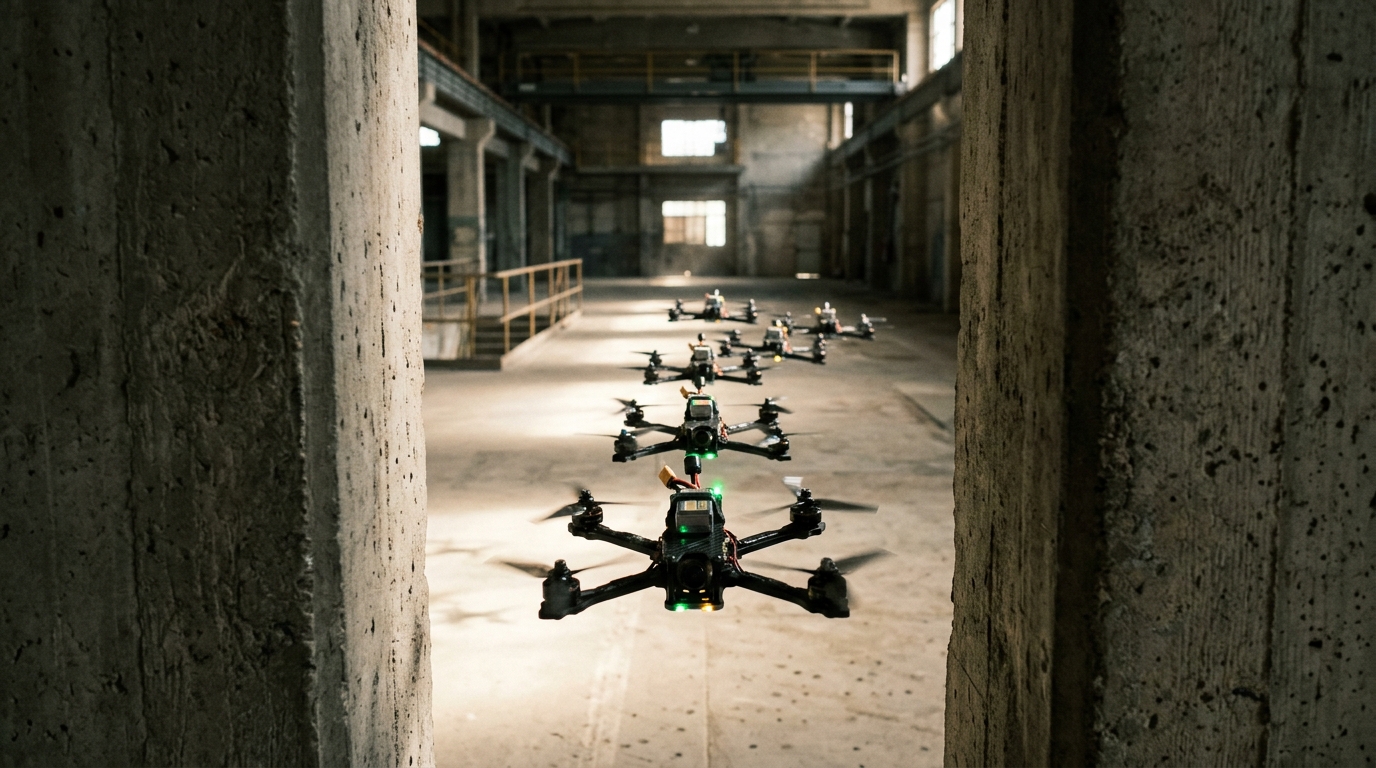
A newly reported decentralized control architecture allows swarms of quadcopters to autonomously reconfigure flight formations, safely navigating narrow gaps and maintaining group stability even during severe wind gusts. Developed in a hierarchical structure isolating swarm-level planning from individual vehicle dynamics, the framework pairs an improved artificial potential field algorithm with an event-based reconfiguration mechanism. In high-fidelity simulations of five quadcopters based on standard multi-rotor parameters, the system resolved an operational limitation of static formation controllers, which cause multi-agent groups to stall at tight openings. By continuously evaluating environmental clearance through onboard spatial perception, each quadcopter dynamically determines whether to compress formation geometry or transition into a single-file queue. The autonomous framework achieved a one-hundred percent mission success rate across complex obstacle scenarios while maintaining spatial coordination and bounded positioning errors.
Coordinating the collective motion of unmanned aerial vehicles in three-dimensional environments presents intricate aerodynamic and kinematic hurdles distinguishing multi-copter swarms from ground robots. Aerial swarms deployed for search and rescue operations, automated security patrols, and infrastructure inspections must simultaneously fulfill conflicting objectives: progressive goal navigation, physical obstacle avoidance, and inter-agent collision prevention. Previous research explored coordination paradigms such as leader-follower configurations, virtual structures, and behavior-based reactive schemes. While structured leader-follower and virtual structure models enforce geometric consensus, they remain reliant on persistent inter-agent communication links and sensitive parameter tuning vulnerable to telemetry interruptions. In contrast, behavior-based frameworks utilizing artificial potential fields offer decentralized real-time reactivity by treating robots as particles responding to potential forces. However, conventional artificial potential fields frequently suffer from local minima traps and cannot adapt rigid topologies to accommodate restricted spatial corridors.
To bridge the gap between reactive navigation and dynamic 3D topological flexibility, the research team structured their system into a two-layer hierarchy separating high-level swarm decision-making from low-level vehicle stabilization. The simulation models each quadcopter as a six-degree-of-freedom rigid body derived using Kane’s Method, matching the physical inertia, mass properties, and geometry of a standard DJI F450 airframe. The mathematical representation integrates translational positions in a north-east-down inertial frame with rotational kinematics expressed via four-parameter attitude quaternions and front-right-down angular velocity rates. Beyond rigid-body aerodynamics, the dynamic model incorporates aerodynamic drag coefficients, macroscopic environmental wind vectors, and rotor thrust and torque. To ensure dynamic fidelity, actuator response is modeled as a second-order DC motor system characterized by a static gain, time constant, and damping ratio, forming a comprehensive twenty-one-element state vector integrated numerically using an adaptive Dormand-Prince differential solver.
Vehicle-level stabilization is governed by a decentralized, multi-loop cascaded proportional-integral-derivative controller translating high-level translational position setpoints into concrete motor commands. Outer translation loops process position tracking errors through a proportional position controller, deriving reference velocity vectors that feed into a velocity proportional-integral-derivative controller alongside feedforward accelerations to compute three-axis directional thrust demands. A thrust-to-attitude transformation block converts these directional components into a scalar collective thrust and target attitude quaternions. Inner rotational loops process attitude errors through an attitude proportional block to establish desired body angular rates, followed by a rate proportional-derivative controller generating roll, pitch, and yaw torques. Allocation mixers distribute these forces across four propulsion units. Baseline validation confirmed the robustness of this inner loop during autonomous takeoff routines, where individual quadcopters attained their target altitude of negative two meters with a settling time of 3.34 seconds, exhibiting no lateral drift.
At the swarm supervisory tier, the high-level planner functions as a decentralized collective intelligence calculating position setpoints for every vehicle without requiring a centralized dispatcher. Planner logic operates via an automated state machine orchestrating transitions between an initial synchronized vertical ascent and the operational mission phase once all agents achieve altitude tolerance. Within the active navigation mode, the planner synthesizes multiple distinct behavioral velocity vectors, including formation-keeping, global migration, collision repulsion, and specialized tailgating. Formation-keeping vectors guide individual aircraft toward pre-established geometric topologies, such as a directional V-shape configuration or regular circular polygons defined by distributed relative coordinate matrices. Migration behavior drives the collective toward an active three-dimensional destination at a predetermined cruising speed. Simultaneously, localized repulsive collision vectors activate whenever static obstacles or neighboring aircraft breach a predefined safety radius, computing repulsive velocities scaled by dedicated obstacle and inter-agent avoidance gains.
To elevate planar ground-robot behaviors into fully operational three-dimensional flight, the framework incorporates an adaptive formation-orientation mechanism paired with decoupled horizontal maneuvering. Traditional multi-agent planners frequently enforce simultaneous position and heading tracking, forcing multi-rotor craft into rotational oscillations that degrade stability. The investigated planner continuously calculates the horizontal formation yaw angle directly from the normalized vector linking the swarm centroid to the active spatial waypoint, rotating the target geometry to face the migration direction. Because quadcopters possess omnidirectional horizontal translation capabilities actuated through roll and pitch tilts, individual vehicle yaw angles remain steadily aligned with the global migration vector even when executing evasive maneuvers. Furthermore, followers engaged in tailgating behavior regulate only translational longitudinal spacing relative to their designated forward leader, maintaining a constant reference separation distance while eliminating parasitic yaw coupling that could otherwise compromise aerodynamic stability during transit through confined spaces.
The foundational innovation enabling spatial adaptability is the event-based reconfiguration control strategy, which actively modifies swarm geometry based on continuous environmental perception. Each quadcopter scans its immediate forward path to locate the nearest obstacle boundaries to its left and right, projecting the distance between these points perpendicular to the migration axis to estimate available environmental clearance. If the measured passage width contracts below the nominal formation span yet permits multi-agent traversal, the planner dynamically scales a geometric compression coefficient, shrinking the lateral footprint while preserving baseline topology. When the corridor narrows past a critical threshold governed by physical vehicle radius and clearance safety factors, the system executes a discrete mode switch. In this regime, formation maintenance is suppressed in favor of single-file tailgating, where each agent dynamically identifies its local leader using forward-projection distance ranking along the travel axis, establishing a collision-free sequential queue without centralized intervention.
Comparative performance simulations contrasting the static improved artificial potential field against the event-based reconfiguration planner demonstrated profound behavioral divergence when encountering physical bottlenecks. In an open baseline environment populated with scattered static obstacles, both algorithmic approaches achieved nominal success with comparable performance metrics, completing the mission in approximately 66 seconds with mean overall tracking errors near 0.24 meters and high velocity alignment values around 0.89. However, when challenged by a narrow gap restricting passage below nominal V-shape dimensions, the rigid formation constraints of the static controller conflicted directly with repulsive avoidance vectors. This conflict trapped the static swarm at the opening, resulting in complete navigational failure. Conversely, the event-based reconfiguration planner smoothly compressed its formation scaling factor before transitioning into single-file queuing, traversing the gap to complete the mission in 59.735 seconds with an average operational error of 0.692 meters and an orderliness index of 0.878 before fully restoring its original geometry.
The investigation rigorously evaluated disturbance rejection by injecting intense, periodic aerodynamic wind gusts throughout the narrow passage maneuver to assess collective stability under adverse environmental forcing. The simulated gust model introduced cyclic ten-second pulses featuring four-second active bursts characterized by four-meter-per-second peak horizontal velocities directed head-on against the swarm flight path. Despite these severe physical perturbations, the event-based controller maintained complete navigational integrity, finishing the traverse in an identical duration of 59.735 seconds with only a marginal reduction in average velocity from 0.561 to 0.557 meters per second. Tracking error shifted imperceptibly from 0.692 to 0.694 meters, demonstrating effective disturbance rejection by the cascaded inner loops. Remarkably, collective motion cohesiveness actually increased under headwind loading, with the average orderliness index rising from 0.878 to 0.925. Opposing wind forces compelled all quadcopters to exert continuous forward thrust, suppressing uncoordinated lateral wandering at the expense of sharp periodic surges in motor power consumption.
Further simulation scenarios demonstrated the versatility of the extended navigation architecture across complex non-linear spatial trajectories and continuous reference tracking, while highlighting key theoretical boundaries. In multi-segment waypoint trials, five quadcopters navigated through successive spatial coordinates interspersed with static obstacle towers under wind disturbances, maintaining velocity orderliness metrics above 0.8 despite sharp reorientation maneuvers. Similarly, in circular tracking evaluations along a four-meter radius, the decentralized architecture preserved cohesive formation geometry without inducing velocity oscillations. However, in a concave U-shaped trap scenario, the memoryless reactive planner experienced catastrophic local minima stall as attractive goal vectors and repulsive obstacle forces completely cancelled each other. The authors noted that escaping such traps requires supplementing reactive algorithms with non-reactive heuristics such as wall-following routines. Furthermore, transitioning to physical multi-copter platforms will necessitate incorporating localized rotor downwash interference, extended Kalman filter state estimation, and delay-tolerant communication protocols to withstand real-world turbulence and latency.
Subject of Research: Decentralized hierarchical formation control and topological reconfiguration for quadcopter swarms
Article Title: Decentralized formation control system design for swarm quadcopters using an improved artificial potential field and event-based reconfiguration control
Article References: Herdian, I. A., Ekawati, E., Mukhlish, F., & Prabaswara, P. (2026). Decentralized formation control system design for swarm quadcopters using an improved artificial potential field and event-based reconfiguration control. Journal of King Saud University – Engineering Sciences, 38(5), Article 41. https://doi.org/10.1007/s44444-026-00111-4
Image Credits: AI Generated
DOI: 10.1007/s44444-026-00111-4
Keywords: Quadcopter swarms, Decentralized formation control, Improved artificial potential field, Event-based reconfiguration control, Cascaded PID control, Aerial robotics, Trajectory tracking, Wind disturbance rejection, Single-file tailgating, Dynamic formation orientation, Kane's method, DJI F450 frame, Narrow gap traversal, Orderliness index, Unmanned aerial vehicles, Autonomous takeoff, Topological trap limitation
News Source: Denise Maddox. (November 18, 2026). Decentralized Swarm System Dynamically Reconfigures Quadcopters to Clear Narrow Passages. Scienmag.