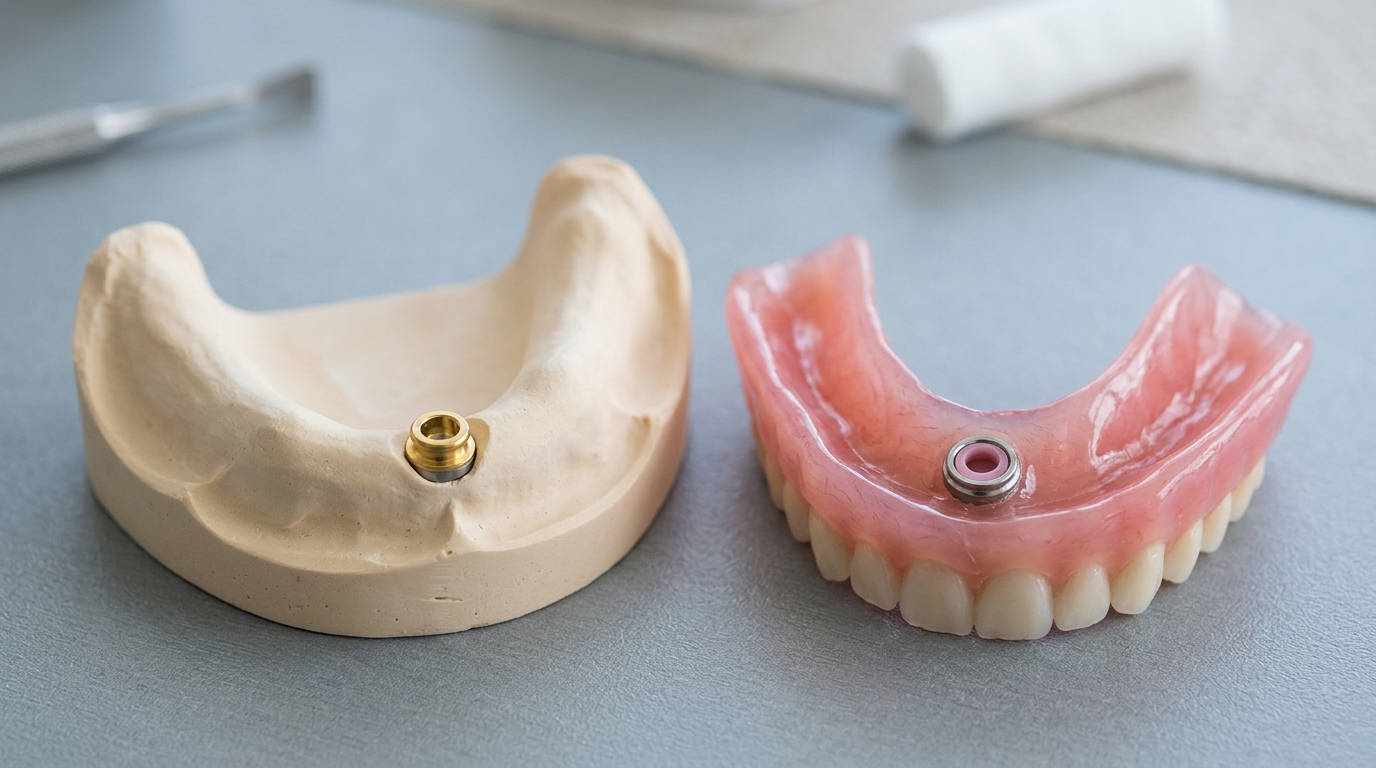
A systematic review published in BMC Oral Health reports that single implant-retained mandibular overdentures show low rates of implant loss under conventional or early loading protocols, yet require frequent maintenance of retention components and present risks of fracture when prostheses remain unreinforced. The synthesis evaluated long-term outcomes to summarize prosthetic maintenance demands and mechanical complications that had not been fully consolidated in earlier literature.
Conducted by researchers Kadambari Bharali, Kapil Hazarika, and Nilutpal Deuri, the investigation followed a protocol registered under PROSPERO identifier CRD420261422355. Investigators executed searches across seven electronic sources on 17 October 2026 and supplemented their retrieval through citation tracking in OpenAlex. Eligible research included trials and cohort studies examining edentulous adult patients restored with a single midline mandibular implant retaining an overdenture and monitored for at least 12 months after loading.
Selection, data extraction, and quality appraisal were conducted independently by two reviewers. The authors utilized the RoB 2 tool to evaluate randomized controlled trials and the MINORS instrument to assess observational cohorts. Because study designs and reported metrics varied, the team conducted a qualitative synthesis without meta-analysis, rating the certainty of the cumulative evidence using the GRADE approach.
Across the surveyed literature, the review incorporated 68 reports originating from 41 distinct studies, including 27 randomized trials and 14 cohort investigations encompassing a collective total of 1,157 participants. Observed follow-up intervals across the gathered studies extended from 12 months to 15 years. Notably, none of the included randomized trials achieved an assessment indicating a low risk of bias.
Implant stability proved high across conventional approaches, with 16 out of 21 studies reporting zero implant losses following conventional or early loading. However, in the single trial that directly randomized participants between loading protocols, immediate loading yielded 9 failures among 81 implants, compared to only 2 failures among 77 implants placed under conventional loading.
Mechanical upkeep proved to be the most common clinical demand identified throughout the evidence base. Maintenance of retention elements occurred frequently, with two trials documenting adjustments in 76 of 102 patients and 23 of 29 patients over a five-year observation period. Furthermore, structural fractures in unreinforced dentures—principally located adjacent to the attachment—impacted between 27 of 102 and 6 of 11 patients over periods spanning 5 to 15 years.
In contrast to unreinforced prostheses, three small studies evaluating dentures built with metal reinforcement documented no fracture incidents. The review authors noted that metal reinforcement and delayed loading schedules might mitigate mechanical complications. Nonetheless, the authors emphasized that all evaluated outcomes throughout the review were characterized by low or very-low certainty.
Subject of Research: Prosthetic maintenance and complications of single implant-retained mandibular overdentures
Article Title: Prosthetic maintenance and complications of single implant-retained mandibular overdentures: a systematic review
Article References: Bharali, K., Hazarika, K., & Deuri, N. (2026). Prosthetic maintenance and complications of single implant-retained mandibular overdentures: a systematic review. BMC Oral Health. https://doi.org/10.1186/s12903-026-10382-7
Image Credits: AI Generated
DOI: 10.1186/s12903-026-10382-7
Keywords: single implant-retained overdentures, mandibular overdentures, edentulous adults, midline mandibular implant, prosthetic maintenance, mechanical complications, retention-element adjustment, denture fracture, unreinforced dentures, metal reinforcement, conventional loading, immediate loading, systematic review, RoB 2, MINORS, GRADE certainty
News Source: Ophelia Keating. (November 18, 2026). Single Mandibular Implants Retain Overdentures Well but Require Frequent Maintenance. Scienmag.