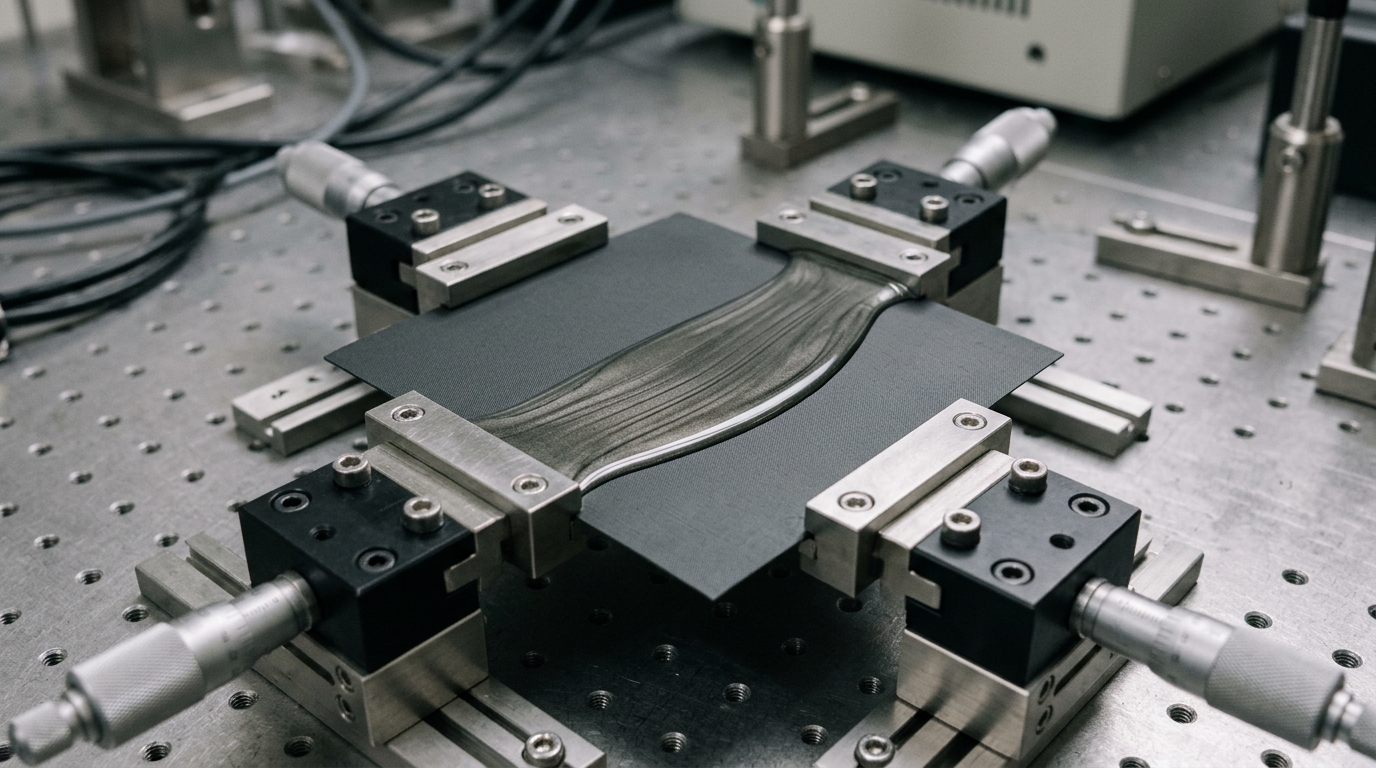
A computational investigation into advanced thermal transport has established that dispersing aluminum oxide and titanium dioxide nanoparticles into conventional engine oil significantly enhances heat transfer rates while maintaining stable fluid dynamics across a bidirectionally stretching sheet. In the research, a team of mathematical modeling specialists formulated and resolved the governing equations for a non-Newtonian hybrid Casson fluid subject to magnetohydrodynamic forces, Darcy-Forchheimer porous resistance, thermal radiation, and convective boundary interactions. The study demonstrated that surface convective heating exerts a dominant influence on cooling performance, with a fourfold increase in the Biot number from 0.1 to 0.4 driving a 209.05 percent surge in the local Nusselt number. By integrating classical boundary value numerical algorithms with multilayer artificial neural network architectures, the researchers confirmed that the derived dual-phase flow solutions remain temporally stable under realistic physical perturbations, providing predictive insight for thermal regulation systems in industrial manufacturing and high-performance mechanical operations.
Thermal transport fluids have long encountered efficiency limitations in high-load engineering systems, where base lubricants like engine oil exhibit modest thermal conductivities that constrain rapid heat dissipation. While conventional mono-nanofluids containing a solitary metallic or metal-oxide nanoparticle species can elevate conductive performance, recent thermophysical investigations indicate that hybrid nanofluids provide superior transport capabilities through complementary particle dynamics. The formulation evaluated by the authors combines alumina and titania nanoparticles dispersed within an engine-oil matrix, modeled under the constitutive rheological framework of a Casson fluid to account for shear-thinning and yield-stress behaviors. In operational environments such as polymer extrusion, metal rolling, continuous die drawing, and industrial lubrication, boundary surfaces frequently stretch in multiple directions simultaneously, creating complex three-dimensional flow patterns that alter the surrounding boundary layers and challenge the performance of traditional Newtonian fluid models.
To rigorously describe the interaction between the moving boundary and the non-Newtonian lubricant, the authors developed a three-dimensional mathematical model rooted in the fundamental conservation laws of mass, momentum, and energy. The boundary geometry consists of an infinitely extending flat sheet located at the coordinate plane where vertical position equals zero, moving outward along orthogonal horizontal axes with linear velocities proportional to spatial coordinates. The fluid formulation incorporates viscous dissipation, Joule heating arising from an applied transverse magnetic field, Darcy-Forchheimer inertial drag through a porous matrix, and radiative heat flux characterized by the Rosseland approximation. In addition, the interface incorporates convective surface heating governed by an ambient fluid temperature and a generalized velocity slip condition. This comprehensive framework accounts for the simultaneous physical influences that govern practical heat exchange equipment operating under demanding electromagnetic and mechanical environments.
Because the coupled governing partial differential equations are mathematically intractable in their raw form, the authors implemented similarity transformations that matched boundary layer scaling and reduced the system to coupled ordinary differential equations. These similarity variables non-dimensionalized the velocity fields, spatial coordinates, and thermal gradients, while identically satisfying the fluid continuity equation. The resulting system was analyzed numerically using MATLAB’s robust bvp4c boundary value problem solver, which applies a three-stage Lobatto IIIa collocation formula to achieve fourth-order accuracy across stiff domains. To ensure rigorous computational fidelity, the research team conducted a detailed mesh-independence assessment, contrasting grid densities ranging from 700 to 1300 nodes. Comparing the 700-node mesh to the selected 1000-node baseline revealed minute percentage variations on the order of 10⁻¹² percent in skin friction and local Nusselt numbers, verifying that numerical discretization artifacts were eliminated.
A critical contribution of the research lies in its rigorous temporal stability analysis, which assessed whether the derived steady-state flow profiles represent physically realizable and sustainable operational regimes. Because nonlinear boundary layer equations can admit multiple mathematical branches that may prove unstable in physical systems, the authors transformed the steady framework into an unsteady formulation by introducing dimensionless time and applying linearized perturbation theory. By expressing the velocity and temperature distributions as small temporal perturbations superimposed on the steady base solutions, the researchers established an eigenvalue problem governed by an infinite sequence of decay rates. Following asymptotic far-field boundary relaxation protocols, the sign of the smallest eigenvalue was tracked across varying magnetic and rheological conditions. Every calculated eigenvalue remained positive across the investigated domains, demonstrating that small external perturbations decay exponentially over time and confirming the physical stability of the observed hybrid nanofluid boundary layers.
To eliminate the substantial computational overhead of repeatedly executing complex numerical boundary value solvers during engineering optimization cycles, the researchers developed an artificial neural network surrogate. The neural model incorporated a multilayer perceptron framework featuring an input layer fed by the similarity coordinate, a hidden processing layer governed by nonlinear sigmoid activation functions, and an output layer designed to predict the primary velocity, secondary velocity, and dimensionless temperature profiles. The network was trained using the Levenberg-Marquardt backpropagation algorithm across a structured dataset comprising 1000 similarity coordinate samples and 4000 corresponding numerical target points generated by the bvp4c solver. By partitioning the dataset into distinct training, validation, and testing subsets, the architecture minimized mean squared error while preventing overfitting, achieving highly accurate function approximation across diverse parameter inputs.
The evaluation of the trained artificial neural network demonstrated exceptional fidelity when benchmarked directly against the finite-difference collocation results. Validation mean squared errors reached 1.9342 × 10⁻¹⁰ for primary velocity gradients, 2.0878 × 10⁻¹⁰ for secondary transverse velocity profiles, and 1.1763 × 10⁻¹⁰ for the thermal distribution, with convergence achieved within fewer than 300 training epochs. Error histograms confirmed that prediction residuals clustered tightly around the zero-mean line, while linear regression plots indicated near-perfect alignment along the ideal unity slope diagonal across all computational phases. Absolute error profiles between numerical data and neural forecasts remained beneath 10⁻⁵ across the majority of the spatial domain, occasionally peaking near 1.5 × 10⁻³ under heightened magnetic field intensities. This data-driven accuracy verifies that compact neural networks can reliably substitute for stiff differential equation solvers in simulating complex multiphase non-Newtonian flows.
Detailed numerical evaluation of velocity distributions highlighted how fluid rheology and external resistive forces govern momentum boundary layer development. Elevating the Casson fluid parameter produced a monotonic increase in both the primary and secondary velocity components throughout the fluid layer, reflecting a reduction in yield stress that permits momentum generated by the stretching sheet to penetrate deeper into the bulk fluid. Conversely, intensifying the transverse magnetic interaction parameter produced a marked deceleration in fluid velocity as the opposing Lorentz retarding force resisted convective motion. Similarly, increasing the Forchheimer inertial parameter and porous media resistance introduced quadratic drag mechanisms that suppressed both velocity vectors, with deceleration most pronounced adjacent to the moving solid boundary. These opposing mechanical effects offer a controllable mechanism for fine-tuning fluid delivery rates in industrial coating processes.
Thermal profiles exhibited pronounced sensitivity to external radiative, magnetic, and boundary heating parameters. Increasing the Casson parameter lowered fluid temperatures across the boundary layer, because heightened fluid motion accelerated convective energy transport away from the heated solid boundary. In contrast, enlarging the magnetic parameter produced steady thermal gains due to the combined influence of flow deceleration and internal resistive Joule dissipation. Incorporating thermal radiation and internal heat generation similarly thickened the thermal boundary layer, elevating dimensionless temperatures by introducing volumetric heat sources into the flowing stream. The most dominant heating response occurred through the convective surface condition: as the Biot number climbed from 0.1 to 0.4, surface thermal interaction intensified, driving fluid temperatures upward while amplifying the local Nusselt number from 0.07559 to 0.23361.
Analysis of wall shear phenomena further revealed that surface drag is closely linked to non-Newtonian yield characteristics and porous medium resistance. Skin friction coefficients along both lateral axes climbed substantially when magnetic field intensity and porosity parameters were increased, because the corresponding deceleration steepened velocity gradients immediately adjacent to the stationary sheet coordinates. Conversely, raising the Casson fluid parameter diminished the surface skin friction coefficients, as the reduction in plastic yield stress reduced fluid resistance against surface shear deformation. Surface suction acted as an additional stabilizing factor, drawing high-momentum fluid toward the boundary and decreasing wall friction. Meanwhile, the local Nusselt number decreased by approximately 4.05 percent when the magnetic parameter rose from 0.1 to 0.4 and dropped by 0.12 percent across expanding radiation values, demonstrating that excessive fluid drag hampers convective cooling performance.
The researchers contextualized their findings by evaluating the physical implications for high-load industrial machinery, lubrication design, and modern polymer manufacturing. The numerical results suggest that the integration of alumina and titania nanoparticles within lubricating engine oils can markedly elevate heat extraction efficiency without triggering hydrodynamic instabilities, provided operating conditions are carefully calibrated. However, the authors explicitly emphasized several structural limitations inherent to their mathematical and computational model. The theoretical formulations assume an idealized, uniform dispersion of rigid nanoparticles and do not incorporate complex real-world phenomena such as particle agglomeration, sedimentation, non-uniform particle size distributions, or temperature-dependent thermophysical property variations. Furthermore, because the study is entirely theoretical and numerical, direct physical experimentation across full-scale mechanical prototypes will be essential before translating these predictive findings into industrial manufacturing guidelines.
Subject of Research: Numerical stability analysis and artificial neural network modeling of magnetohydrodynamic Al₂O₃–TiO₂ engine-oil hybrid Casson nanofluid flow
Article Title: Stability and ANN-assisted analysis of MHD Al₂O₃–TiO₂/engine-oil hybrid Casson nanofluid flow over a bidirectionally stretching sheet
Article References: Rooman, M., Yousaf, S., Khan, D., & Alshehri, M. H. (2026). Stability and ANN-assisted analysis of MHD Al₂O₃–TiO₂/engine-oil hybrid Casson nanofluid flow over a bidirectionally stretching sheet. Discover Nano, 21(1), Article 654. https://doi.org/10.1186/s11671-026-05134-z
Image Credits: AI Generated
DOI: 10.1186/s11671-026-05134-z
Keywords: hybrid nanofluid, Casson fluid, artificial neural network, bvp4c solver, stability analysis, heat transfer, engine oil, alumina nanoparticles, titania nanoparticles, stretching sheet, magnetohydrodynamics, Biot number, local Nusselt number, porous medium, Forchheimer parameter, viscous dissipation, thermal radiation
News Source: Cassandra Pierce. (November 18, 2026). Neural Network Analysis Models Stable Hybrid Nanofluid Flow Over Bidirectionally Stretching Sheets. Scienmag.