A research team has demonstrated that an independent dual-pipeline machine learning framework can predict Parkinson’s disease with high precision by assessing vocal acoustics and motor handwriting drawings through separate analytical streams. Developed by investigators at the Vellore Institute of Technology, the system couples block-level acoustic feature selection with deep convolutional visual embeddings, routing each modality through a two-stage stacked ensemble combining Histogram-Based Gradient Boosting and logistic regression. In computational evaluations on benchmark datasets, the specialized voice pipeline achieved a test accuracy of ninety-six percent and an area under the receiver operating characteristic curve of 0.987, while the motor drawing pipeline attained an accuracy of eighty-four percent alongside an area under the curve of 0.907. Rather than forcing heterogeneous data into an early multimodal fusion architecture that might introduce cross-domain noise, the framework evaluated acoustic phonation and fine-motor handwriting dynamics as distinct, complementary diagnostic channels. These findings indicate that both non-invasive modalities capture distinct neurodegenerative patterns, offering objective digital markers to support clinical decision-making.
Parkinson’s disease is a chronic, progressive neurodegenerative disorder caused by the loss of dopamine-producing neurons within the substantia nigra pars compacta. This neurochemical depletion produces cardinal motor impairments, including resting tremor, muscle rigidity, postural instability, and bradykinesia, alongside non-motor symptoms such as sleep disturbances, autonomic dysfunction, mood alterations, and subtle cognitive decline that frequently emerge years before visible physical signs appear. Standard clinical diagnosis relies on neurological evaluation using the Unified Parkinson’s Disease Rating Scale, an established diagnostic instrument that remains subjective, time-consuming, and susceptible to examiner variability. These limitations create an urgent requirement for objective, non-invasive digital assessment tools capable of identifying subtle neuromotor deficits during early stages. Because neurodegeneration disrupts vocal tract dynamics—causing reduced pitch variation, amplitude fluctuations, phonatory instability, and tremor—as well as fine-motor control during pen manipulation, computational analysis of vocalizations and drawing trajectories offers a practical pathway for screening without specialized clinical equipment.
To examine vocal characteristics, the researchers utilized phonation data from the publicly available Parkinson’s Disease Speech Signal Features Dataset, containing 756 recordings spanning 564 Parkinson’s disease patients and 192 healthy control subjects. The raw phonations were originally represented by a 754-dimensional numerical feature vector capturing acoustic properties such as jitter, shimmer, harmonic-to-noise ratios, Mel-Frequency Cepstral Coefficients, and wavelet features. The investigators removed the first two columns representing subject identification codes and gender metadata because they do not reflect acoustic properties, leaving 752 biological acoustic descriptors. Missing values were resolved using mean or median imputation based on feature skewness, followed by z-score standardization. Because the dataset presented substantial class imbalance between diseased and healthy samples, the researchers applied Borderline-SMOTE to generate 372 synthetic healthy samples near the decision boundary. This expanded the healthy cohort to 564 instances, producing a balanced dataset of 1,128 samples that was partitioned into an 80:20 subject-independent split containing 902 training samples and 226 test samples.
To structure high-dimensional acoustic data, the investigators implemented a Block-wise Mutual Information with Stability Selection framework. The 752 standardized descriptors were organized into eight physiologically interpretable blocks: twenty-one baseline signal descriptors, three intensity features representing amplitude variation, four formant features measuring articulatory resonance precision, four bandwidth descriptors capturing formant damping, twenty-two vocal fold features evaluating glottal parameters, eighty-four Mel-Frequency Cepstral Coefficients, 182 multiscale wavelet descriptors, and 432 Tunable-Q wavelet transform coefficients. Using bootstrap resampling, the algorithm calculated mutual information between individual features and diagnostic labels, ranking attributes within each block across resampling iterations. Through a block-wise quota allocation strategy, the framework selected 299 stable acoustic features: seven baseline descriptors, three intensity metrics, four formant frequencies, four bandwidth measures, seven vocal fold parameters, thirty-two cepstral coefficients, seventy-two wavelet attributes, and 170 Tunable-Q wavelet coefficients. Normalized stability weights yielded relative values of 0.247 for intensity, 0.155 for wavelets, 0.139 for cepstral descriptors, 0.125 for Tunable-Q wavelets, 0.121 for baseline descriptors, 0.090 for vocal fold measures, 0.070 for formants, and 0.053 for bandwidth.
The 299 selected features served as input for the Block Stability Stacked Model, a two-stage ensemble architecture designed to capture nonlinear acoustic interactions while maintaining interpretability. In the first stage, the architecture employed Histogram-Based Gradient Boosting models trained on individual acoustic blocks, optimizing binary cross-entropy loss through additive decision tree boosting. Key training settings included a learning rate of 0.05, a maximum tree depth of eight, a subsample fraction of 0.8, and up to 1,000 iterations, with hyperparameters optimized through five-fold cross-validation and early stopping monitored by area under the curve. Probability outputs generated by the boosting models across each block were concatenated into a meta-feature vector for every sample. In the second stage, an L2-regularized logistic regression meta-classifier processed this meta-vector to calculate the final disease probability. Features from Mel-Frequency Cepstral Coefficients and Tunable-Q wavelet transforms carried the strongest positive regression weights, demonstrating their dominant role in modeling tremor-related spectral distortions, while formant and intensity features contributed supportive articulatory information.
Evaluated on the independent test set of 226 balanced acoustic samples, the voice-based Block Stability Stacked Model demonstrated strong predictive capability, attaining an accuracy of ninety-six percent, an F1-score of 0.957, and an area under the receiver operating characteristic curve of 0.987. Detailed classification metrics confirmed balanced precision and recall across both cohorts: the model achieved a precision of 0.96, a recall of 0.95, and an F1-score of 0.96 for the 113 healthy control samples, while reaching a precision of 0.95, a recall of 0.96, and an F1-score of 0.96 for the 113 Parkinson’s disease samples. Stratified five-fold cross-validation on the training set confirmed model stability, yielding mean scores of 0.957 with a standard deviation of 0.011 for accuracy, 0.957 with a standard deviation of 0.011 for F1-score, and 0.987 with a standard deviation of 0.004 for area under the curve. Furthermore, confusion matrix analysis demonstrated minimal cross-class misclassification, while training curves showed rapid convergence with low variance.
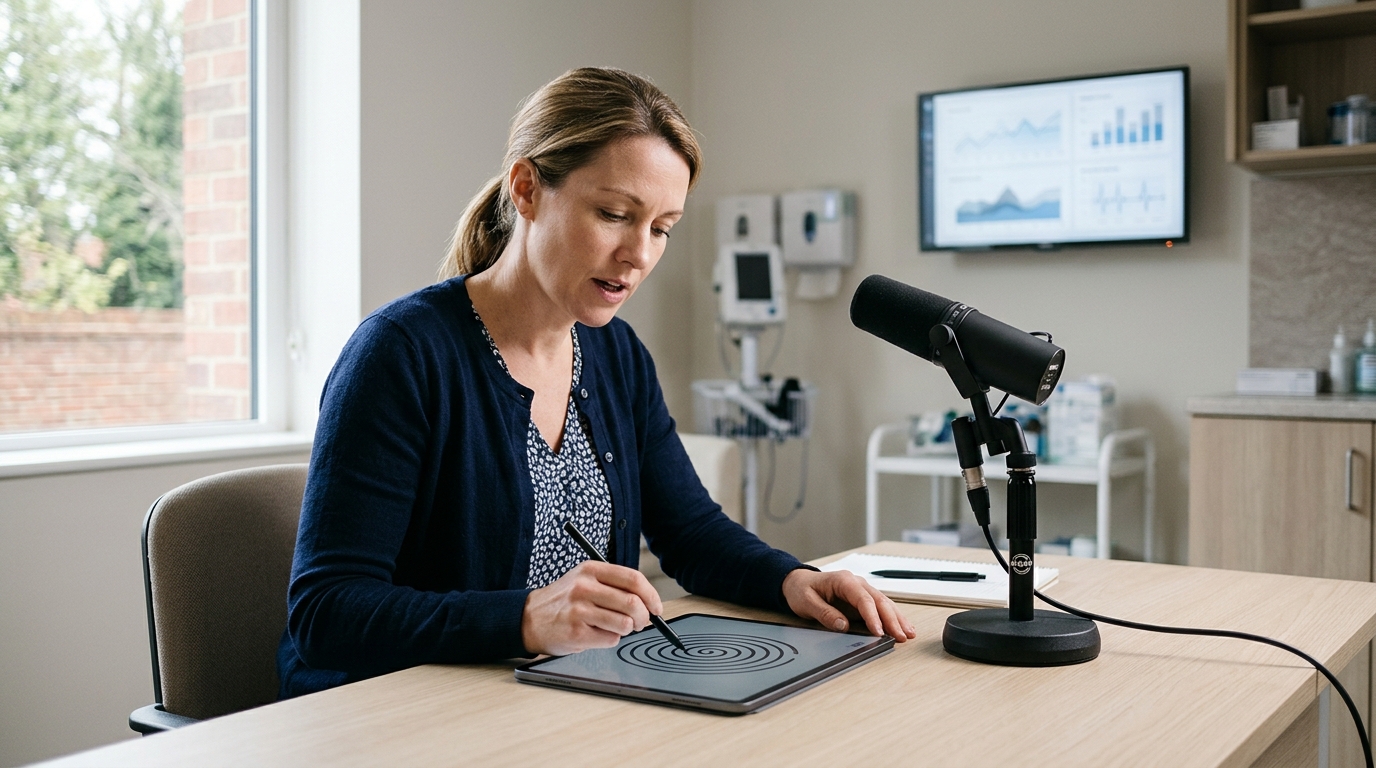
Alongside acoustic evaluation, the researchers assessed fine-motor impairment using the Parkinson’s Drawings Dataset, which records handwriting patterns from spiral and wave drawing exercises performed on digital tablets under identical technical conditions. These drawing tasks capture neuromotor irregularities such as pen pressure dysregulation, tremor frequency, micrographia, and stroke smoothness loss, with spirals emphasizing continuous circular control and waves tracking oscillatory consistency. The dataset originally comprised 204 RGB image samples evenly divided between 102 Parkinson’s disease patients and 102 healthy control participants. To address small dataset size and increase training diversity, the investigators applied data augmentation with an expansion factor of four to the training data, incorporating horizontal flipping, rotations within plus or minus eight degrees, zoom scaling within plus or minus fifteen percent, translations within plus or minus eight percent, and contrast adjustments within plus or minus fifteen percent. A stratified 80:20 train-test split yielded 652 augmented entries for training and 164 unaugmented images reserved exclusively for testing.
To extract informative representations from drawing patterns, the motor framework employed a DenseNet-121 convolutional network initialized with ImageNet-pretrained weights. The pretrained backbone was kept frozen during training, while a specialized embedding head—comprising global average pooling, dropout with a 0.3 rate, a 128-dimensional dense layer with rectified linear unit activation, and a sigmoid output layer—was trained using the augmented drawing entries. Activations from the 128-dimensional layer were extracted as visual feature embeddings capturing stroke curvature, tremor amplitude, and movement smoothness. The researchers calculated mean neuronal activations across all samples, evaluated the activation distribution via histogram ranking, and performed low-activation pruning to remove dimensions below the twentieth percentile. This pruning eliminated redundant or inactive neurons while preserving key neuromotor characteristics. The resulting reduced embedding vector was then provided to a stacked ensemble comprising a Histogram-Based Gradient Boosting base learner and a regularized logistic regression meta-classifier that computed the final disease probability.
Assessed on the independent test set of 164 unaugmented drawing images, the motor pipeline achieved an overall classification accuracy of eighty-four percent and an area under the receiver operating characteristic curve of 0.907. Detailed performance metrics revealed a precision of 0.82, a recall of 0.88, and an F1-score of 0.85 across eighty-two healthy test drawings, compared to a precision of 0.87, a recall of 0.80, and an F1-score of 0.84 across eighty-two Parkinson’s disease drawings. To evaluate class separation in the embedding space, the authors generated two-dimensional projections using principal component analysis and t-distributed stochastic neighbor embedding. Quantitative cluster analysis showed that principal component analysis attained a Silhouette Score of 0.2443 and a Davies-Bouldin Index of 1.5061, whereas t-distributed stochastic neighbor embedding achieved a Silhouette Score of 0.1242 and an index of 4.9026. Although principal component analysis produced superior class structure, the silhouette value of 0.2443 indicates persisting overlap between healthy and Parkinson’s drawing samples.
Comparative benchmarking against existing Parkinson’s disease detection methods demonstrated the competitive performance of the dual-pipeline framework across both evaluated modalities. In speech analysis, the 96 percent accuracy attained by the stacked framework outperformed previous approaches on the same speech dataset, including AdaBoost with linear support vector classification at 85.09 percent, random forests at 86.24 percent, standard k-nearest neighbors at 88.80 percent, and principal component-assisted k-nearest neighbors at 93.43 percent. For motor drawing analysis, the 84 percent accuracy exceeded convolutional autoencoders that reached sixty percent and improved upon previous VGG networks that achieved eighty-three percent. Despite these results, the authors noted several limitations, emphasizing that speech and handwriting data were obtained from separate participant cohorts rather than a unified patient group. Furthermore, sample sizes remain limited, necessitating synthetic augmentation. Future work will focus on expanding multimodal cohorts, exploring temporal architectures like Long Short-Term Memory networks and Vision Transformers, integrating explainability tools such as SHAP and Grad-CAM, and pursuing model compression for clinical screening.
Subject of Research: Dual-pipeline machine learning framework evaluating acoustic features and drawing embeddings for Parkinson's disease prediction
Article Title: Dual-pipeline stacked ensemble framework for Parkinson's disease prediction using voice and image features
Article References: D A, K., A, S. J., K, U. M., & O S, J. N. (2026). Dual-pipeline stacked ensemble framework for Parkinson's disease prediction using voice and image features. Frontiers in Neurology, 17, Article 1934330. https://doi.org/10.3389/fneur.2026.1934330
Image Credits: AI Generated
DOI: 10.3389/fneur.2026.1934330
Keywords: Parkinson's disease, machine learning, stacked ensemble, voice analysis, motor drawing, DenseNet-121, histogram gradient boosting, BMISS feature selection, acoustic biomarkers, spiral drawing, wave drawing, TQWT features, MFCC descriptors, neuromotor impairment, logistic regression, Borderline-SMOTE, biomedical signal processing
News Source: Diana Fleming. (November 18, 2026). Dual-Pipeline Machine Learning System Predicts Parkinson’s Disease from Voice and Drawing Patterns. Scienmag.