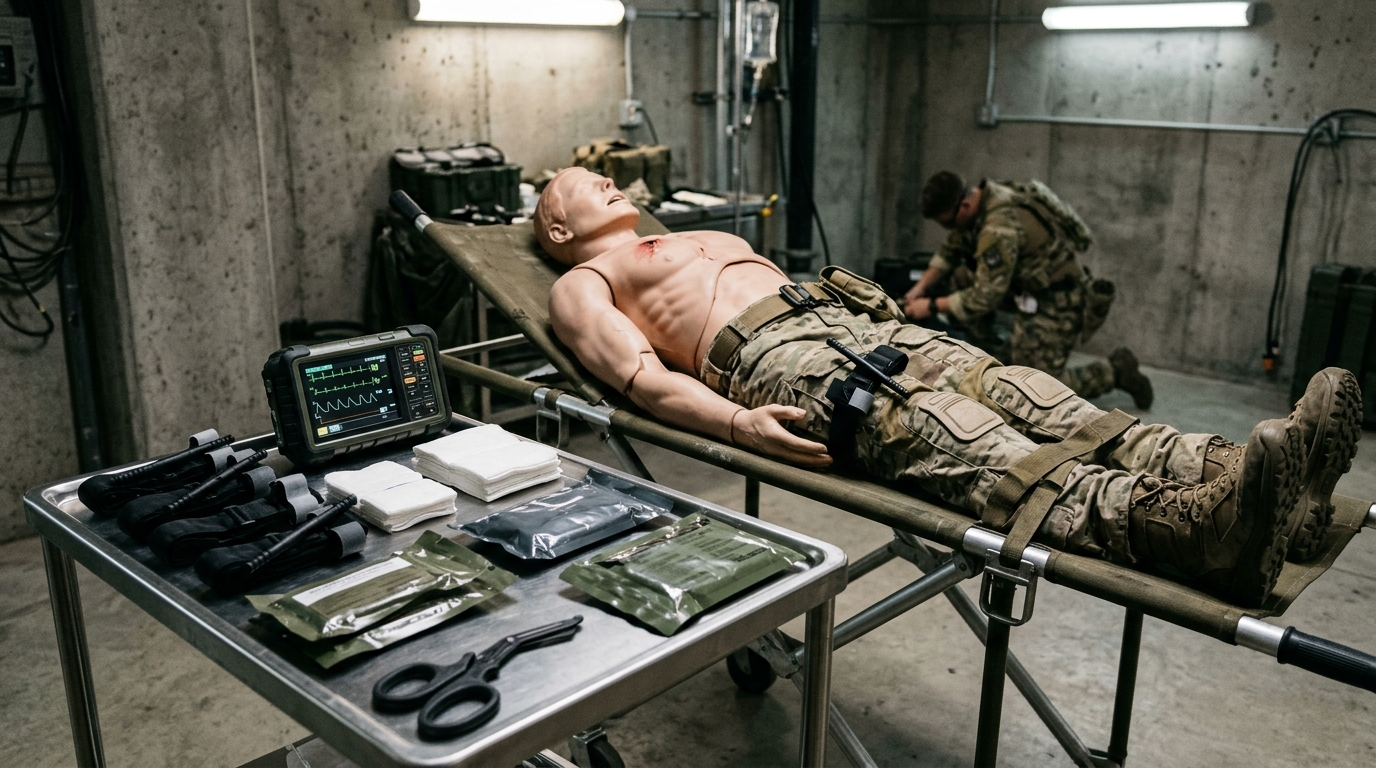
A multidisciplinary panel of fourteen civilian and military trauma specialists has established a standardized thirty-five-item evaluation tool designed to assess clinical performance during high-fidelity simulations of complex combat trauma care. Modern armed conflicts generate severe polytrauma injury patterns that are predominantly driven by explosive blast mechanisms, producing primary blast damage alongside secondary penetration, crush injuries, and severe thermal burns. Concurrently, tactical operational challenges such as restricted medical evacuation by air frequently extend prehospital stabilization intervals across multiple hours or even days. In countries like Switzerland, where healthcare systems are advanced but civilian trauma center caseloads overwhelmingly involve blunt injuries from falls and vehicular accidents rather than penetrating combat trauma, clinical exposure to battlefield casualty profiles remains scarce. To bridge this critical exposure gap, investigators structured a consensus framework to facilitate an upcoming multicenter, high-fidelity in-situ simulation study evaluating the medical management of a severely wounded combat casualty across varying professional echelons.
Developing an objective evaluation system across diverse civilian and military care environments necessitated resolving deeply rooted differences in clinical training paradigms, professional terminology, and procedural prioritization. Traditional civilian emergency algorithms structured around Advanced Trauma Life Support paradigms historically emphasized the classic airway, breathing, and circulation progression. Conversely, military medicine adheres to Tactical Combat Casualty Care and the MARCH protocol, which demands immediate, aggressive intervention for catastrophic external hemorrhage prior to addressing airway stabilization. To reconcile these disparate perspectives without diluting clinical relevance, the investigators initiated a rigorous, two-step consensus project adhering to DELPHISTAR methodology guidelines. The initial phase employed the face-to-face Nominal Group Technique with five board-certified anesthesiologists, trauma surgeons, and active-duty military physicians from the Swiss Armed Forces. This structured group executed silent generation of assessment metrics, sequential round-robin presentations without interruption, guided discussions to eliminate redundant measures, and initial ranking votes to assemble a preliminary non-timed evaluation instrument aligned with established international resuscitation guidelines.
Following the preliminary drafting phase, the panel expanded to fourteen credentialed experts, maintaining a strict balance of seven civilian and seven military healthcare specialists from institutions across Switzerland. The assembled cohort comprised eight licensed physicians specializing in trauma surgery, anesthesiology, intensive care medicine, and orthopedics, as well as six non-physician clinicians including experienced civilian paramedics and active-duty Special Forces Medical Sergeants holding United States Army 18D qualifications. This expanded expert cohort engaged in a multi-round Delphi consensus process administered electronically over a span of one hundred twenty days. In the opening Delphi round, each participant evaluated the standardized twenty-five-minute simulation scenario, assigned relative importance point weights ranging from one to thirty for prospective clinical interventions, proposed acceptable completion time thresholds for critical actions, and submitted prospective modifications. Subsequent iterations distributed anonymized, statistically aggregated group feedback, enabling participants to adjust individual scoring iteratively until unanimous consensus was achieved at the conclusion of the fifth round.
The completed assessment instrument contains thirty-five distinct evaluation items organized into eight structured clinical sections, yielding a maximum achievable score of one thousand sixty-one points. Scoring architecture divides available credit between seven hundred sixty-one points dedicated to technical intervention quality and three hundred points allocated to procedural timeliness. For each timed medical action, achieving the targeted intervention within the predefined time window confers ten full points. Delayed performance triggers an automatic penalty of one point deducted per elapsed minute beyond the target limit, whereas completely omitting an action or exceeding the designated window by more than ten minutes results in zero points for the temporal domain. Interpersonal communication, behavioral competencies, and non-technical crisis resource management behaviors were purposefully omitted from this scoring schedule, as the research group designated those dimensions for independent assessment via the T-NOTECHS framework and adapted crisis resource management Likert scales during live simulation executions.
Descriptive statistical evaluations performed using IBM SPSS Statistics version twenty-nine demonstrated significant alignment across broad scoring trends while highlighting subtle divergences between civilian and military philosophies. Across all thirty-five medical interventions, military panelists assigned slightly lower overall score weights, submitting an average of 1.8 fewer points per item, while permitting a modest average delay of twenty-six additional seconds compared to civilian evaluators. Variance analyses indicated that civilian experts exhibited broader standard deviations in their acceptable time thresholds, averaging 4.5 minutes compared to 4.0 minutes among military counterparts. Conversely, scoring point distributions varied more widely among military raters, who recorded an average standard deviation of 6.1 points compared to 5.1 points within the civilian subgroup. These descriptive variations directly reflect how divergent operating environments, baseline resources, and differing tactical constraints shape professional expectations regarding medical urgency and procedural execution under operational stress.
Addressing three life-threatening exsanguinating bleeding sites emerged as an equal priority for both groups, each assigning an identical mean importance value of 27.6 points. However, military specialists demanded far more aggressive temporal performance, specifying a mean target completion interval of 1.8 ± 0.8 minutes, whereas civilian clinicians permitted 3.9 ± 3.1 minutes. Conversely, civilian specialists placed markedly higher point values and tighter time windows on secondary circulatory interventions, awarding an average of 24.3 ± 4.3 points over 9.0 ± 4.6 minutes, compared to 20.8 ± 6.4 points across 11.4 ± 4.6 minutes from military reviewers.
Protracted panel deliberations surrounded the formulation of scoring criteria for initial fluid resuscitation and volume replacement strategies. Within Central European civilian prehospital frameworks, balanced crystalloid solutions remain the predominant initial resuscitation fluid under European guidelines for traumatic bleeding management, supported by short evacuation transit times to tertiary centers that emphasize rapid transport over protracted field stabilization. In sharp contrast, Tactical Combat Casualty Care doctrine has largely replaced crystalloid resuscitation with the prioritized administration of cold-stored or fresh whole blood, or balanced component transfusions delivering packed red blood cells, fresh frozen plasma, and platelets in a balanced one-to-one-to-one ratio. Although the Swiss Armed Forces maintain a pre-screened low-titer group O fresh whole blood walking blood bank protocol, lack of supporting civilian storage logistics prevents cold-stored whole blood deployment. Consequently, the panel established an adaptable scoring standard that permits teams to execute locally supported resuscitation guidelines, ranging from crystalloid therapy to hospital massive transfusion protocols.
Coagulation management produced comparable methodological discussions regarding logistical feasibility within a compressed twenty-five-minute simulation window. While administration of tranexamic acid achieved broad support, dosing strategies diverged between the military convention of two grams administered by rapid push or short infusion and the civilian standard of one gram bolus followed by an eight-hour infusion. The panel formally accepted both therapeutic approaches within the evaluation tool. To address early fibrinogen depletion, experts recognized that point-of-care viscoelastic testing using thromboelastometry or thromboelastography, along with the reconstitution of cryoprecipitate or fibrinogen concentrate, is exceptionally difficult to complete within twenty-five minutes. Rather than penalizing teams lacking rapid laboratory machinery, the panel established elective bonus point awards for teams successfully initiating targeted point-of-care coagulation assays or fibrinogen infusions, ensuring that teams lacking advanced point-of-care coagulation systems are not unfairly disadvantaged during baseline scoring.
Scene safety protocols and neurological evaluations revealed additional marked contrasts between tactical operational realities and civilian institutional risk governance. When evaluating the imperative to disarm casualties and confiscate hazardous weapons, civilian specialists unanimously assigned the maximum score of thirty points with zero standard deviation, identifying immediate weapons confiscation as non-negotiable for provider safety. In contrast, military experts assigned a mean importance of 19.9 ± 10.9 points, acknowledging that lightly wounded combatants in combat zones often retain operational responsibilities unless incapacitated by traumatic brain injury, profound shock, or psychoactive medications.
The study authors documented several structural limitations inherent to their preliminary consensus protocol. The foundational Nominal Group Technique was restricted to five physicians due to scheduling and logistical constraints, which might have restricted early metric generation prior to wider Delphi expansion. Furthermore, the overall panel size of fourteen experts restricts generalizability, meaning subgroup analyses remain purely exploratory and were not subjected to formal statistical significance testing. The investigative team also noted that the tool relies on expert consensus rather than prospective empirical trial validation, and that the one hundred twenty-day consensus timeline introduced potential risk for recall variations across iterative rounds. Nevertheless, by capturing the clinical and operational divergences between military and civilian emergency systems, this Delphi consensus framework provides an objective, standardized metric designed to evaluate team performance and advance interprofessional combat trauma education across future simulation trials.
Subject of Research: Development of a consensus-based evaluation tool for high-fidelity combat trauma simulation
Article Title: A novel evaluation tool for combat trauma simulation: Delphi expert panel consensus report
Article References: Weber, S., Teuber, H., Hatz, B. A., Kuny, M., Grande, B., Kolbe, M., Pape, H.-C., & Baettig, S. J. (2026). A novel evaluation tool for combat trauma simulation: Delphi expert panel consensus report. Patient Safety in Surgery, 20(1), Article 32. https://doi.org/10.1186/s13037-026-00493-z
Image Credits: AI Generated
DOI: 10.1186/s13037-026-00493-z
Keywords: Combat Trauma Simulation, Delphi Consensus Process, Nominal Group Technique, Emergency Medicine, Trauma Surgery, Tactical Combat Casualty Care, Advanced Trauma Life Support, Exsanguinating Hemorrhage, Prehospital Trauma Life Support, Tranexamic Acid, Fluid Resuscitation, Massive Transfusion Protocol, Point-of-Care Coagulation Testing, Fibrinogen Replacement, Swiss Armed Forces, Cervical Spine Immobilization, Glasgow Coma Scale
News Source: Ophelia Keating. (November 18, 2026). Delphi Expert Panel Establishes Evaluation Tool for Combat Trauma Simulation. Scienmag.