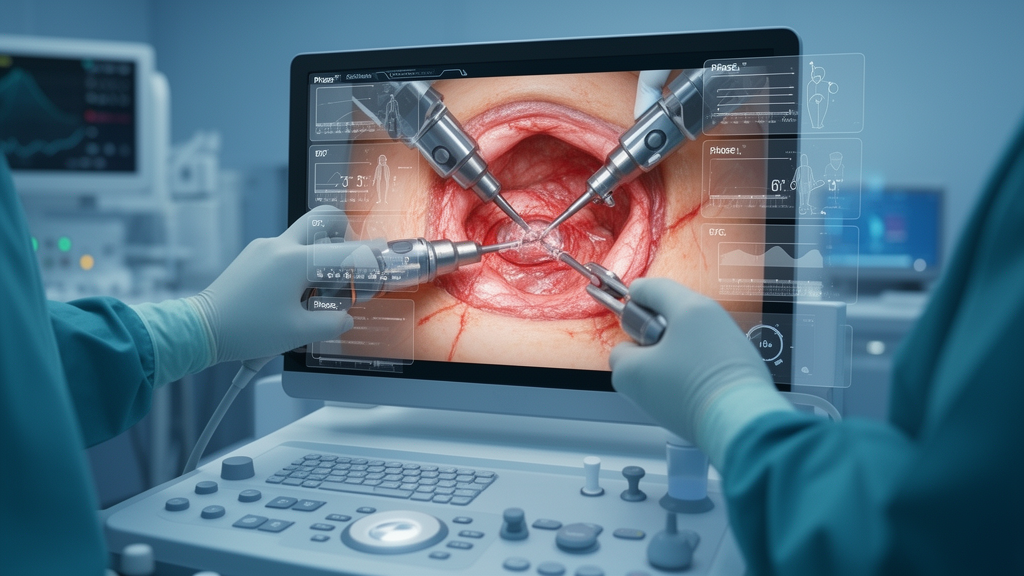
A multicenter retrospective study in Japan has demonstrated that a deep learning model can automatically recognize operative phases in laparoscopic low anterior resection videos, providing an objective measurement of surgical efficiency based on phase duration. The research team evaluated whether artificial intelligence could reliably track procedural progress and help distinguish technical performance between certified and non-certified surgeons.
Laparoscopic low anterior resection is a technically demanding colorectal procedure conducted within the confined anatomical space of the narrow pelvic cavity. In this surgical setting, individual operative skill substantially influences perioperative outcomes. Despite its importance, conventional methods for evaluating surgical expertise remain predominantly subjective, labor-intensive, and difficult to scale across clinical institutions.
To establish an automated assessment pipeline, researchers collected and retrospectively analyzed 192 laparoscopic low anterior resection videos sourced from 44 institutions across Japan. Expert annotators cataloged the surgical footage frame by frame, segmenting each recorded operation into 17 predefined procedural phases to create a comprehensive reference standard for machine training and comparative verification.
The investigative team developed an automated phase-recognition model based on the EfficientNet-B7 convolutional neural network architecture. When tested across the multi-institutional dataset, the deep learning model achieved an overall accuracy of 83.7 percent, demonstrating a precision of 73.9 percent, a recall of 71.5 percent, and an overall F1-score of 71.9 percent across the categorized phases.
Surgeons performing the operations were categorized according to their certification status under the Endoscopic Surgical Skill Qualification System. Investigators examined multiple operative metrics, including overall procedure duration, phase durations, total pelvic dissection time, and the frequency of phase transitions, comparing manual ground-truth annotations directly against the AI-generated phase predictions.
Manual video analysis revealed that non-certified surgeons experienced significantly longer total operative times and prolonged duration across several individual phases, most prominently during pelvic dissection phases associated with total mesorectal excision. Automated analysis by the deep learning model successfully reproduced the significantly longer total operative time observed in the non-certified group.
The artificial intelligence model also demonstrated a similar trend toward prolonged pelvic dissection time among non-certified practitioners, although this specific machine-derived difference did not reach statistical significance. In addition, analyses of phase-transition counts revealed no significant differences between the certified and non-certified cohorts in either manual or automated assessments.
The authors concluded that deep learning-based phase recognition facilitates automated phase-duration analysis and delivers an objective metric of operative efficiency in laparoscopic low anterior resection. Because prolonged total mesorectal excision duration may capture meaningful differences in technical expertise, this framework supports scalable, objective assessment systems in colorectal surgery.
Subject of Research: Automated deep learning phase recognition and objective surgical skill assessment in laparoscopic low anterior resection
Article Title: Automated surgical phase recognition using deep learning and objective skill assessment based on phase duration in laparoscopic low anterior resection: a multicenter study
Article References: Tadokoro, Y., Takenaka, S., Kitaguchi, D., Takasaki, H., Okamoto, N., Tabata, Y., Ogane, T., Sasaki, K., Takeshita, N., Kinugasa, Y., & Ito, M. (2026). Automated surgical phase recognition using deep learning and objective skill assessment based on phase duration in laparoscopic low anterior resection: a multicenter study. International Journal of Colorectal Disease. https://doi.org/10.1007/s00384-026-05278-5
Image Credits: AI Generated
DOI: 10.1007/s00384-026-05278-5
Keywords: laparoscopic low anterior resection, surgical phase recognition, deep learning, surgical skill assessment, EfficientNet-B7, colorectal surgery, total mesorectal excision, pelvic dissection, Endoscopic Surgical Skill Qualification System, multicenter study, phase duration, operative time, phase transitions, video annotation, surgical efficiency, computer-assisted surgery
News Source: Blake Davidson. (November 18, 2026). Deep Learning Recognizes Surgical Phases to Assess Skill in Laparoscopic Procedures. Scienmag.