• HOME
  • NEWS
  • EXPLORE
    • CAREER
      • Companies
      • Jobs
    • EVENTS
    • iGEM
      • News
      • Team
    • PHOTOS
    • VIDEO
    • WIKI
  • BLOG
  • COMMUNITY
    • FACEBOOK
    • INSTAGRAM
    • TWITTER
Thursday, November 19, 2026
BIOENGINEER.ORG
No Result
View All Result
  • Login
  • HOME
  • NEWS
  • EXPLORE
    • CAREER
      • Companies
      • Jobs
        • Lecturer
        • PhD Studentship
        • Postdoc
        • Research Assistant
    • EVENTS
    • iGEM
      • News
      • Team
    • PHOTOS
    • VIDEO
    • WIKI
  • BLOG
  • COMMUNITY
    • FACEBOOK
    • INSTAGRAM
    • TWITTER
No Result
View All Result
Bioengineer.org
No Result
View All Result
Home NEWS Science News Biology

TEX264 UFMylation Promotes ER-Phagy by Enhancing Its Interaction With LC3B

by
November 18, 2026
in Biology
Reading Time: 2 mins read
0
TEX264 UFMylation Promotes ER-Phagy by Enhancing Its Interaction With LC3B

TEX264 UFMylation Promotes ER-Phagy by Enhancing Its Interaction With LC3B

Share on FacebookShare on TwitterShare on LinkedinShare on RedditShare on Telegram

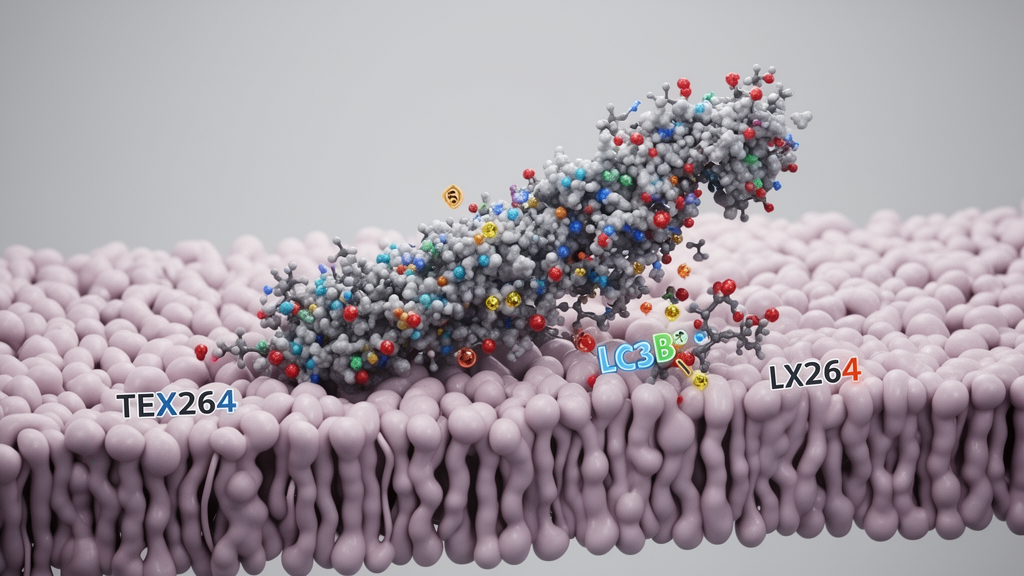
Researchers have identified the protein TEX264 as a substrate of UFMylation and demonstrated that this post-translational modification enhances the interaction between TEX264 and LC3B to promote ER-phagy.

Writing in the journal Frontiers in Cell and Developmental Biology, the research team noted that although UFMylation had previously been implicated in ER-phagy, the precise molecular mechanisms and cellular substrates involved in the process remained incompletely characterized. To clarify these unknown mechanisms, the investigators designed an experimental workflow to evaluate whether TEX264 serves as a direct target for UFMylation and to determine how modification alters its function during ER-phagy.

To measure autophagic activity directed at the endoplasmic reticulum, the authors engineered specialized molecular tools. Specifically, they constructed two dual-fluorescent reporter systems: an mCherry-eGFP-KDEL reporter and an mCherry-eGFP-TEX264 reporter. These fluorescent reporters enabled the researchers to reliably monitor and assess ER-phagy activity under defined experimental conditions in the laboratory.

The investigators then carried out targeted biochemical assays to analyze the modification state of TEX264. A dedicated UFMylation assay was used to examine the occurrence of TEX264 UFMylation and map its specific modification sites. In addition, the team performed Western blotting, co-immunoprecipitation, or Co-IP, and immunofluorescence microscopy to systematically track and assess the UFMylation of TEX264 during active ER-phagy.

Detailed mapping of the protein identified TEX264 as an authentic substrate of UFMylation, revealing that the modifier protein UFM1 is conjugated to five distinct lysine residues. The specific modification sites identified on TEX264 were lysine 196, lysine 201, lysine 300, lysine 310, and lysine 312.

Functional experiments demonstrated that interfering with this modification pathway impairs cellular clearance mechanisms. The researchers found that either the depletion of UFL1 or the targeted mutation of the five identified TEX264 UFMylation sites compromised TEX264-mediated ER-phagy. In both experimental conditions, this defect occurred because the disruption of UFMylation prevented the normal binding interaction between TEX264 and LC3B.

Finally, the authors examined the oligomeric behavior of the protein using disuccinimidyl suberate cross-linking and bimolecular fluorescence complementation assays. Their analysis revealed that starvation-induced ER-phagy promotes the oligomerization of TEX264 independently of UFMylation. Together, the findings demonstrate that while oligomerization occurs independently during starvation, TEX264 UFMylation specifically promotes ER-phagy by facilitating the critical interaction between TEX264 and LC3B.

Subject of Research: Molecular mechanisms of TEX264 UFMylation in ER-phagy regulation

Article Title: UFMylation of TEX264 promotes ER-phagy by facilitating the TEX264-LC3B interaction

Article References: Zhuang, Y., Guo, Z., Li, B., Jia, F., Zhang, Q., & Cong, Y. (2026). UFMylation of TEX264 promotes ER-phagy by facilitating the TEX264-LC3B interaction. Frontiers in Cell and Developmental Biology, 14, Article 2038552. https://doi.org/10.3389/fcell.2026.2038552

Image Credits: AI Generated

DOI: 10.3389/fcell.2026.2038552

Keywords: TEX264, UFMylation, ER-phagy, LC3B, UFL1, UFM1, mCherry-eGFP-KDEL, mCherry-eGFP-TEX264, disuccinimidyl suberate, bimolecular fluorescence complementation, co-immunoprecipitation, immunofluorescence, Western blotting, protein oligomerization, starvation-induced ER-phagy, lysine modification sites

News Source: Drew Townsend. (November 18, 2026). TEX264 UFMylation Promotes ER-Phagy by Enhancing Its Interaction With LC3B. Scienmag.

Tags: Bimolecular fluorescence complementationco-immunoprecipitationdisuccinimidyl suberateER-phagyimmunofluorescenceLC3Blysine modification sitesmCherry-eGFP-KDELmCherry-eGFP-TEX264protein oligomerizationstarvation-induced ER-phagyTEX264UFL1UFM1UFMylationwestern blotting
Share12Tweet7Share2ShareShareShare1

Related Posts

Autistic Adolescents Rely on Abstract Prototypes During Category Learning, Study Finds

Autistic Adolescents Rely on Abstract Prototypes During Category Learning, Study Finds

November 19, 2026
Rare Chromosome 9 Inversion and Gene Deletion Documented in Malian Leukemia Case

Rare Chromosome 9 Inversion and Gene Deletion Documented in Malian Leukemia Case

November 19, 2026

Mexican Jaguar Corridors Face Structural Habitat Shifts and Movement Bottlenecks

November 19, 2026

Migratory Geese Show Divergent Movement Strategies During Extreme Poyang Lake Drought

November 19, 2026

POPULAR NEWS

  • Oncology Corridor Assessment Identifies Widespread Therapeutic and Environmental Deficits

    Oncology Corridor Assessment Identifies Widespread Therapeutic and Environmental Deficits

    29 shares
    Share 12 Tweet 7
  • Chamomile Oil and Apigenin Suppress Antibiotic Efflux Pump Genes in Clinical Bacteria

    29 shares
    Share 12 Tweet 7
  • Preoperative Arterial Embolization Shows Mixed Complication Risks in Pancreatic Surgery

    29 shares
    Share 12 Tweet 7
  • Mexican Jaguar Corridors Face Structural Habitat Shifts and Movement Bottlenecks

    29 shares
    Share 12 Tweet 7

About

We bring you the latest biotechnology news from best research centers and universities around the world. Check our website.

Follow us

Recent News

French Study Evaluates Real-World Nivolumab Rechallenge Outcomes in Advanced Lung Cancer

Mirogabalin Side Effects in Spinal Stenosis Resolved in Most Trial Patients

Autistic Adolescents Rely on Abstract Prototypes During Category Learning, Study Finds

Subscribe to Blog via Email

Enter your email address to subscribe to this blog and receive notifications of new posts by email.

Join 89 other subscribers
  • Contact Us

Bioengineer.org © Copyright 2023 All Rights Reserved.

Welcome Back!

Login to your account below

Forgotten Password?

Retrieve your password

Please enter your username or email address to reset your password.

Log In
No Result
View All Result
  • Homepages
    • Home Page 1
    • Home Page 2
  • News
  • National
  • Business
  • Health
  • Lifestyle
  • Science

Bioengineer.org © Copyright 2023 All Rights Reserved.