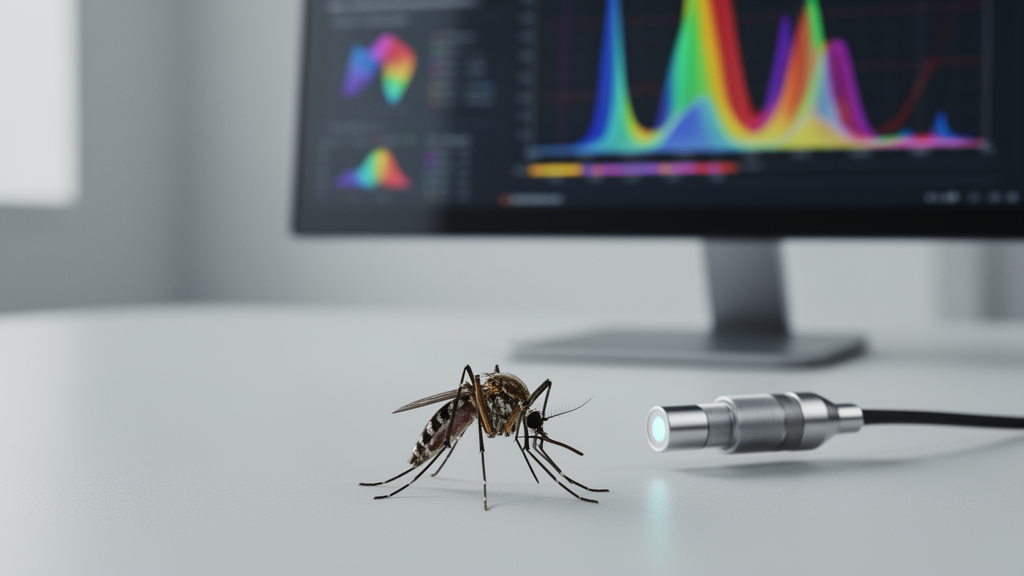
Researchers have demonstrated that mid-infrared spectroscopy paired with supervised machine learning can determine the age class of Culex pipiens, an important mosquito vector of arboviruses. By analyzing the chemical signature of the insect cuticle, the spectroscopic technique identifies spectral patterns that change across the mosquito lifespan. The authors developed predictive models capable of classifying mosquitoes into epidemiologically relevant age groups, offering a practical framework to improve vector surveillance and assess disease transmission risk in regions where these vectors thrive.
Culex pipiens is a widespread mosquito species and a key vector of several medically important arboviruses, including West Nile virus, across temperate areas. In recent years, public health monitoring has recorded increased transmission of Culex-borne arboviruses globally. This growing spread highlights an ongoing requirement for targeted vector surveillance and refined risk assessment frameworks. However, accurately tracking vector populations demands biological insight into whether individual mosquitoes have survived long enough to acquire and transmit viral agents.
Mosquito age serves as a primary determinant of transmission potential within wild populations. Evaluating the age structure of field mosquitoes is critical because females must survive through the pathogen-specific incubation period before they can transmit an arbovirus. Among the female mosquitoes that successfully survive this necessary incubation interval, their remaining lifespan determines how many subsequent feeding cycles and opportunities they have to bite and infect new hosts. Despite the recognized epidemiological importance of tracking vector age, existing methods for determining the age of Culex pipiens remain largely unsuitable for widespread use.
To address this challenge, researchers developed an age determination model using mid-infrared spectroscopy. The method captures the unique chemical signature of the mosquito cuticle, which undergoes natural biochemical alterations throughout the insect’s lifespan. By recording these cuticular spectrum changes, the system enables mosquitoes to be categorized into age groups that carry epidemiological significance. Furthermore, the spectroscopic measurements achieve sufficient precision to permit fine-scale assessments of mosquito age, providing quantitative data to evaluate transmission hazards in greater detail.
The experimental evaluation relied on spectra collected from a recently established laboratory colony of Culex pipiens. In total, the authors acquired spectra from more than 1,500 individual female mosquitoes and over 500 male mosquitoes. The researchers established predictive models across differing degrees of age resolution to evaluate classification performance. For female mosquitoes, age classifications were evaluated at three resolutions: coarse resolution with two age classes, intermediate resolution with four age classes, and fine resolution with eight age classes. Male mosquitoes were classified separately across three age classes.
The results indicated that mid-infrared spectroscopy could predict the age class of Culex pipiens with good accuracy, though performance varied according to the resolution applied. When tested against an unseen spectra dataset, the trained machine learning model successfully predicted the age class of the mosquitoes. However, predictive accuracy declined as the models moved from coarse to intermediate and fine resolutions. Notably, the spectroscopic method identified newly emerged mosquitoes with high accuracy, maintaining strong classification performance even when analyzed under the fine resolution structure.
In their conclusions, the investigators demonstrated that mid-infrared spectroscopy reliably determines the age of Culex pipiens based on detectable shifts in cuticular spectra across adult life. This analytical approach holds potential applications for assessing the risk of arbovirus transmission by natural Culex populations and for monitoring the outcomes of targeted vector control strategies. The authors state that additional research will be required to validate the spectroscopic method among field populations and to determine whether the technique can be broadened to related mosquito species.
Subject of Research: Age determination in Culex pipiens mosquitoes using mid-infrared spectroscopy and machine learning
Article Title: Mid-infrared spectroscopy and supervised machine learning can determine age class of arboviral vector Culex pipiens
Article References: Carmichael, R. M., Pazmiño-Betancourth, M., Parvy, J.-P., Kulkarni, S., Dick, J. T. A., Modrzynska, K., Babayan, S. A., Cuthbert, R. N., Ferguson, H. M., Baldini, F., & Pondeville, E. (2026). Mid-infrared spectroscopy and supervised machine learning can determine age class of arboviral vector Culex pipiens. Parasites & Vectors. https://doi.org/10.1186/s13071-026-07776-5
Image Credits: AI Generated
DOI: 10.1186/s13071-026-07776-5
Keywords: Culex pipiens, mid-infrared spectroscopy, supervised machine learning, mosquito age determination, mosquito cuticle, cuticular spectra, arbovirus vector, West Nile virus, vector surveillance, transmission risk assessment, pathogen incubation period, mosquito lifespan, age structure, vector control evaluation, newly emerged mosquitoes, laboratory colony, female mosquito age, unseen spectra dataset
News Source: Teresa Odom. (November 18, 2026). Mid-Infrared Spectroscopy and Machine Learning Determine Culex pipiens Mosquito Age. Scienmag.