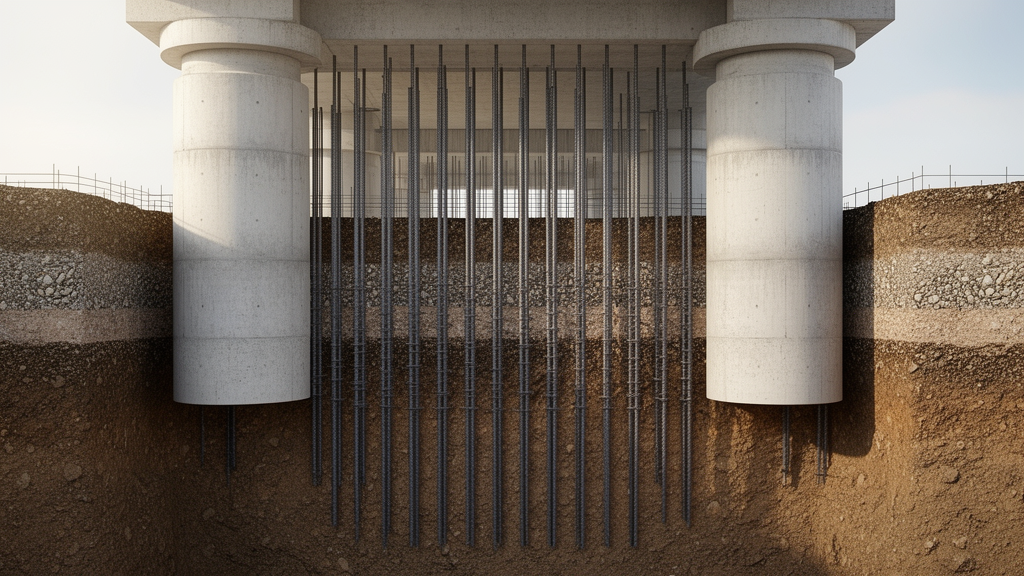
A comprehensive investigation combining field monitoring and three-dimensional finite element modeling has identified the mechanical mechanisms governing ground surface settlement during the staged sinking of open caissons in soft soil regions. The research demonstrates that ground surface settlement induced by caisson sinking exhibits a distinct exponential decay distribution, with its critical disturbance boundary concentrated within an influence range of approximately 0.6 times the sinking depth from the structure outer wall. By systematically evaluating soil plastic strain progression and foundation deformation, the study establishes that auxiliary jet grouting reinforcement piles provide effective containment only when specific geometric thresholds are met. Truncating deep shear failure surfaces requires a pile length ratio of at least 1.0 relative to sinking depth, while setting the pile diameter between 1.0 and 1.3 times the caisson wall thickness achieves an optimal balance between displacement suppression and construction economics.
Open caissons serve as vital underground structures constructed at the ground surface and subsequently sunk to predetermined target elevations by systematically excavating interior soil. Due to their high structural stability, small construction footprint, and well-defined operational sequence, caissons are widely deployed for bridge foundations, deep working shafts in pipe jacking operations, and urban underground infrastructure. The empirical foundation of this study is situated along the high-voltage power tunnel reconstruction project on Nanniwan Avenue, which extends 6.299 kilometers from Garden Expo Avenue to Hanxi 3rd Road, crossing beneath major railway lines with pipe overburden depths ranging between 5 and 15 meters. The field observations specifically examined working shaft A18, located along a curved section terminating at shaft A20 with an internal pipe diameter of DN3000 across a 139.7-meter alignment, where reinforced circular caissons were sunk through sensitive soft strata.
The structural geometry of working shaft A18 features a total height of 13.8 meters, an outer diameter of 12.5 meters, a wall thickness of 1.0 meter, and a bottom cutting edge with a tread width of 0.4 meters. The caisson fabrication was executed in four vertical stages: a bottom cutting edge layer measuring 3.2 meters in height with a 1.0-meter reinforced bevel; a secondary layer of 3.8 meters accommodating pipe jacking portals; and two upper retaining segments with a combined height of 6.0 meters. Subsurface geotechnical investigations revealed a stratigraphy consisting sequentially of miscellaneous fill, plain fill, silty clay, clay, and silty clay containing silt lenses. The caisson sinking process primarily traversed the silty clay stratum, an elastoplastic medium prone to intense shear yielding under construction disturbances. As the caisson sinks, downward frictional traction along the external perimeter and interior unloading cause severe stress redistribution, which risks damaging adjacent urban buildings if unmitigated.
Previous studies regarding open caissons have predominantly relied on empirical curve-fitting derived from isolated field datasets or unreinforced numerical tests. Earlier research by Chu and colleagues characterized sidewall friction relaxation zones using stepped wall profiles, while Shao and collaborators established empirical formulas for cutting edge end resistance based on laboratory shear tests. Xie and co-workers developed settlement formulas from ninety-six numerical runs focusing on retained interior soil plugs, and Xu and colleagues observed a triangular settlement envelope spanning 1.7 times excavation depth in jacked caissons. Broader excavation analyses by Wang and Zhou demonstrated that disturbance boundaries in cohesive strata frequently form basin-shaped troughs rather than inverted triangles, governed by beam-lining interactions and volume loss rates. However, these historical models addressed unsupported sinking or tunnel excavations, leaving the governing control mechanisms of external pile reinforcement geometry unquantified.
To evaluate actual spatial deformations during sinking, a rigorous field monitoring program was established around shaft A18 utilizing a high-precision Leica LS15 digital leveling instrument. Monitoring was conducted in strict adherence to national engineering standards, including the Construction Specification for Caisson and Pneumatic Caisson (GB/T 51130-2016), the Standard for Monitoring of Building Excavation Engineering (GB 50497-2019), and the Code for Deformation Measurement of Building and Structure (JGJ 8-2016). Seven settlement monitoring points were arranged along a perpendicular radial path extending outward from the caisson wall to a boundary distance of 16 meters. Three reference benchmarks outside the deformation zone formed a closed leveling network operating under second-class precise leveling standards, maintaining instrument station permissible height-difference errors within plus or minus 0.5 millimeters and misclosure within plus or minus 1.0 times the square root of n millimeters. Baseline readings were established from three consecutive pre-sinking surveys, while active measurements were collected daily, accelerating to twice daily during rapid sinking and reducing to alternate days during pauses, terminating only when settlement rates stayed below 1 millimeter per day for three consecutive days.
Complementing the field program, a three-dimensional numerical simulation was established in ABAQUS software to capture internal stress states, cutting edge resistance, and wall-soil interactions. The computational soil domain was set to 50 meters in length, 50 meters in width, and 30 meters in depth, satisfying the recommended standard of three to five times the sinking depth to minimize artificial boundary reflections. The soil mass, concrete caisson, and surrounding reinforcement piles were discretized using C3D8R eight-node linear hexahedral reduced-integration solid elements. Soil excavation and stepped sinking penetration were simulated via the element birth and death technique, sequentially deactivating interior soil elements and applying prescribed vertical displacements to the caisson body. Master-slave contact pairs were implemented at all structure-soil interfaces, assigning normal contact to a hard contact formulation and tangential behavior to a penalty friction formulation using a friction coefficient of 0.14, determined through the empirical relation of tangent phi for the predominant silty clay.
The mechanical behavior of the soil was captured using an elastoplastic constitutive model governed by the Mohr-Coulomb yield criterion, while the concrete caisson structure and reinforcement piles were treated as linear elastic bodies. Although the Mohr-Coulomb model adopts a constant stiffness modulus and does not track the complex volumetric strain evolution typical of soft soils, its shear parameters cohesion and internal friction angle accurately dictate plastic yielding under progressive shear loading. Total stress analysis was adopted because dewatering measures maintained groundwater levels during construction, isolating instantaneous shear deformations from long-term consolidation settlement.
Verification against field data confirmed the accuracy and stability of the numerical formulation. The calculated ground surface settlement profile exhibited a mean relative error of approximately 10 percent across the seven radial monitoring points when compared to final field leveling measurements. The physical monitoring values were slightly higher than numerical predictions, an effect attributed to minor caisson tilting and corrective steering maneuvers in the field that increased local sidewall friction. Overall structural deformation remained exceptionally minor, with maximum horizontal displacements along the x-axis reaching only 0.39 millimeters and maximum vertical displacements along the z-axis reaching 0.30 millimeters. Symmetrical deformation patterns and the absence of localized stress concentrations confirmed that the caisson descended smoothly as a rigid monolithic unit without severe eccentric loading, matching inclinometer field observations.
Simulation of the soil domain revealed that plastic strain initiates beneath the cutting edge at an excavation depth of 5 meters, where interior soil plugs are still shallow and elastic. As sinking proceeds, this plastic zone extends progressively toward the exterior sidewalls and inward beneath the caisson core, driving the equivalent plastic strain from zero to a maximum of 0.29 at final grade. Ground surface settlement follows an exponential decay with radial distance from the wall. Vertical subsidence remained under 8 millimeters when sinking depth was below 10 meters, but accelerated to a peak of approximately 12 millimeters as depth reached 13 meters. Extracting settlement curves confirmed that the spatial decay rate slows dramatically beyond 0.6 times the sinking depth, proving that auxiliary reinforcement measures must be concentrated within this specific radial distance to protect nearby urban structures.
The internal mechanics within the caisson pit demonstrated a coupled process termed exterior settlement and interior heave. At shallow sinking depths, removal of overburden triggers elastic unloading rebound, producing a downward-opening parabolic heave profile across the pit floor where maximum upward movement occurs at the center. As excavation advances, the substantial earth pressure differential between the outside and inside forces deep exterior soil to flow plastically around the bottoms of the caisson and piles. This plastic shear flow shifts the basal deformation into an inverted parabolic profile with a gentle central rise and sharp protrusions on both sides near the caisson perimeter, where maximum upward heave reached 85 millimeters. A continuous shear slip arc penetrates from the base of the excavation directly to the ground surface, confirming that surface subsidence is the outward manifestation of deep plastic soil squeezing.
Parametric simulations examining reinforcement pile length ratios, designated as alpha representing pile length divided by caisson sinking depth, demonstrated that structural containment increases non-linearly with pile depth. Five test groups with a constant pile diameter of 1.0 meter evaluated alpha ratios of 0.5, 0.8, 1.0, 1.3, and 1.5. In scenarios with insufficient pile length, peak ground settlements reached 26.58 millimeters at alpha 0.5 and 21.0 millimeters at alpha 0.8, with steep settlement gradients in the near-field zone within 6 meters of the caisson. When alpha reached 1.0, maximum settlement decreased to 19.6 millimeters, functioning as a critical mechanical threshold where the pile body intersects and anchors the deep slip arc. Extending the ratio to 1.3 and 1.5 reduced surface settlement to approximately 3.5 millimeters and 3.04 millimeters respectively, representing an overall displacement suppression exceeding 88 percent compared to the shortest pile group.
Subsequent evaluations analyzed the pile diameter ratio, designated as beta representing pile diameter divided by caisson wall thickness, while holding the length ratio fixed at 1.3 and the pile elastic modulus at 750 megapascals. At beta 0.5, the small pile section lacked sufficient bending stiffness to withstand lateral soil squeezing, experiencing plastic yielding that caused numerical convergence failure. For stable configurations across beta ratios of 0.8, 1.0, 1.3, and 1.5, maximum settlement dropped from 10.49 millimeters at beta 0.8 down to 6.3 millimeters at beta 1.3, reflecting a 33 percent reduction. Beyond beta 1.3, further diameter increases produced negligible improvement, with settlement slightly rising to approximately 6.5 millimeters as confinement saturated. Consequently, selecting an alpha ratio between 1.3 and 1.5 alongside a beta ratio between 1.0 and 1.3 offers an optimal engineering balance between ground deformation control and material economy in comparable soft soil strata.
Subject of Research: Ground surface settlement and reinforcement parameter optimization for caissons in soft soils
Article Title: Ground surface settlement and reinforcement parameter optimization for caissons in soft soil regions
Article References: Ye, J., Cheng, H., Ren, Y., & Liu, X. (2026). Ground surface settlement and reinforcement parameter optimization for caissons in soft soil regions. Journal of Engineering and Applied Science, 73(1), Article 466. https://doi.org/10.1186/s44147-026-01312-z
Image Credits: AI Generated
DOI: 10.1186/s44147-026-01312-z
Keywords: open caisson, ground surface settlement, reinforcement piles, soft soil mechanics, numerical simulation, ABAQUS, Mohr-Coulomb criterion, plastic zone evolution, basal soil heave, jet grouting, settlement trough, power tunnel, field monitoring, silty clay, shear slip surface, equivalent plastic strain, urban geotechnical engineering
News Source: Denise Maddox. (November 18, 2026). Reinforcement Piles Curb Ground Settlement Within Critical Zone Around Sinking Caissons. Scienmag.