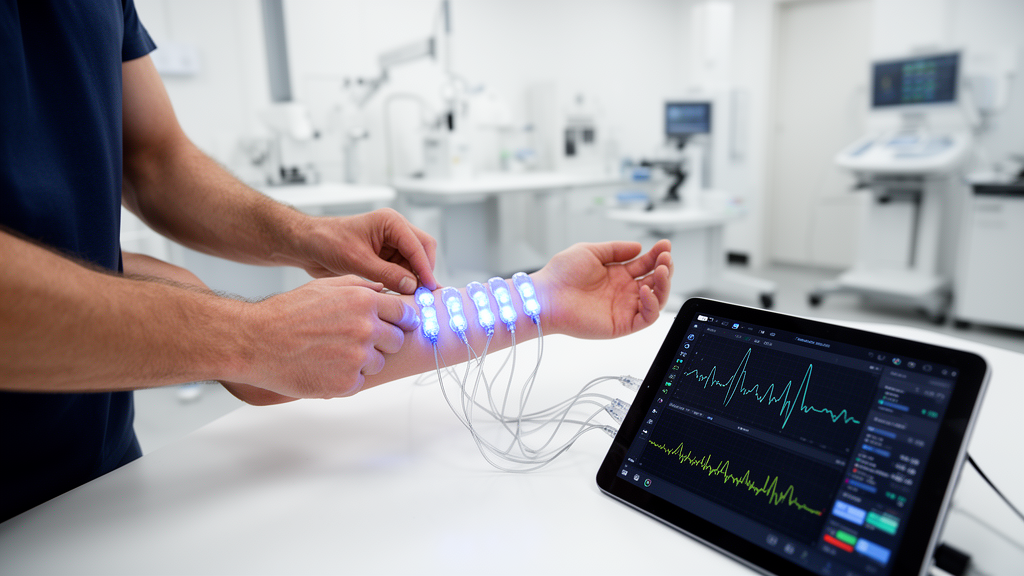
A new hypothesis and theory article published in Frontiers in Digital Health proposes Functional Human Traits and Sensor-Wide Association Studies as a conceptual and methodological architecture for evaluating individual-level representations of physiological response capacities. Authored by Angela Lausch, Toralf Kirsten, Peter Selsam, and Jan Bumberger, the work addresses a core limitation in digital health: while wearable and digital sensors allow longitudinal observation of human physiology and behavior, reproducible statistical associations and predictive performance do not verify which physiological construct a sensor-derived representation actually measures.
To bridge this gap, the researchers distinguish statistical representation, construct interpretation, and mechanistic explanation. Under the proposed framework, a Functional Human Trait is formally defined as a quantitative representation of a specified physiological response capacity. To qualify as a valid trait, the representation must be supported by temporal repeatability over a justified time interval alongside independent biological evidence obtained under explicitly stated conditions.
The Sensor-Wide Association Studies architecture links four sequential stages: documented sensor features, exploratory analysis, candidate construction, and independent evaluation. In the exploratory phase, the authors note that outcome-guided screening estimates feature–outcome associations, whereas unsupervised analysis identifies statistical structure across sensor signals. However, the framework emphasizes that neither exploratory approach directly identifies an underlying physiological construct.
Moving from exploratory signals to candidate construction requires several explicit criteria. According to the article, candidate construction demands a formal measurement model, individual-level estimation that incorporates uncertainty, and rigorous statistical tests designed to address competing construct interpretations. To demonstrate how candidate construction functions in practice, the authors present a hypothetical cardiovascular heat-response example using a longitudinal model.
The architecture also outlines four distinct dimensions for independent evaluation rather than relying solely on predictive accuracy. Specifically, the framework separates statistical replication, technical robustness, temporal repeatability, and biological support into distinct evaluation criteria.
Environmental sensing and semantic integration are incorporated into the framework as optional supporting components when relevant to a specific research question. Environmental sensing and semantic integration are optional supporting components within the framework when relevant to the research question.
Addressing the broader implications for digital health, the authors emphasize that biological support does not establish a causal mechanism or confirm clinical usefulness. Applications aiming to establish digital biomarkers require separate, dedicated validation for their intended clinical use. Furthermore, the authors caution that the real-world feasibility and added value of Functional Human Traits and Sensor-Wide Association Studies remain to be demonstrated empirically.
Subject of Research: Methodological framework for evaluating functional human traits using sensor-wide association studies
Article Title: Sensor-wide association studies: a methodological architecture for developing and evaluating functional human traits
Article References: Lausch, A., Kirsten, T., Selsam, P., & Bumberger, J. (2026). Sensor-wide association studies: a methodological architecture for developing and evaluating functional human traits. Frontiers in Digital Health, 8, Article 1952373. https://doi.org/10.3389/fdgth.2026.1952373
Image Credits: AI Generated
DOI: 10.3389/fdgth.2026.1952373
Keywords: Functional Human Traits, Sensor-Wide Association Studies, digital biomarkers, wearable sensing, physiological response capacity, longitudinal observation, candidate construction, measurement model, temporal repeatability, technical robustness, biological support, outcome-guided screening, unsupervised analysis, semantic data integration, environmental sensing, multimodal sensing
News Source: Ophelia Keating. (November 18, 2026). Researchers Propose Sensor Framework to Define and Evaluate Functional Human Traits. Scienmag.