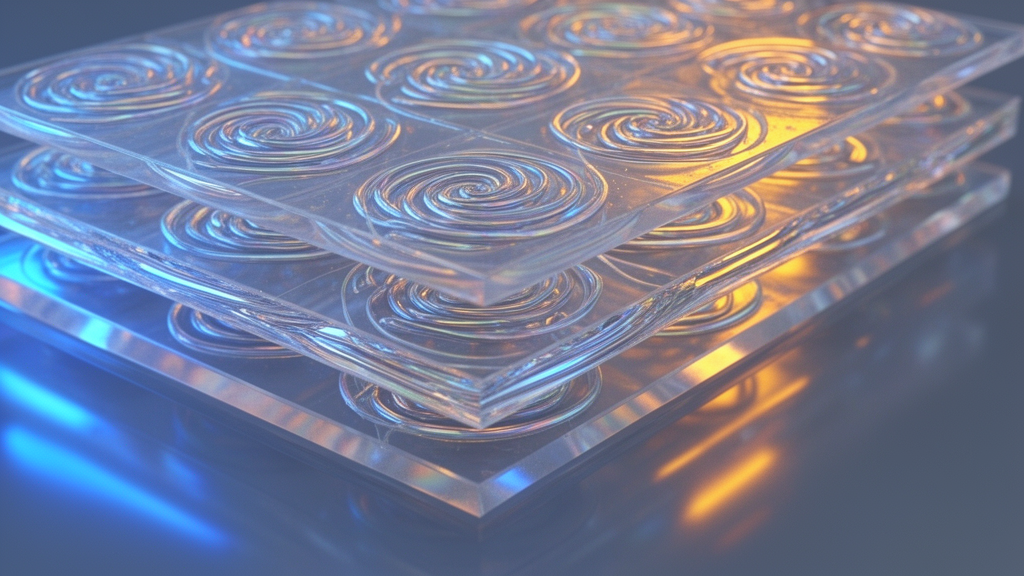
In a significant advance for soft-matter physics, researchers have demonstrated that intentionally designing broken symmetries in nematic vortex crystals enables liquid crystals to function as reconfigurable, high-density topological information storage devices. While nematic liquid crystals form the operational basis of commercial displays, their capacity to serve as reconfigurable, non-volatile data storage media has historically remained unexplored. The research team established that engineering broken symmetries within nematic vortex crystal lattices produces exponential microscopic configurational complexity exceeding the configurational entropy of conventional atomic crystals. This informational capacity originates from the manifold topological pathways through which surface-anchored nematic defect lines combine, yielding distinct local free-energy minima and tailored broken symmetries throughout the material. By generalizing crystalline phenomena such as interstitial defects, substitutional sites, and grain boundaries into fluid soft matter, this experimental platform establishes a versatile framework for developing soft-matter-based topological memory and neuromorphic computation.
The physical principles governing these topological defect networks offer an instructive parallel to artificial materials engineered to emulate natural condensed matter, notably the colloidal atom paradigm. In materials research, colloidal particles engineered with customized geometric shapes, topological features, or surface-grafted DNA hybridization strands have routinely exceeded the structural diversity found in basic atomic and molecular systems. The demonstrated liquid-crystal defect platform expands this concept by showing that topological defects in nematics vastly exceed the diversity of assembled states achievable in natural condensed matter. Topological defect lines possessing particle-like characteristics self-organize into regular arrays and combinatorially diverse dimer configurations. Because these states are stabilized through robust surface boundary conditions, the system reliably maintains defect lattices that would normally prove unstable or undergo rapid annihilation in atomic crystals. Furthermore, strong surface pinning permits the stable integration of mismatched symmetries between the lattice and its basis, unlocking rich combinatorial connectivity between adjacent pinning sites.
To physically fabricate and experimentally validate these reconfigurable soft-matter lattices, the research team utilized the nematic compound 4-cyano-4′-pentylbiphenyl, widely designated as 5CB. The liquid crystal was infiltrated via capillary action into glass cells engineered with internal gaps ranging from 5 to 30 micrometers and cross-sectional dimensions of 20 by 20 square millimeters. Uniform gap spacing was enforced by dispersing calibrated silica spheres within a fast-setting epoxy adhesive applied along the cell borders. For planar-mode cells, inner glass surfaces were coated with an approximately 10-nanometer-thick layer of azobenzene dye SD1 dissolved at 1.0 weight percent in dimethylformamide, spin-coated at 3,000 revolutions per minute for 45 seconds and cured at 100 degrees Celsius for 10 minutes. For hybrid-mode cells, one substrate was prepared with azobenzene while the opposing plate was coated with polyimide SE5661, spin-coated at 2,700 revolutions per minute for 30 seconds and baked at 90 and 180 degrees Celsius to induce homeotropic orientation.
The macroscopic organization of the liquid crystal director field was guided by periodic arrays of vortices serving as structured surface boundary conditions across the treated glass substrates. For square-periodic defect arrays, the fundamental repeating unit cell was designed to incorporate four localized vortices exhibiting alternating winding numbers designated by k. The mathematical distribution of the nematic director field was defined as a planar vector whose local orientation angle depended on the winding number, the azimuthal angle from the vortex center, and an intentional phase shift. This phase offset was selected to guarantee smooth director transitions across adjacent defects, set to zero for integer winding numbers and alternating between zero and half-pi for half-integer values. For triangular lattice arrangements, researchers engineered rectangular repeating units containing a central defect of winding number plus two surrounded by four corner defects with winding numbers of minus two, with all unit-cell configurations numerically relaxed before photoalignment.
Transferring these complex director patterns onto experimental substrates was accomplished using an optical photopatterning setup employing a collimated blue-light beam and an Epson EMP-730 microdisplay providing 1,024 by 768 pixels. Because azobenzene dye molecules align perpendicularly to the polarization vector of incident blue light, modulating the projected polarization enabled continuous spatial programming of the surface easy axis at an addressable optical resolution of 1 to 2 micrometers. Completed exposure routines required exposure times spanning seconds to minutes. In hybrid-mode cells, localized defect units could be rewritten or inverted without a dedicated erase cycle simply by projecting updated polarized light patterns onto the azobenzene layer. In planar cells, however, optical rewriting in thicker cell geometries encountered physical constraints imposed by the Mauguin effect, wherein optical waveguiding through twisted nematic layers rotated polarization away from the alignment axis, effectively arresting further dye reorientation.
Beyond surface photoalignment, the team achieved dynamic spatial reconfiguration of bulk disclination lines through localized laser-tweezers surgery. The surgical apparatus incorporated an ytterbium-doped fiber laser operating at 1,064 nanometers, regulated by a phase-only spatial light modulator with 512 by 512 pixels integrated into an inverted optical microscope. By focusing 50 to 60 milliwatts of laser power through a twenty-times objective lens, localized optical absorption generated controlled heating that elevated the liquid crystal into the isotropic phase. As the laser spot translated across the cell, the local thermal zone dragged the disclination line, stretching and redirecting its path before quenching it back into the ordered nematic state upon cooling. Because the elastic free energy of a disclination line scales directly with its total length, translation speeds were constrained to prevent defect lines from escaping the optical trap. Optical monitoring was conducted under red illumination using a charge-coupled device camera.
To theoretically substantiate their physical observations, the researchers carried out continuum numerical modeling by minimizing the Landau-de Gennes free-energy functional for the tensorial order parameter. The mathematical formulation accounted for bulk phase parameters alongside three distinct Frank-like elastic constants that govern splay, twist, and bend deformation modes. In hybrid cell simulations, the elastic constants were set to introduce a pronounced energetic penalty for bend deformations, with the bend-to-splay ratio established at 1.6, and a reduced energetic cost for twist deformations, with the twist-to-splay ratio set at 0.4, reflecting the known elastic anisotropy of 5CB. Finite difference calculations utilizing gradient descent algorithms successfully mapped equilibrium director profiles and scalar order parameter distributions across numerical meshes with heights between 10 and 30 grid units. The computational profiles verified that the stability of distinct disclination geometries stems directly from the balance between bulk elastic distortions and surface anchoring constraints.
Direct quantitative validation between experimental defect structures and theoretical models was achieved through polarized optical microscopy simulations based on the Jones matrix formalism. By calculating local optical retardance and optical axis orientation across finite computational grids using 5CB optical anisotropy of 0.18, simulated transmitted intensity profiles were generated across multiple discrete visible wavelengths, including red at 640 nanometers, green at 540 nanometers, and blue at 430 nanometers. The calculated polarizing micrographs matched experimental recordings with high fidelity. Furthermore, analytical expressions derived for the line tensions of positive wedge, negative wedge, and twist disclinations confirmed that line free energy depends logarithmically on the outer boundary radius relative to a core radius of approximately 10 nanometers. Calculations also captured the energetic contributions of surface-bound boojum point defects formed over positive and negative lattice sites, demonstrating how local elastic free energy differences govern the relative stability of competing tile geometries.
Crucially, the nematic vortex crystal platform provides a hierarchical, multilayer architecture for non-volatile information encoding departing from conventional binary memory paradigms. The macroscopic connectivity of bulk disclination lines maps mathematically onto a planar dimer model whose state degeneracy grows exponentially with the total number of surface pinning sites, governed by Catalan’s constant. In a modest 10 by 10 pinning array, this topological dimer mapping alone yields approximately 4.6 trillion distinct, stable configurations. Adding a finite density of mobile topological charges introduces an additional entropy contribution determined by the Shannon information function of the charge distribution. Furthermore, because individual surface anchoring sites can be independently programmed or inverted between binary states, the underlying surface layer provides an independent storage manifold scaling exponentially with the number of pinning sites. When downscaled to a 1-square-millimeter footprint with a 2-micrometer lattice pitch, the combined configurations offer an astronomical state degeneracy with a base-ten logarithm exceeding 110,000.
Looking toward future practical implementations, the researchers emphasized that the mechanical and optical principles demonstrated through laser tweezers can be translated into electrical and magnetic control architectures. Because liquid-crystal defect configurations respond predictably to localized field gradients, future device layouts could incorporate thin-film transistor arrays similar to active-matrix displays, or leverage liquid-crystal-on-silicon technology to attain micrometric pixel pitches and rapid cycle times. In addition to high-density topological memory, these reconfigurable vortex crystals hold substantial promise for in-material neuromorphic computation, where history-dependent defect pathways and plastic-crystal-like dynamics perform physical logic operations without continuous power consumption. By uniting non-volatile topological stability, optical addressability, and rich multistate degeneracy within a flexible soft-matter medium, this engineered defect platform provides a compelling technological bridge between condensed matter physics and unconventional computational hardware.
Subject of Research: Topological defect complexity and reconfigurable information storage in nematic liquid crystals
Article Title: Designed broken symmetries facilitate configurational complexity in nematic vortex crystals
Article References: Meng, C., Kos, Ž., Wu, J.-S., Nisoli, C., Dunkel, J., & Smalyukh, I. I. (2026). Designed broken symmetries facilitate configurational complexity in nematic vortex crystals. Nature Materials. https://doi.org/10.1038/s41563-026-02779-0
Image Credits: AI Generated
DOI: 10.1038/s41563-026-02779-0
Keywords: nematic liquid crystals, nematic vortex crystals, topological defects, disclination lines, topological memory, neuromorphic computing, laser tweezers, photopatterning, dimer models, broken symmetries, substitutional defects, azobenzene photoalignment, Landau-de Gennes theory, elastic anisotropy, Jones matrix, boojum point defects, liquid crystal on silicon
News Source: Denise Maddox. (November 18, 2026). Engineered Broken Symmetries in Liquid Crystals Enable Multilayer Topological Information Storage. Scienmag.