A pilot field investigation evaluating grounds maintenance workers in the southeastern United States found that personal occupational exposures frequently approached or surpassed recommended occupational safety thresholds for both hand-arm vibration and environmental heat strain. In the study, published in the Journal of Occupational Medicine and Toxicology by researchers Seunghyeon Yang, Nathan Chen, Claudiu T. Lungu, and Jonghwa Oh, ten groundskeepers employed at an Alabama higher education institution underwent continuous physiological and environmental monitoring during three full work shifts between June and September 2025. One groundskeeper demonstrated a three-day average daily vibration exposure value, standardized as an eight-hour equivalent frequency-weighted magnitude of 3.0 meters per second squared on the right hand and 2.9 meters per second squared on the left hand, directly exceeding the American Conference of Governmental Industrial Hygienists action limit of 2.5 meters per second squared. Concurrently, personal core body temperature monitoring demonstrated that 19.0 percent of total monitored work hours across the cohort exceeded the upper normal physiological threshold of 38.0 degrees Celsius, underscoring substantial concurrent exposure risks during summer maintenance duties.
Grounds maintenance personnel regularly deploy powered equipment to manage commercial, institutional, and residential landscapes, leading to sustained occupational exposure to mechanical hand-arm vibration. Employment in groundskeeping is projected to expand by four percent over the next decade within the United States, outpacing average occupational growth rates and placing an expanding workforce at risk of simultaneous physical and thermal hazards, especially across warm southern climates. Prolonged occupational overexposure to hand-arm vibration is etiologically linked to hand-arm vibration syndrome, a complex pathology characterized by irreversible peripheral vascular, neurological, and musculoskeletal impairments, including secondary Raynaud phenomenon or vibration-induced white finger. Workplace prevalence of hand-arm vibration syndrome among power tool operators across the United States has historically been estimated between 20 and 50 percent, yet comprehensive exposure data for groundskeepers have remained limited. Concurrently, heavy physical exertion under hot conditions induces thermal strain, heat rash, heat exhaustion, and heat stroke, with potential vascular and neurological consequences that compound physical strain from motorized equipment operation.
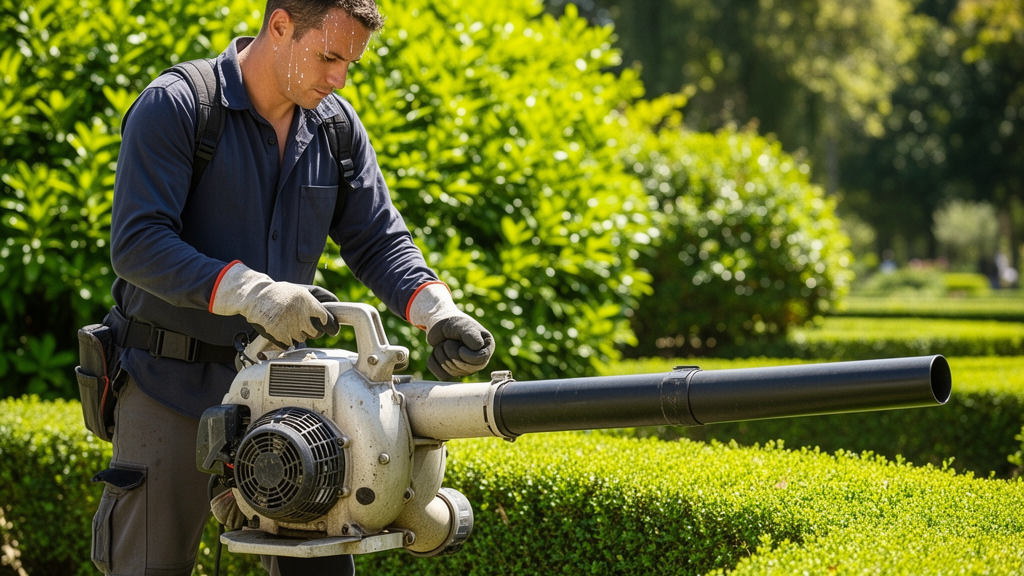
The study protocol evaluated ten adult groundskeepers, comprising one Caucasian worker and nine Hispanic workers, all of whom were biologically male and right-hand dominant. Participants had a mean age of 35.8 years with a range spanning from 21 to 56 years, alongside an average occupational tenure operating vibrating landscape machinery of 14.4 years, ranging between 2 and 32 years. Anthropometric evaluations recorded an average worker height of 161.3 centimeters, an average body mass of 76.8 kilograms, and a mean body mass index of 29.6 kilograms per square meter. The crew was organized into small teams of one to three workers under daily operational task assignments set by their site manager, performing shifts from 6:30 AM to 3:00 PM, separated by an unmonitored lunch break from 11:00 AM to 12:00 PM. Trained research assistants directly observed and documented hourly operational activities, recording routine usage of grass trimmers, backpack blowers, riding blowers, a walk-behind edger, seating mowers, a riding mower, hedge trimmers, and a motorized pole saw under routine field maintenance conditions.
Evaluation of hand-transmitted mechanical vibration followed International Organization for Standardization standards ISO 5349-1 and ISO 5349-2, utilizing Svantek SV103 tri-axial dosimeters worn across both hands throughout the work shifts. Each dosimeter palm adapter was situated directly at the gripping interface between the palm and tool handle, placed beneath work gloves when cloth or nitrile gloves were worn to accurately capture genuine transmitted acceleration without mechanical interference. The devices measured frequency-weighted root-mean-square acceleration across three orthogonal single axes, designated x, y, and z, within one-third octave frequency bands from 0.8 to 1,600 Hertz sampled at one-second intervals. Pre-calibration and post-calibration procedures were executed daily using an SV110 vibration calibrator at an acceleration of 10 meters per second squared across reference frequencies of 79.58 and 159.2 Hertz. In accordance with established field methodologies, transient and unrepresentative acceleration artifacts exceeding 50 meters per second squared were removed prior to downstream computational analyses.
Vibration assessments combined the root-mean-square orthogonal components into the vibration total value, calculated as the square root of the sum of squared single-axis accelerations. Daily vibration exposure values, expressed as standardized eight-hour equivalent daily magnitudes, were derived from individual operating durations relative to an eight-hour reference baseline. Daily hand-arm vibration exposure doses were determined by multiplying mean tool-specific vibration magnitudes by daily operating durations and summing across all tools used by each worker. To estimate cumulative lifetime exposure, researchers administered a standardized questionnaire adapted from the European VIBRISK technical report to capture individual occupational histories, daily tool hours, operating days per week, and lifetime working years. Correlation factors were computed by comparing dosimeter logging records against self-reported questionnaire durations to correct for potential recall inaccuracies, assigning a default factor of 1.0 when direct tool observations were absent or inconsistent, thereby enabling standardized mathematical estimation of lifetime cumulative exposure doses across both hands.
Across all ten groundskeepers, the cohort mean daily vibration exposure was 2.1 plus or minus 0.6 meters per second squared for the right hand and 2.1 plus or minus 0.5 meters per second squared for the left hand. Three individual workers exceeded the action limit of 2.5 meters per second squared on the right hand during at least one monitoring shift, while four workers exceeded that limit on their left hand on at least one day. One participant exceeded the action threshold across all three consecutive monitoring days, recording three-day mean exposures of 3.0 meters per second squared in the right hand and 2.9 meters per second squared in the left hand. Across individual tools, hedge trimmers produced the highest mean vibration total values at 5.4 meters per second squared for the right hand and 6.5 meters per second squared for the left hand, followed closely by grass trimmers at 5.5 meters per second squared on both sides. Conversely, backpack blowers demonstrated the lowest average vibration intensities, measuring 2.3 meters per second squared on the right hand and 1.7 meters per second squared on the left hand.
Total accumulated daily vibration dose varied from 6.2 to 23.7 meters per second squared on the right hand and 4.6 to 23.4 meters per second squared on the left hand across the monitored crew. Seating mowers accounted for the greatest overall proportion of total daily vibration exposure dose at 33.6 percent, driven primarily by prolonged duration of continuous operation rather than raw peak acceleration, followed by grass trimmers at 16.6 percent, backpack blowers at 15.2 percent, and hedge trimmers at 11.0 percent. Lifetime cumulative dose calculations averaged 49,683.3 plus or minus 4,346.1 hour meters per second squared for the right hand and 46,134.5 plus or minus 25,956.3 hour meters per second squared for the left hand, spanning broad ranges of 1,128.5 to 172,333.0 hour meters per second squared and 1,102.4 to 161,462.6 hour meters per second squared, respectively. Grass trimmers generated the highest single lifetime contribution among equipment classes, averaging approximately 14,570 hour meters per second squared across each hand, followed by seating mowers, which contributed approximately 9,830 hour meters per second squared right-handed and 11,793 hour meters per second squared left-handed.
Personal thermal strain was tracked continuously using SlateSafety BAND V2 wearable physiological bands secured with direct skin contact to each participant’s left triceps, positioned proximal to the dosimeter unit while avoiding tattoos or scar tissue. The non-invasive wearable sensors estimated core body temperature at ten-second intervals using real-time photoplethysmography algorithms based on heart rate dynamics, streaming continuous data directly to a cloud monitoring platform while excluding unphysiological values beneath 36.0 degrees Celsius. Concurrently, environmental heat conditions were quantified using a calibrated waterless wet bulb globe temperature monitor alongside a tripod-mounted portable weather station elevated between 1.2 and 1.5 meters adjacent to the active work zones. The monitoring station logged ambient air temperature, relative humidity, and solar radiation, allowing direct calculation of the heat index and wet bulb globe temperature to evaluate environmental stress against proposed federal safety thresholds.
The ambient working conditions reflected typical southeastern summer weather, recording a mean ambient air temperature of 30.3 plus or minus 4.1 degrees Celsius with excursions between 19.5 and 40.1 degrees Celsius, average relative humidity of 59.9 plus or minus 14.5 percent, and solar radiation averaging 217.8 plus or minus 248.5 watts per square meter. The environmental heat index averaged 34.5 plus or minus 5.4 degrees Celsius, during which 90.9 percent of work hours exceeded the proposed Occupational Safety and Health Administration initial trigger of 26.7 degrees Celsius, and 66.0 percent exceeded the proposed high heat trigger of 32.2 degrees Celsius. Measured wet bulb globe temperature averaged 28.4 plus or minus 3.6 degrees Celsius, with 93.4 percent of hours exceeding the heavy workload initial trigger of 23.1 degrees Celsius and 65.4 percent exceeding the heavy workload high heat trigger of 26.7 degrees Celsius. In parallel, participants registered a mean estimated core body temperature of 37.7 plus or minus 0.4 degrees Celsius, with individual averages reaching 38.1 degrees Celsius and peak individual durations above the 38.0 degree Celsius physiological limit reaching 33.0 percent of total work hours.
Statistical evaluation demonstrated no significant linear or monotonic correlations between participant-day summary values of estimated core body temperature and the measured environmental parameters, including ambient air temperature, relative humidity, solar radiation, heat index, and wet bulb globe temperature. Pearson correlation coefficients ranged from negative 0.11 to positive 0.17, while Spearman rank correlation coefficients ranged from negative 0.08 to positive 0.16, with all associations yielding non-significant p-values above 0.05. The researchers observed that physiological thermal strain varied notably between workers even when subjected to identical microclimatic conditions, suggesting that individual metabolic work intensities, hydration habits, body mass composition, and heat acclimatization substantially modulate internal physiological strain. The authors noted several key limitations, including the small cohort of ten male groundskeepers, the pilot three-day monitoring window, and self-reported recall constraints in lifetime vibration records, concluding that integrating personal physiological wearable monitoring with environmental indices offers a more protective framework for managing dual mechanical and heat hazards in outdoor workforces.
Subject of Research: Occupational hand-arm vibration and personal heat stress evaluation among grounds maintenance workers
Article Title: Field-based evaluation of hand–arm vibration (HAV) and heat exposure among grounds maintenance workers in the southeastern United States: a pilot study
Article References: Yang, S., Chen, N., Lungu, C. T., & Oh, J. (2026). Field-based evaluation of hand–arm vibration (HAV) and heat exposure among grounds maintenance workers in the southeastern United States: a pilot study. Journal of Occupational Medicine and Toxicology, 21(1), Article 36. https://doi.org/10.1186/s12995-026-00523-7
Image Credits: AI Generated
DOI: 10.1186/s12995-026-00523-7
Keywords: hand-arm vibration, grounds maintenance workers, heat stress, core body temperature, wet bulb globe temperature, heat index, occupational health, vibration dosimeter, SlateSafety wearable, American Conference of Governmental Industrial Hygienists, Occupational Safety and Health Administration, vibration total value, daily vibration exposure A(8), hand-arm vibration syndrome, lifetime cumulative vibration, environmental heat metrics, southeastern United States
News Source: Ophelia Keating. (November 18, 2026). Southeastern Groundskeepers Face Elevated Hand-Arm Vibration and Severe Heat Stress. Scienmag.