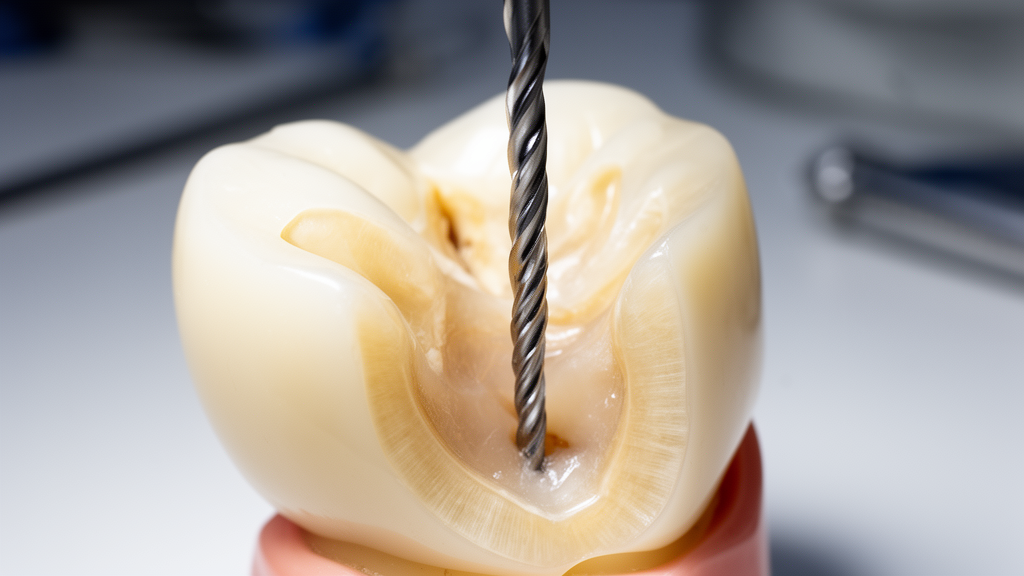
In a finite element study evaluating post space preparation, drill geometry significantly altered stress magnitude, spatial distribution, and cumulative exposure within root dentin. The dynamic simulation demonstrated that an experimental drill design featuring a one-third pitch, designated as the B-type configuration, consistently generated the lowest peak maximum principal stress across both preparation stages. This configuration also produced the lowest combined area under the stress-time curve, demonstrating a relatively favorable stress profile under the simulated operational conditions.
Post space preparation performed following endodontic treatment can induce mechanical stress concentrations within root dentin, thereby increasing the risk of dentinal defects or root fracture. Although drill geometric design is considered a potential factor influencing biomechanical behavior during preparation, the exact effects of different drill designs on root stress distribution remained unclear. To address this uncertainty, researchers evaluated how different geometric designs influence stress patterns during post space preparation using finite element analysis.
To investigate these biomechanical effects, the research team developed a finite element model of a mandibular first premolar. The investigation analyzed five drill configurations, using commercial RelyX Fiber Post Drills (#1 and #2; 3M ESPE) as the control group. Against these commercial controls, the authors evaluated four modified geometric designs that systematically altered drill pitch and cutting edge count to assess their influence on the surrounding root structure.
The four modified configurations included two variations in pitch and two variations in the number of cutting edges. Pitch modifications consisted of a one-half pitch design, designated as A-type, and a one-third pitch design, designated as B-type. The cutting edge modifications evaluated configurations with four cutting edges, designated as C-type, and six cutting edges, designated as D-type. The researchers applied explicit dynamic analysis to simulate a complete two-stage drilling procedure.
During the simulated two-stage drilling procedure, the authors evaluated both the magnitude and spatial distribution of maximum principal stress, or σ_max. In addition to assessing peak stress concentrations, the simulation tracked cumulative stress exposure sustained by the root dentin. Cumulative exposure was quantified through the area under the stress-time curve, abbreviated as AUC, providing a comparative measure of total mechanical stress experienced across the duration of both preparation stages.
The findings revealed that drill geometry markedly influenced mechanical responses within the mandibular premolar model. The B-type drill consistently demonstrated the lowest peak σ_max and the lowest combined two-stage AUC among the tested designs. Conversely, the D-type drill produced the highest peak stresses and the highest cumulative stress exposure. Furthermore, spatial analysis showed that specific geometric modifications resulted in peak stress concentrations in the apical third of the root, whereas other configurations predominantly exhibited peak stress concentrations in the middle third.
Within the limitations of this finite element analysis, the investigators concluded that drill geometry governs stress magnitude, distribution, and cumulative exposure in root dentin during post space preparation. The B-type design exhibited the lowest peak stress in both preparation stages and the lowest combined two-stage AUC under the simulated conditions. The authors highlighted that pitch and cutting edge count directly shape stress patterns, indicating that a reduced pitch design with a moderate number of cutting edges provides a comparatively lower stress response that may inform future instrument design.
Subject of Research: Biomechanical effects of post space preparation drill designs on root dentin stress distribution
Article Title: Effects of post space preparation drill designs on root stress distribution: a finite element analysis
Article References: Chen, R., Li, L., Jiang, L., Tong, X., Guo, R., Zhang, C., & Cheng, H. (2026). Effects of post space preparation drill designs on root stress distribution: a finite element analysis. BMC Oral Health. https://doi.org/10.1186/s12903-026-10472-6
Image Credits: AI Generated
DOI: 10.1186/s12903-026-10472-6
Keywords: post space preparation, root stress distribution, finite element analysis, drill geometric design, root dentin, endodontic treatment, mandibular first premolar, maximum principal stress, area under the curve, RelyX Fiber Post Drills, explicit dynamic analysis, drill pitch, cutting edge geometry, dentinal defects, root fracture, biomechanical behavior
News Source: Ophelia Keating. (November 18, 2026). Reduced Pitch Drill Geometry Lowers Root Stress During Simulated Post Preparation. Scienmag.