A single session of terminal knee extension exercise synchronized with rhythmic auditory cues significantly increased vastus medialis motor unit action potentials in athletes two weeks after anterior cruciate ligament reconstruction, according to a randomized controlled trial published in Knee Surgery & Related Research. Researchers evaluated neuromuscular responses in the vastus medialis muscle during the crucial early postoperative window, observing that performing resistance exercises in time with a metronome elicited greater improvements in motor unit recruitment compared to completing identical exercises at a self-selected pace. The findings indicate that integrating external auditory rhythms into early postoperative rehabilitation protocols may help overcome neural activation deficits commonly seen after surgical ligament reconstruction.
While reconstructive surgery serves as the standard clinical approach to restore structural knee stability, post-surgical recovery remains prolonged and economically burdensome, with combined healthcare and rehabilitation expenses exceeding thirty-eight thousand dollars.
A primary driver of prolonged functional impairment after reconstructive surgery is persistent quadriceps muscle dysfunction, particularly within the vastus medialis component of the extensor mechanism. Conventional rehabilitation modalities, ranging from targeted resistance loading to functional neuromuscular conditioning and electrical stimulation, often leave persistent weakness unresolved, with up to forty percent of surgical patients demonstrating significant strength asymmetries three years after their primary operation.
In the first two weeks following reconstructive surgery, joint swelling and altered sensory signals disrupt normal spinal reflex pathways and create asymmetrical cortical excitability across the cerebral hemispheres. Consequently, standard volitional exercises performed in this initial period frequently fail to drive adequate vastus medialis activation, reinforcing the clinical need for novel therapeutic strategies that specifically address both peripheral muscular capacity and central neural activation pathways.
To investigate whether auditory sensorimotor coupling could bypass or mitigate these early neural activation deficits, investigators designed a randomized clinical trial examining terminal knee extension exercise performed with or without auditory pacing. Synchronizing voluntary physical movements with rhythmic auditory pacing, such as a steady metronome cadence, has demonstrated utility in high-performance sports training and resistance exercise by modulating motor cortex excitability. By engaging auditory-motor networks that encompass the auditory cortex, primary motor cortex, premotor area, supplementary motor area, and cerebellum, rhythmic pacing enhances motor planning and descending neural drive, suggesting a potential clinical application for early postoperative arthrogenic inhibition.
The clinical trial enrolled male and female athletes aged eighteen to forty years who had undergone primary anterior cruciate ligament reconstruction within the previous two weeks and possessed a pre-injury Tegner activity score greater than four. Participants were recruited from Siriraj Hospital and Golden Jubilee Medical Center at Mahidol University, all having received either a bone-patellar tendon-bone autograft or a hamstring tendon autograft. Candidates were excluded if non-weight-bearing restrictions were present, if knee extension range of motion was restricted, if active or passive flexion fell below thirty degrees, or if major secondary musculoskeletal disorders had occurred within the preceding six months.
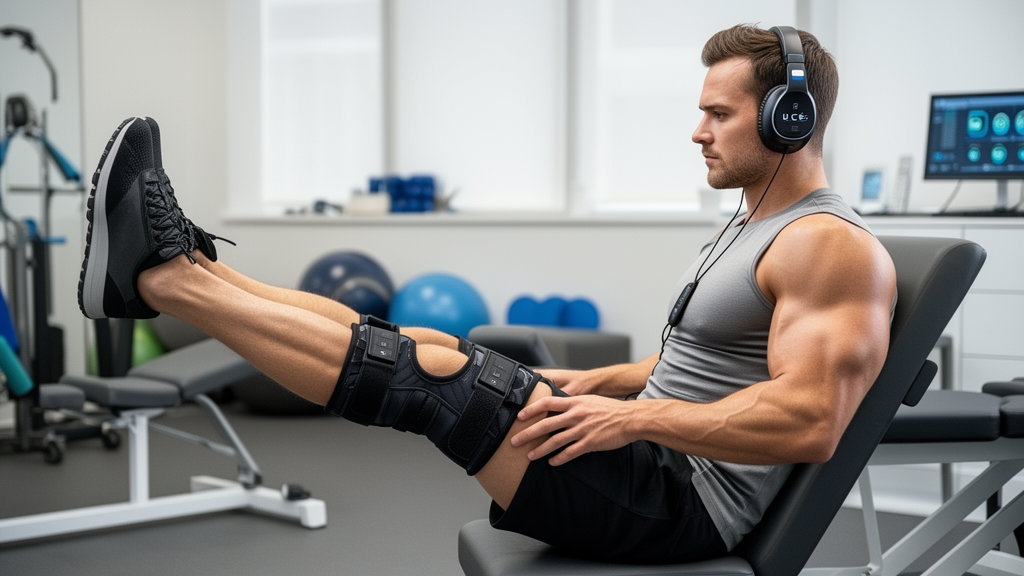
Participants performed the terminal knee extension exercise using an elastic resistance band providing 2.1 kilograms of external tension positioned around the knee joint. Training intensity was controlled across both cohorts at a rating of six to seven on the Borg category-ratio scale, corresponding to approximately seventy percent of single-repetition maximum capacity. The experimental group executed three sets of ten repetitions synchronized with an auditory metronome set at one hertz, while the control group completed three identical sets at a self-selected pace. Both cohorts rested for three minutes between sets, and acceptable pain levels were strictly kept between zero and five on a numeric rating scale. Muscle function was evaluated before and after exercise using four-channel decomposition electromyography sensors placed over the vastus medialis according to standard anatomical guidelines.
Statistical evaluation of decomposition electromyography data demonstrated marked improvements unique to the auditory-cued intervention. The auditory-cued cohort showed statistically significant increases in average motor unit action potential, rising from a baseline median of 43.07 microvolts to 50.33 microvolts, alongside a significant rise in peak motor unit action potential from 55.54 microvolts to 61.69 microvolts. Between-group comparisons confirmed that participants performing terminal knee extension with metronome pacing achieved significantly greater increases in both peak motor unit action potential, with a median increase of 12.59 microvolts versus 6.26 microvolts, and average motor unit action potential, gaining 11.31 microvolts compared to 2.24 microvolts in self-paced controls.
In addition to action potential adaptations, the auditory-cued group demonstrated selective enhancements in vastus medialis firing dynamics and gross muscle activity. Within-group analyses revealed that average electromyographic activity rose from 14.23 microvolts at baseline to 17.60 microvolts post-intervention, while peak motor unit firing rates increased from a mean of 10.50 pulses per second to 12.66 pulses per second. In contrast, participants performing unpaced terminal knee extension showed no statistically significant pre-to-post improvements across any evaluated metric. The observed expansion of motor unit action potential amplitudes indicates greater recruitment of higher-threshold, larger motor units, corroborating the hypothesis that auditory-motor coupling elevates descending central neural drive to counteract postoperative arthrogenic inhibition.
While these findings highlight auditory-cued terminal knee extension as an accessible, safe, and effective acute modality for facilitating vastus medialis recruitment, the authors noted several key limitations. The trial evaluated immediate neuromuscular responses following a single exercise bout; thus, the long-term retention of these adaptations across progressive rehabilitation phases remains uncharacterized. The investigators concluded that larger clinical trials examining multi-week interventions and evaluating functional outcomes are required to confirm whether the immediate neural enhancements generated by auditory pacing accelerate recovery milestones and reduce long-term quadriceps weakness after reconstructive knee surgery.
To capture motor unit adaptations with precision, the investigators implemented a standardized testing and recording protocol before and after the exercise bouts. During testing sessions, participants performed five voluntary knee extension repetitions, holding each contraction for five seconds followed by five seconds of rest, before resting in a seated position for ten minutes to clear acute muscular fatigue. Neuromuscular activity was detected using four-channel decomposition sensors positioned at eighty percent of the distance between the anterior superior iliac spine and the joint space along the medial collateral ligament. Signal reliability was strictly confirmed prior to data collection by preparing the skin site, ensuring baseline electrical noise remained beneath ten microvolts, and verifying green status on the acquisition system’s quality meter. Electromyographic data were sampled at one thousand hertz across a twenty to four hundred fifty hertz bandwidth, while specialized decomposition software isolated individual motor unit firing patterns and action potential waveforms.
Methodological controls were also integrated into participant allocation and statistical design to prevent confounding baseline disparities. The study sample size was determined through statistical power software to achieve eighty percent power at an alpha threshold of 0.05, assuming a large interaction effect size derived from earlier decomposition electromyography investigations. Although thirty-eight post-surgical athletes were initially recruited, sixteen individuals were excluded based on strict safety criteria and two were omitted due to incomplete sensor data. To maintain comparability across the remaining twenty participants, researchers paired individuals across the experimental and control cohorts by balancing biological sex, chronological age within three years, dominant limb, graft selection, concurrent meniscal procedures, and baseline activity scores. Consequently, the groups displayed no statistically significant baseline differences in age, body mass index, or surgical characteristics.
The differential response between decomposition metrics and global surface electromyography underscores important physiological distinctions in how neural drive manifests during early rehabilitation. While action potential amplitudes revealed significant between-group divergence, average electromyography and peak firing rates did not show statistically significant differences between the two training cohorts. Surface electromyography provides only a broad, composite measure of gross muscle activity, whereas decomposed signals offer finer sensitivity to identify distinct changes in motor unit recruitment thresholds and rate coding. Furthermore, the absence of exercise-related adverse events during the protocol supports the viability of auditory-synchronized resistance loading for stimulating vastus medialis neuromuscular pathways without exceeding safe mechanical thresholds.
Subject of Research: Immediate effects of auditory-cued terminal knee extension on vastus medialis neuromuscular recruitment following anterior cruciate ligament reconstruction
Article Title: Auditory-cued terminal knee extension enhances vastus medialis motor unit function in the early phase following ACL reconstruction: a randomized controlled trial
Article References: Nitkotom, S., Lertwanich, P., Kiratisin, P., Suntornon, P., Sonsukong, A., Rangsiyanon, P., Tosapornsupaluck, A., Vachalathiti, R., Areerak, K., Piamthipmanas, T., Chaijenkij, K., & Sinsurin, K. (2026). Auditory-cued terminal knee extension enhances vastus medialis motor unit function in the early phase following ACL reconstruction: a randomized controlled trial. Knee Surgery & Related Research, 38(1), Article 42. https://doi.org/10.1186/s43019-026-00343-3
Image Credits: AI Generated
DOI: 10.1186/s43019-026-00343-3
Keywords: Anterior Cruciate Ligament, ACL Reconstruction, Terminal Knee Extension, Vastus Medialis, Auditory Cueing, Motor Unit Action Potential, Motor Unit Firing Rate, Electromyography, Decomposition Electromyography, Arthrogenic Muscle Inhibition, Neuromuscular Control, Quadriceps Dysfunction, Rehabilitation, Physical Therapy, Sports Injury, Metronome Pacing
News Source: Ophelia Keating. (November 18, 2026). Auditory Cues Enhance Vastus Medialis Function After ACL Reconstruction. Scienmag.