Modern management of multiple sclerosis in Germany has reached a critical juncture where clinical innovation has outpaced the logistical capacity of the healthcare system to deliver it uniformly, according to an expert-informed implementation review published in Neurological Research and Practice. Led by Marc Pawlitzki and colleagues, the nationwide analysis synthesises health-services research and real-world clinical experience, demonstrating that earlier diagnosis, broader access to high-efficacy disease-modifying therapies, and refined longitudinal monitoring protocols have greatly enhanced the potential for favourable long-term patient outcomes. However, these medical advancements have concurrently escalated the necessity for specialised neurological expertise, dedicated infusion facilities, rapid magnetic resonance imaging, structured safety protocols, and cross-sector coordination. The investigators argue that achieving high-quality multiple sclerosis care cannot be treated solely as an individual clinical prescription decision, but must instead be recognized and managed as an inherent property of the overarching healthcare delivery architecture.
To conceptualize the systemic determinants governing care delivery, the authors introduced an analytical framework separating structural healthcare determinants from practical patient-facing elements. Structural conditions are anchored by national regulatory frameworks alongside reimbursement and financing systems, while patient-facing care is driven by dedicated specialty centres and structured intersectoral collaboration between hospitals and outpatient practices. Bridging these distinct levels are two foundational components: comprehensive digitalization across the care continuum and the formal education and clinical specialisation of medical and non-medical professionals. The authors emphasize that whenever any structural pillar remains underdeveloped or bridging mechanisms fail to connect administrative policies with clinical practice, a measurable discrepancy emerges between theoretical therapeutic potential and real-world delivery. German health-services data confirm that this gap is widespread, demonstrating that observed regional variations in therapy initiation, care intensity, and monitoring adherence stem from measurable systemic deficits rather than arbitrary differences in physician prescribing habits.
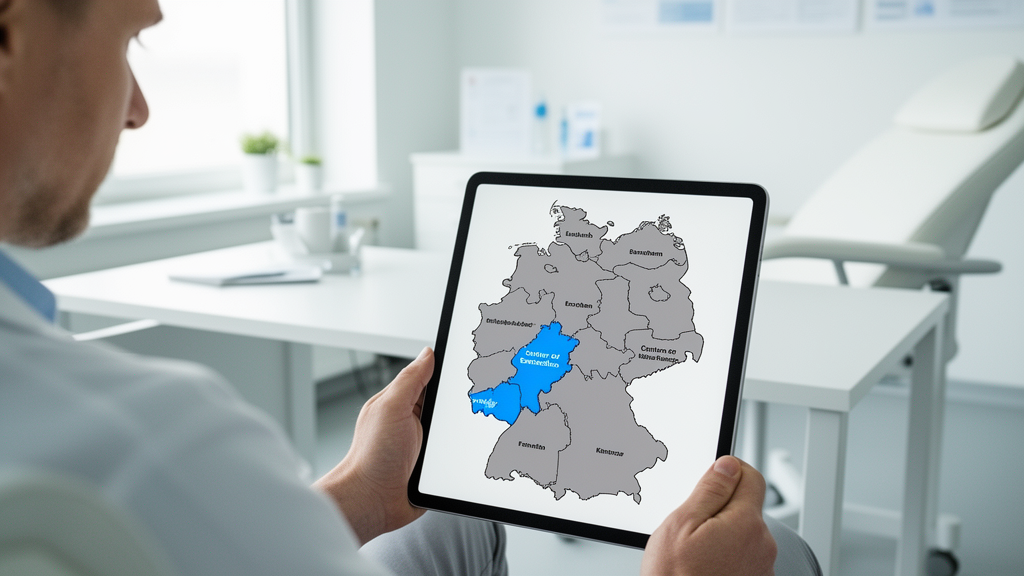
Substantial empirical evidence documents marked geographic disparities in multiple sclerosis treatment across German regions. A nationwide statutory health insurance claims analysis encompassing the period from 2017 to 2022 revealed that nearly half of all individuals diagnosed with multiple sclerosis received no disease-modifying therapies during the multi-year observation window, with regional non-treatment proportions fluctuating between 37.5 percent and 54.0 percent when categorized by postal code areas. While non-treatment can sometimes reflect advanced age, clinical contraindications, progressive disease phases, or informed patient choices rather than clinical undertreatment, the extent of regional variation indicates systematic access discrepancies. Furthermore, a national travel-time investigation showed that while 64.2 percent of the German population can reach a certified specialty centre within thirty minutes by car and 96.5 percent within one hour, prolonged transit burdens remain clinically detrimental for mobility-impaired individuals, exacerbating caregiver strain and impeding adherence to required safety evaluations.
Operational constraints have also restricted the practical implementation of international benchmark guidelines within routine German clinical settings. In a structured survey evaluating brain-health quality benchmarks, German neurological specialists reported that established target intervals for evaluating emerging symptoms, concluding diagnostic workups, and initiating therapies were frequently unachievable in routine practice, even within major urban medical centres, due to acute resource limitations. The feasibility gap is particularly pronounced in the delivery of modern high-efficacy disease-modifying treatments. Although pharmacy dispensing statistics demonstrate a pronounced nationwide shift toward early high-efficacy regimens since 2020, successful long-term administration demands rigorous risk stratification, pre-treatment vaccination reviews, serial safety laboratory panels, infection management, and dependable neuroimaging access. When community neurology practices and regional hospital departments lack integrated scheduling workflows or adequate infusion chair capacity, clinical intentions diverge sharply from everyday practice, creating avoidable treatment delays and safety vulnerabilities.
Shifts in inpatient utilization further highlight the evolving structural pressures placed upon the German healthcare delivery system. A comprehensive analysis of German hospital and day-care admissions between 2019 and 2024 demonstrated an ongoing, regionally uneven migration of routine multiple sclerosis care away from inpatient wards and toward ambulatory settings. Consequently, the cohort of patients remaining within inpatient departments exhibits substantially higher functional disability, clinical complexity, and procedural intensity. Parallel to this trend, demographic ageing among individuals living with multiple sclerosis has amplified the prevalence of multimorbidity, polypharmacy, and severe physical impairment. These complex clinical profiles necessitate structured frameworks for treatment de-escalation, immunotherapy discontinuation, and comprehensive symptomatic management. In response, specialised facilities such as Kamillus Klinik Asbach and Sauerlandklinik Hachen have implemented multidisciplinary inpatient neurological complex treatment programs, which prioritize multidimensional reassessment, medication rationalization, and coordinated outpatient transition planning over isolated functional rehabilitation.
At the ambulatory level, specialized structural initiatives designed to bridge fragmented sectors face administrative and regulatory friction. The Federal Joint Committee established Ambulante Spezialfachärztliche Versorgung for multiple sclerosis, an interdisciplinary ambulatory framework permitting office-based specialists and hospital clinicians to collaborate under unified contractual standards. While this mechanism facilitates multidisciplinary networks encompassing radiology, ophthalmology, neuropsychology, and physical rehabilitation, its routine adoption remains impeded by restrictive participation criteria and administrative overhead. Professional societies, including the Disease-Related Competence Network Multiple Sclerosis and the German Multiple Sclerosis Society, have highlighted that the current reimbursement catalogue excludes coverage for essential diagnostic instruments, such as standardized cognitive assessments, fatigue questionnaires, optical coherence tomography, and serum neurofilament light chain testing. For individuals experiencing severe functional impairment, specialized medical centres for adults with disabilities and dedicated neurological palliative care units, such as that at University Hospital Greifswald, provide vital holistic support.
To overcome geographic isolation and socioeconomic inequalities, several regional healthcare networks have pioneered collaborative clinical models. Analysis of German health data demonstrated that individuals with lower socioeconomic status were significantly less likely to receive high-efficacy disease-modifying drugs, revealing persistent disparities independent of insurance status. In response, LMU Hospital Munich established the Neuroimmunology Network across southern Bavaria, utilizing formal inter-hospital cooperation agreements to extend advanced diagnostic consultations and therapeutic decision support into community facilities. Similarly, St. Vincenz Hospital in Paderborn created an outward-facing ambulatory structure conducting approximately 2,000 annual outpatient visits and maintaining eight infusion stations for roughly 350 immunotherapy patients, supported by continuous liaison with regional politicians and local general practitioners. Complementary high-volume outpatient initiatives in Kassel, which cares for roughly 1,100 patients within ambulatory specialist frameworks, and the Maria Hilf clinic in Mönchengladbach demonstrate that large-scale community care can successfully integrate recurring regional case conferences and investigator-led clinical research.
Addressing chronic workforce shortages requires structural reorganization of clinical duties through formal skill-mix frameworks and task delegation. Routine responsibilities, including safety laboratory screening, vaccination verification, standardized triage, adherence counseling, and patient-reported outcome collection, can be safely transferred to qualified non-physician staff, such as multiple sclerosis nurses and physician assistants. The Papenburg model, situated in a rural district characterized by limited physician density, exemplifies this operational redesign. Operating across a multi-site ambulatory medical care centre managing approximately 22,000 patient contacts per calendar quarter, the program redistributes standardized monitoring and coordination tasks to trained medical assistants and physician assistants. This redistribution preserves physician time for intricate diagnostic evaluations and treatment escalations. The practice maintains direct telemedical and referral links to academic centres in Düsseldorf and Münster, establishing an integrated care corridor that maintains high clinical safety without overburdening regional specialist physicians.
Sustainable expansion of delegated clinical care depends fundamentally on accredited academic curricula that establish transparent competency tiers and formal supervision guidelines. In Germany, structured educational initiatives have emerged to cultivate advanced specialized expertise across professions. A notable institutional development is the four-semester, part-time master of science degree in Multiple Sclerosis Management offered through Dresden International University under the patronage of the German Multiple Sclerosis Society. Accredited in 2019 as an industry-independent academic curriculum, the program provides comprehensive postgraduate training for neurologists, specialized nurses, physical therapists, psychologists, and clinical pharmacists. Delivered largely through a cloud-based digital learning platform, the curriculum covers theoretical neuroimmunology, diagnostic procedures, clinical trial methodology, immunotherapy management, symptomatic rehabilitation, and quality documentation. By fostering a common clinical vocabulary across hospital and community environments, such training initiatives bridge traditional sectoral divides and provide the operational foundation necessary to scale delegated care pathways safely.
Digital health infrastructure serves as the technological engine required to standardize and scale coordinated care pathways across disparate clinical environments. At the Center of Clinical Neuroscience in Dresden, researchers developed a structured multiple sclerosis monitoring matrix that categorizes clinical evaluation into parallel disease-monitoring and intervention-monitoring pathways. This infrastructure supported the QPATH4MS initiative, which utilized a structured Delphi consensus process involving medical experts from Germany, Austria, and Switzerland to establish twenty-four standardized quality indicators governing clinical examinations, neuroimaging intervals, and therapeutic reviews. These digital architectures culminate in comprehensive frameworks such as MS360°, which integrates continuous sensor tracking, home-based digital assessments, and scheduled on-site clinical visits. Through automated algorithmic alerts reviewed by multidisciplinary teams, this hybrid care model enables dynamic risk stratification. Concurrently, hospital-embedded Living Labs, such as that in Dresden featuring the MSPEECH clinic-integrated vocal analysis module, enable rapid, compliant co-development of digital biomarkers under European medical device and data protection regulations.
Translating these diverse regional innovations into a unified national standard requires the coordinated deployment of formal policy instruments and scalable network designs. The Federal Joint Committee Innovation Fund has functioned as a primary incubator, financing targeted research and new models of care, including the TENEAM project in rural Brandenburg and Mecklenburg-Vorpommern, which evaluates structured telemedical pathways for initial patient contact and rapid specialist triage. Ultimately, the authors advocate for the widespread adoption of hub-and-spoke networks, wherein centralized academic hubs manage complex diagnostic confirmations, treatment escalations, and virtual case conferences, while peripheral community spokes oversee routine administration, safety monitoring, and supportive management under unified digital protocols. Future conceptual tools, including artificial intelligence-driven digital twins to simulate therapeutic responses, depend directly on these standardized data infrastructures. The authors conclude that closing regional disparities in German multiple sclerosis care demands four actionable priorities: establishing measurable quality indicators, reimbursing cross-sector coordination, standardizing non-physician delegation, and embedding interoperable digital tools into routine practice.
Subject of Research: Healthcare delivery challenges and regional organizational models for multiple sclerosis care in Germany
Article Title: Delivering high-quality multiple sclerosis care in Germany: challenges and regional models
Article References: Pawlitzki, M., Huntemann, N., Masanneck, L., Werner, N. M., Zimmermann, J., Postert, T., Lassek, C., Meuth, S. G., Gehring, K., Havla, J., Albrecht, P., Ziemssen, T., & Grothe, M. (2026). Delivering high-quality multiple sclerosis care in Germany: challenges and regional models. Neurological Research and Practice, 8(1), Article 75. https://doi.org/10.1186/s42466-026-00531-2
Image Credits: AI Generated
DOI: 10.1186/s42466-026-00531-2
Keywords: multiple sclerosis, healthcare delivery, regional care models, disease-modifying therapies, ambulatory specialist care, ASV-MS, hub-and-spoke networks, task delegation, physician assistants, telemedicine, QPATH4MS, digital patient pathways, MS360, Innovation Fund, TENEAM, neurological complex treatment, health services research
News Source: Ophelia Keating. (November 18, 2026). German Multiple Sclerosis Care Faces Regional Gaps Despite Treatment Advances. Scienmag.