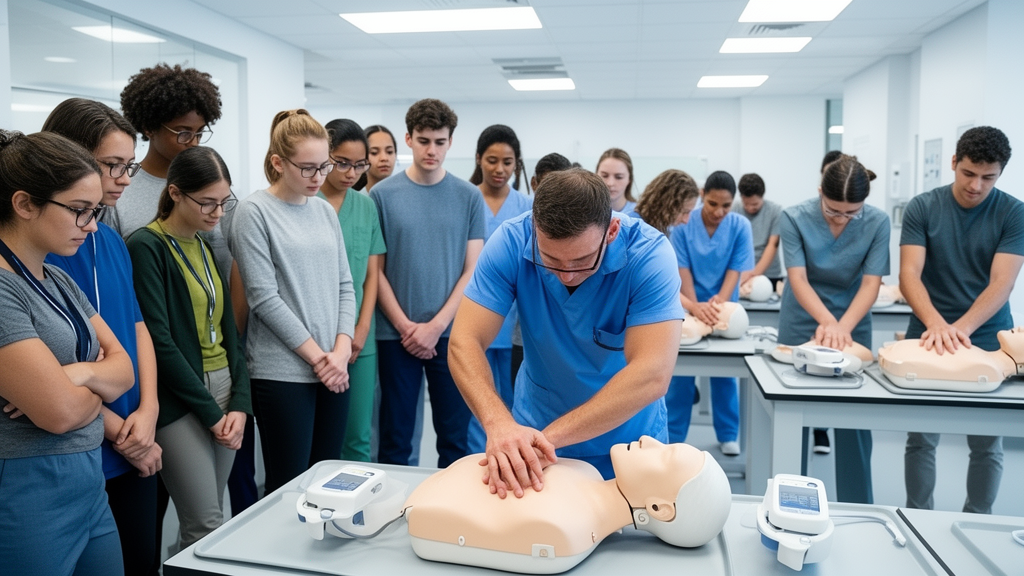
A single-arm quasi-experimental study has demonstrated that certified instructor-led Basic Life Support training successfully brings participants from varied educational backgrounds to a uniform level of theoretical cardiopulmonary resuscitation knowledge. Researchers evaluating practicing healthcare professionals, medical students, and laypeople observed that while initial competence differed substantially, post-training assessment scores converged across all cohorts. These findings indicate that standardized instructional delivery effectively bridges baseline educational disparities in emergency resuscitation principles immediately following structured classroom coursework.
Published in the International Journal of Emergency Medicine, the investigation addressed longstanding challenges in cardiopulmonary resuscitation education and implementation. Although structured training programs routinely enhance critical life-saving techniques and provider attitudes, conventional instructor-led sessions frequently struggle with subjective appraisals of CPR quality. Because practical resuscitation performance often remains suboptimal among both trained clinicians and members of the public, the investigative team sought to objectively measure how certified instruction influences theoretical knowledge acquisition across populations with fundamentally contrasting prior experience.
The research team recruited 285 total participants who registered for certified Basic Life Support courses and categorized them into three distinct cohorts. These study groups comprised practicing healthcare professionals, enrolled medical students, and laypeople possessing no formal medical training background. By comparing these distinct demographics within a single uniform curriculum, the authors aimed to determine whether standardized instruction offers equivalent educational gains or whether existing clinical familiarity dictates the degree of theoretical comprehension achieved during basic life-support training sessions.
To evaluate theoretical competence before and after instruction, the researchers administered an anonymous twelve-question assessment based on official resuscitation guidelines established by the American Heart Association. Every participant completed this identical standardized examination immediately prior to commencing the course and once again directly following the completion of instructor-led training. The investigative protocol compared individual pre-training and post-training scores to quantify precise knowledge gains, evaluating both aggregate cohort performance and group-specific adjustments across individual subject items.
Across the entire study cohort of 285 individuals, theoretical knowledge scores exhibited statistically significant improvement, rising from a pre-test mean of 80.35 percent with a standard deviation of 13.95 percent to a post-test mean of 90.88 percent with a standard deviation of 8.46 percent. Baseline evaluations clearly mirrored each group’s prior professional exposure. Healthcare professionals recorded the highest initial baseline score at 89.18 percent, followed by medical students at 80.34 percent, whereas laypeople started at a baseline of 70.74 percent.
Despite these widely diverging starting baselines, the post-course evaluation demonstrated no statistically significant difference between the three groups, yielding a p-value of 0.378. This lack of post-training divergence confirmed an equitable score convergence among participants regardless of prior background. While the overall cohort, medical students, and laypeople achieved statistically significant improvements with p-values below 0.001, the score increase observed among healthcare professionals did not reach statistical significance, recording a p-value of 0.055 due to their already elevated baseline.
Granular analysis of individual test items revealed subtle distinctions in how different learner populations process emergency resuscitation concepts. Lay participants appeared to encounter a theoretical-practical dissonance, displaying difficulty with the conceptual recall of correct hand positioning and chest compression depth despite completing hands-on practical training. The researchers suggested that novice learners might develop procedural motor memory during physical simulations while their conscious theoretical recollection remains somewhat inconsistent or biased during written testing.
In contrast, healthcare professionals demonstrated only marginal gains regarding the foundational Basic Life Support algorithm. The investigators hypothesized that experienced clinicians experienced cognitive interference, as established clinical workflows and advanced care frameworks competed with the streamlined sequence taught in basic courses. Consequently, the study concluded that while instructor-led courses equalize baseline disparities, novices benefit primarily from algorithmic simplicity, suggesting that future emergency educational assessments must increasingly integrate procedural metrics alongside purely cognitive examinations.
Subject of Research: Cardiopulmonary resuscitation knowledge acquisition through instructor-led basic life support training
Article Title: From diverse baselines to score convergence in cardiopulmonary resuscitation knowledge: a pre-post study on instructor-led training to healthcare professionals, medical students and laypeople
Article References: Nicolau, A., Jorge, I., Lourenço, I., Mendes, G., & Granja, C. (2026). From diverse baselines to score convergence in cardiopulmonary resuscitation knowledge: a pre-post study on instructor-led training to healthcare professionals, medical students and laypeople. International Journal of Emergency Medicine. https://doi.org/10.1186/s12245-026-01404-w
Image Credits: AI Generated
DOI: 10.1186/s12245-026-01404-w
Keywords: cardiopulmonary resuscitation, basic life support, instructor-led training, resuscitation education, theoretical knowledge, score convergence, healthcare professionals, medical students, laypeople, pre-post study, American Heart Association, cognitive interference, theoretical-practical dissonance, chest compression depth, hand positioning, emergency medicine
News Source: Ophelia Keating. (November 18, 2026). Instructor-Led Life Support Training Equalizes Resuscitation Knowledge Across Diverse Backgrounds. Scienmag.