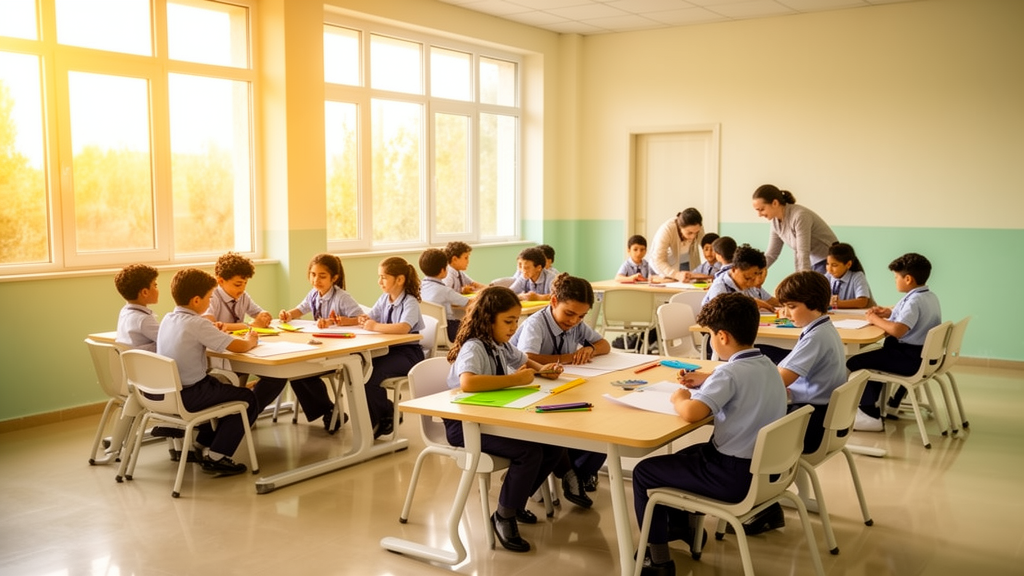
Integrated spatial-functional and psychological support is the greatest predictor of overall occupant satisfaction in primary schools, according to an adjusted regression model evaluating public school facilities across the north and west of Tehran. In the adjusted regression model, this integrated dimension emerged as the primary predictor of overall satisfaction, demonstrating a standardized beta coefficient of 0.762 (p < 0.001). The research utilized post-occupancy evaluation (POE), a methodical approach designed to examine how occupied buildings adapt to the functional, psychological, spatial, and environmental needs of their users. Across the ten evaluated public primary schools, the study assessed how users perceived their day-to-day spatial and environmental conditions.
The evaluation evaluated responses from a total of 768 participants across the ten public schools, comprising 384 kids alongside 384 adults who served as teachers and administrative staff. To gather data, the two groups completed two concurrent, age-appropriate questionnaires regarding environmental and spatial conditions. When evaluating the collected survey responses, researchers discovered that there was no evidence of measurement invariance between the student questionnaire version and the adult questionnaire version. Because measurement invariance between the adult and student versions was not established, the research team selected the adult dataset for the study’s final inferential analyses.
Inferential statistical testing through Pearson correlation analysis demonstrated multiple distinct associations with overall occupant satisfaction. Overall satisfaction was positively correlated with motivational support (r = 0.706), furniture and material quality (r = 0.701), ventilation (r = 0.586), and fresh air availability (r = 0.435). Meanwhile, perceived summer thermal discomfort showed a statistically negative correlation with overall satisfaction (r = −0.327). These measured Pearson correlation coefficients establish the direct associations between satisfaction, specific thermal and air quality factors, material provisions, and supportive spatial conditions within the evaluated public primary schools.
To investigate the underlying structure of the 24 preserved questionnaire items, the researchers conducted an exploratory factor analysis. This exploratory factor analysis determined that four distinct dimensions accounted for 54.48 percent of the total variance in the evaluation. The four identified dimensions were Integrated Spatial-Functional and Psychological Support, Indoor Environmental and Sensory Quality, External Environmental Protection, and Spatial Legibility and Circulation.
According to the researchers, these documented outcomes indicate perceived priorities for further architectural, operational, and technical research in school environments. In addition to outlining these research priorities, the findings support the adoption of a multifaceted, user-sensitive approach to school post-occupancy evaluation.
Subject of Research: Post-occupancy evaluation of environmental and spatial conditions in primary schools
Article Title: A multi-user post-occupancy evaluation of perceived environmental and spatial conditions in Tehran primary schools
Article References: Ilbeigi, M., Ghomeishi, M., Asgharzadeh, A., & Amani, N. (2026). A multi-user post-occupancy evaluation of perceived environmental and spatial conditions in Tehran primary schools. City, Territory and Architecture. https://doi.org/10.1186/s40410-026-00339-2
Image Credits: AI Generated
DOI: 10.1186/s40410-026-00339-2
Keywords: post-occupancy evaluation, primary schools, school architecture, environmental quality, spatial conditions, occupant satisfaction, Tehran, indoor environmental quality, motivational support, furniture quality, classroom ventilation, fresh air availability, summer thermal discomfort, exploratory factor analysis, regression modeling, measurement invariance, spatial legibility
News Source: Denise Maddox. (November 18, 2026). Spatial and Psychological Support Strongly Predicts Tehran Primary School Occupant Satisfaction. Scienmag.