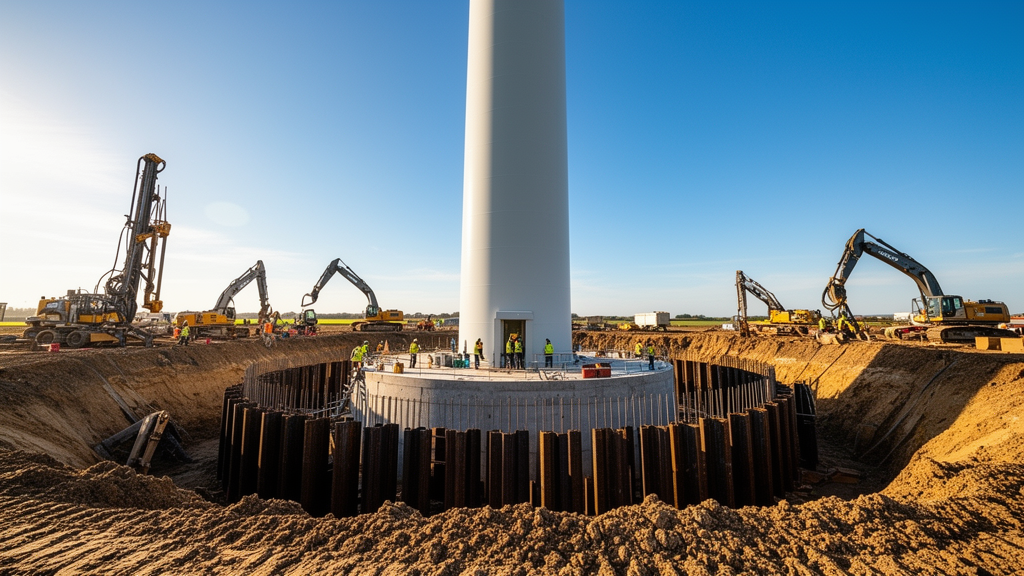
A structural engineering investigation has demonstrated that aging onshore wind turbine foundations can be safely repowered to support much larger, modern generation equipment without undergoing complete demolition. Reporting in the International Journal of Concrete Structures and Materials, a research team led by Haijun Wang evaluated an innovative retrofit approach based on an actual wind farm upgrade project in Shandong Province, China. Rather than tearing out the aging concrete substructures, the proposed strategy underpins the existing octagonal spread foundations from below with a newly poured concrete substructure while structurally anchoring the existing embedded steel foundation ring. Numerical simulations and code-compliant design evaluations revealed that this composite configuration coordinates load-bearing behavior effectively between the old and new structural components. The retrofit successfully meets national engineering safety criteria under both routine operational loads and severe storm conditions, establishing an empirical precedent for repowering aging wind infrastructure while curbing construction disturbance, solid waste generation, and environmental impacts.
The rapid expansion of the wind power industry over recent decades has brought early-generation assets to the end of their operational service lives. Across many early wind installations, turbines originally commissioned with small unit capacities and lower energy conversion efficiencies are slated for replacement with high-capacity, technologically advanced machines. In China, where installed wind capacity has grown swiftly, repowering existing wind sites represents a primary avenue for maximizing asset productivity and optimizing grid output. However, older foundations were engineered specifically to resist the lower dynamic and overturning forces generated by early, low-capacity generators. Subjecting these legacy concrete bases directly to the heightened operational demands of modern multi-megawatt turbines presents severe structural vulnerabilities, including excessive tower inclination, severe concrete cracking, foundation detachment, and potential structural collapse. Consequently, project developers conventionally demolish the legacy foundation entirely to build an expansive, deep-set replacement foundation capable of carrying the heavier dynamic loads.
To assess a sustainable alternative to wholesale demolition, the researchers focused on an engineering retrofit project at an onshore wind farm in Shandong Province initially commissioned in 2011. The operational facility contained forty-five Gamesa 0.85-megawatt wind turbines mounted on octagonal extended spread foundations constructed from C35 concrete with embedded steel connection rings. Each original foundation had an embedment depth of approximately 2.9 meters, an octagonal base side length of 5.9 meters, a side-to-side width of 14.244 meters, a footprint surface area of 168.08 square meters, and a total concrete volume of 281 cubic meters. The planned site upgrade called for decommissioned units to be replaced with heavy-duty 7.5-megawatt wind turbines. Under a conventional full-demolition design, the required new circular spread foundation would require a diameter of 23 meters, an embedment depth of approximately 4.8 meters, and C40 concrete, expanding the foundation depth by 1.9 meters and the lateral footprint outward by 4.378 meters on each side while widening the central pedestal by 1.45 meters.
Prior to designing the composite structural scheme, field engineers conducted core extraction and mechanical testing to verify the structural integrity of the existing foundation concrete. Because the internal concrete quality of aged substructures cannot be assumed uniform, engineers selected foundation units demonstrating an absence of visible surface cracking, material deterioration, or ring-interface damage after long-term service. Technicians extracted three intact cylindrical core specimens from representative structural locations on a typical turbine base, collecting one sample adjacent to the steel foundation ring, one from the elevated pedestal, and one from the expanded octagonal footing corner. Laboratory compression tests revealed that the cores exhibited an estimated compressive strength of 45 megapascals and a representative compressive strength of 50.57 megapascals. Both measurements substantially exceeded the design requirements for C35 concrete, confirming that the foundation material maintained robust compressive capability and possessed sufficient mechanical soundness to support an underpinning retrofit.
The engineering team developed an integrated strengthening scheme inspired by hybrid wind tower substructures, eliminating post-installed rebar drilling into the aged core by repurposing the existing steel foundation ring as the primary structural connector. In this system, high-strength threaded rebars attach to the steel foundation ring, while the newly poured concrete footing extends directly beneath the existing octagonal base to provide comprehensive vertical underpinning. The interface between the existing concrete and the new casting was mechanically roughened and reinforced with welded rebar ties, and the overlying backfill soil was utilized to provide essential counterweight stabilization. To establish a rigorous safety margin, the structural engineers made the conservative design assumption in their analytical code calculations that the structural bearing capacity of the legacy concrete should be completely neglected, crediting the original block strictly as a passive dead-weight counterweight. Material calculations demonstrated that this reuse configuration lowered overall concrete consumption by 7.32 percent and reduced earthwork excavation volume by 40.7 percent compared to the complete demolition baseline.
Subgrade bearing capacity, overturning stability, and sliding resistance were analytically verified in accordance with China’s design standard for onshore wind turbine foundations, NB/T 10311-2019, under standard normal operating and extreme storm load combinations. When subjected to normal eccentric operational loading, the calculated maximum foundation base pressure reached 238.62 kilopascals, which safely satisfies the allowable limit of 360 kilopascals established for the site’s strongly weathered basalt subgrade, which has a characteristic bearing capacity of at least 300 kilopascals. The minimum subgrade reaction was positive at 6.45 kilopascals, verifying that the foundation base retained full surface contact with the supporting ground. Under extreme loading combinations, the peak contact pressure of 265.80 kilopascals remained below allowable criteria, and the resulting ground separation area accounted for only 6.21 percent of the total footprint, comfortably below the code ceiling of 25 percent. Overturning stability ratios were calculated at 4.22 under normal operation and 3.42 under extreme loads, well above the 1.6 safety threshold, while sliding stability safety factors reached 16.88 and 14.36 against a minimum allowable limit of 1.3.
Structural member checks for the composite foundation slab and central pedestal confirmed full compliance with statutory limit states for flexure, shear, punching shear, and cracking behavior. In the structural reinforcement analysis, the new foundation slab was evaluated as an equivalent flexural cantilever member with an effective depth of 1.29 meters carrying the operational loads transmitted from the tower. Inclined cross-section shear evaluation determined that the pedestal region sustained a maximum shear demand of 1410.56 kilonewtons, falling well below the calculated unreinforced shear resistance capacity of 2974.25 kilonewtons. Downward punching shear verification for the slab showed an applied force of 49380.95 kilonewtons against a designated punching shear capacity of 56157.41 kilonewtons across the failure boundary. Furthermore, under normal service load combinations, the calculated maximum crack opening width for the reinforced concrete foundation slab was 0.153 millimeters, remaining strictly within the mandatory engineering tolerance of 0.2 millimeters to prevent reinforcement corrosion and moisture ingress.
To examine local stress distributions and interfacial load-transfer mechanics that analytical formulas cannot fully capture, the researchers developed a three-dimensional finite element model within the ABAQUS software suite. The full numerical domain comprised 321,057 nodes and 287,759 elements, utilizing 284,859 three-dimensional eight-node solid continuum elements and 2,900 embedded two-node truss elements representing internal rebar cages, high-strength threaded rods, and prestressed steel tendons. Subgrade soil strata were represented using a Mohr-Coulomb elastoplastic constitutive model with depth-stratified geotechnical properties derived from boreholes, fixed along the bottom boundary and restrained laterally against horizontal translation. Interfacial contact between concrete and soil was modeled using hard normal behavior and tangential penalty friction with a coefficient of 0.35, matching the frictional formulation defined along the interface between the existing and newly placed concrete. Surface interaction between the steel foundation ring and surrounding concrete matrix was modeled with a friction coefficient of 0.5.
Initial elastic simulations analyzed a new foundation designed with an octagonal underpinning geometry matching the outline of the original base, revealing pronounced stress concentrations at the geometric corners. Under normal and extreme loading, maximum tensile stresses in the octagonal underpinning corners reached 7.857 megapascals and 11.26 megapascals, respectively, while maximum pedestal contact compressive stresses reached 19.31 megapascals and 31.76 megapascals. To eliminate these sharp geometric discontinuities, the researchers modeled an optimized circular underpinning configuration, which yielded continuous axisymmetric load dispersion. This circular geometry lowered peak normal tensile stresses to 5.695 megapascals and extreme tensile stresses to 8.13 megapascals, representing consistent stress reductions of 27.5 percent and 27.8 percent, respectively. Notably, the circular underpinning achieved this stress reduction despite reducing the underpinning concrete volume from 22.03 to 15.16 cubic meters and trimming its contact bearing area from 44.05 to 30.32 square meters, proving that smooth geometric curvature effectively alleviates localized stress accumulation.
Nonlinear finite element analysis utilizing the Concrete Damaged Plasticity constitutive model provided advanced insight into localized cracking risks and load-sharing dynamics within the circular underpinning assembly. Under extreme load combinations, tensile stresses in the base slab reached 4.2 megapascals, exceeding the characteristic tensile strength of 2.39 megapascals for C40 concrete, while tensile stresses at the underpinning interface directly beneath the original footing edge reached 2.5 megapascals. Meanwhile, compressive stresses at the lower anchor plate interface reached 49.3 megapascals under extreme loads, closely approaching the 50.2 megapascal standard capacity of the high-strength grout. Crucially, the internal rebars remained entirely within their elastic range, reaching peak stresses of only 53.48 megapascals and ensuring reliable crack-bridging capability. Cross-sectional force extractions proved that the new foundation carried approximately 63.6 percent of the total reaction force and 73.9 percent of the overturning moment, confirming that while the new substructure absorbs the primary load, the legacy foundation actively participates in composite load-bearing behavior, validating the underpinning strategy as a structurally sound solution for wind farm repowering.
Subject of Research: Structural engineering evaluation of onshore wind turbine foundation reuse and underpinning for repowering
Article Title: Numerical Investigation on Repowering Aging Onshore Wind Turbine Foundations Through a Reuse Strategy: An Engineering Case Study
Article References: Wang, H., Zhang, X., Zhang, X., Guo, Y., Hao, X., Zhao, N., Hao, H., He, S., & Liang, T. (2026). Numerical Investigation on Repowering Aging Onshore Wind Turbine Foundations Through a Reuse Strategy: An Engineering Case Study. International Journal of Concrete Structures and Materials, 20(1), Article 100. https://doi.org/10.1186/s40069-026-00979-1
Image Credits: AI Generated
DOI: 10.1186/s40069-026-00979-1
Keywords: wind turbine foundations, onshore wind repowering, structural underpinning, composite foundation systems, finite element analysis, concrete damaged plasticity, subgrade bearing capacity, overturning stability, sliding resistance, ABAQUS simulation, foundation ring, high-strength threaded rebars, stress concentration, circular underpinning, demolition waste reduction, Mohr-Coulomb plasticity
News Source: Faith Mcneil. (November 18, 2026). Underpinning Aging Wind Turbine Foundations Enables Safe Repowering Without Demolition. Scienmag.