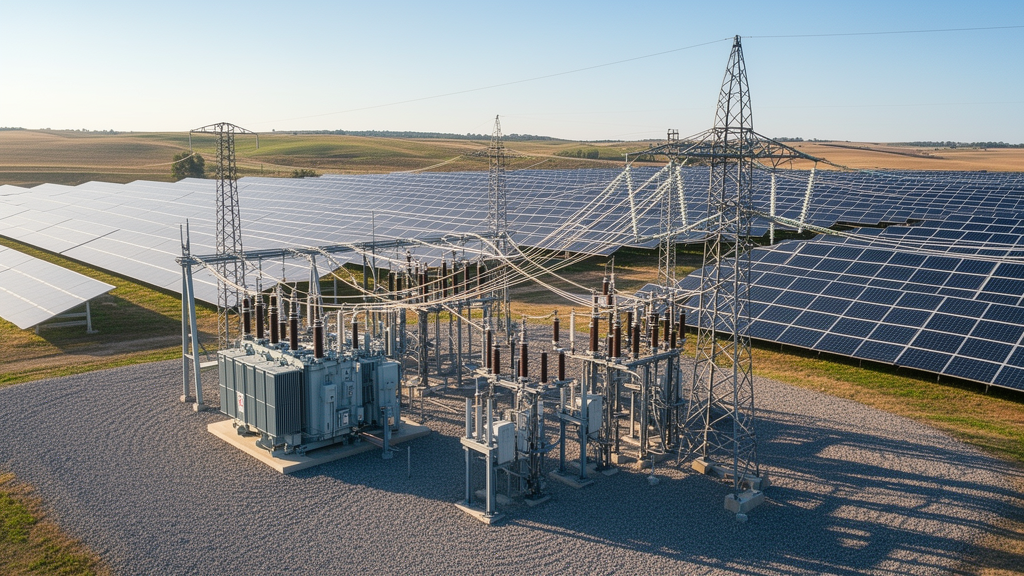
With the increasing integration of distributed photovoltaics into power distribution systems, traditional power flow calculation methods have faced significant challenges regarding convergence speed and parallel efficiency. To address these computational bottlenecks in modern, large-scale power systems, researchers have developed a parallel power flow solving method known as admittance reconstruction and subnetwork collaboration, or ARSC-PF. The study aims to enhance the grid’s ability to maintain robust performance under the dynamic demands of contemporary electrical distribution.
The ARSC-PF approach introduces two primary technical innovations. First, the method employs an error-convergence-driven, asynchronous, iterative mechanism that dynamically identifies and prioritizes localized weak regions within the grid for targeted computation. Second, it utilizes a load-conducting, equivalent injection strategy that facilitates effective electrical decoupling and parallel modeling among subnetworks, allowing for more efficient distribution of the computational load.
Testing on standard IEEE systems and real grid datasets demonstrated notable performance improvements. In simulations conducted on the IEEE 300-node system, the ARSC-PF method achieved a maximum voltage error convergence accuracy of 10^-6 p.u., marking a substantial enhancement over the improved Newton-Raphson method, which reportedly stagnated near 10^-3 p.u. Additionally, in a larger-scale simulation involving 5,000 nodes, the researchers observed a 32 percent reduction in boundary response delay compared to traditional centralized methods.
Beyond computational speed and convergence accuracy, the method provides improved stability under conditions of high photovoltaic penetration. The research findings indicate that ARSC-PF reduces the maximum voltage deviation range by nearly 50 percent, demonstrating an enhanced capacity for disturbance recovery. These results suggest that the method offers a potential technological pathway for bridging the gap between detailed physical grid models and the requirement for scalable computational strategies in heterogeneous power systems.
The research investigates the increasing computational demands of power distribution systems as distributed photovoltaics become more prevalent. By employing admittance reconstruction alongside subnetwork collaboration, the proposed ARSC-PF framework focuses on resolving the specific bottlenecks observed in conventional calculation methods. This study validates the methodology through diverse testing scenarios, specifically benchmarking against the improved Newton-Raphson method on IEEE 300-node models. The team measured key variables including voltage error convergence, boundary response delay, and general system stability under high-load conditions. These experiments reveal that the asynchronous, iterative mechanism allows the grid to prioritize computational resources toward localized weak regions effectively. Consequently, the framework demonstrates a clear improvement in handling heterogeneous power systems. By prioritizing these specific modeling strategies, the research offers a viable approach for maintaining robustness within increasingly complex, large-scale modern electrical distribution.
Subject of Research: Power system optimization and parallel computation
Article Title: Iterative method for grid power flow decoupling based on error convergence coefficient and load equivalence injection
Article References: Ye, C., Li, J., Xiong, L., Jiang, K., Xiao, M., Ao, Y., & Xu, X. (2026). Iterative method for grid power flow decoupling based on error convergence coefficient and load equivalence injection. Discover Applied Sciences. https://doi.org/10.1007/s42452-026-09929-8
Image Credits: AI Generated
DOI: 10.1007/s42452-026-09929-8
Keywords: power distribution systems, photovoltaics, grid stability, admittance reconstruction, subnetwork collaboration, power flow calculation, iterative mechanism, electrical decoupling, IEEE standard systems, grid efficiency, computational modeling, load equivalence, voltage deviation, network response, large-scale grids
News Source: Denise Maddox. (November 18, 2026). Admittance Reconstruction Method Enhances Power Flow Stability in PV-Integrated Grids. Scienmag.