A staged surgical strategy combining titanium mesh-assisted bone grafting with inferior alveolar nerve repositioning successfully enabled stable dental implant rehabilitation in a patient with congenital posterior tooth absence, according to a case report published in BMC Oral Health. The clinical intervention addressed severe developmental alveolar bone deficiency in the lower jaw, allowing clinicians to place standard-length fixtures despite substantial anatomical limitations.
Congenital mandibular posterior tooth agenesis is frequently associated with developmental alveolar bone deficiency across the edentulous region. This anatomical condition commonly manifests as insufficient ridge width, restricted vertical bone height, and significantly reduced bone volume situated above the inferior alveolar nerve canal. In clinical practice, these anatomical constraints increase the difficulty of surgical implant placement and substantially limit the applicability of conventional dental implant protocols.
Consequently, clinicians often face considerable difficulty when attempting to balance alveolar bone reconstruction, inferior alveolar nerve protection, and stable implant-supported rehabilitation in patients with congenital agenesis. The researchers reported that managing such developmental deficiencies requires careful surgical planning to prevent permanent nerve injury while attempting to reconstruct a functional and structurally adequate alveolar ridge contour.
The clinical case involved a 25-year-old female patient who presented with congenital absence of her left mandibular posterior teeth alongside impaired masticatory function. Preoperative evaluation using cone-beam computed tomography revealed severe alveolar bone deficiency in the edentulous area. The diagnostic imaging documented only 5 to 7 millimeters of residual bone height above the inferior alveolar nerve canal and a severely narrow ridge width measuring just 2 to 3 millimeters.
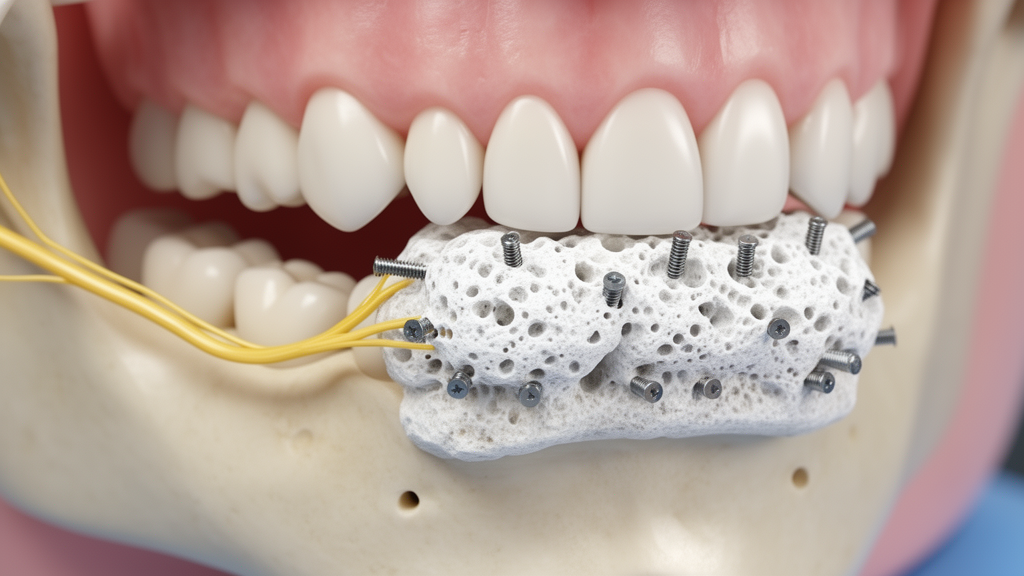
Faced with these horizontal and vertical bone deficiencies, the surgical team adopted a staged treatment strategy. During the first surgical stage, clinicians carried out titanium mesh-assisted bone grafting specifically to reconstruct the alveolar ridge contour. This initial reconstructive procedure was designed to rebuild the necessary bone morphology before attempting any implant fixture placement or neural manipulation.
In the subsequent surgical stage, the team executed an inferior alveolar nerve repositioning procedure combined with guided bone regeneration and the simultaneous placement of standard-length dental implants. Postoperative monitoring demonstrated favorable early mechanical integration within the augmented site, with an evaluation at six months postoperatively yielding an implant stability quotient of 70.
Follow-up assessments conducted at one year postoperatively confirmed favorable outcomes, with the dental implants remaining clinically stable and masticatory function evaluated as satisfactory. Follow-up radiographs revealed no peri-implant radiolucency around the fixtures at the one-year evaluation. Additionally, postoperative lower-lip hypoesthesia experienced by the patient showed marked clinical improvement over time, with no evidence of progressive sensory disturbance.
The study authors concluded that a staged strategy combining titanium mesh-assisted bone augmentation and inferior alveolar nerve repositioning was technically feasible for this single patient presenting with severe horizontal and vertical bone deficiency. However, the researchers emphasized that because the report describes an isolated case with only one year of follow-up, it does not demonstrate superiority over alternative clinical treatment strategies. They noted that further clinical evidence and extended long-term follow-up are necessary to fully assess the predictability, safety profile, and definitive indications of the combined procedure.
Subject of Research: Staged implant rehabilitation for congenital mandibular posterior tooth agenesis
Article Title: Staged implant rehabilitation using customized titanium mesh for bone augmentation combined with inferior alveolar nerve repositioning for congenital mandibular posterior agenesis: a case report
Article References: Wang, Y., Chen, S., Fang, J., Sun, X., & Zhou, Y. (2026). Staged implant rehabilitation using customized titanium mesh for bone augmentation combined with inferior alveolar nerve repositioning for congenital mandibular posterior agenesis: a case report. BMC Oral Health. https://doi.org/10.1186/s12903-026-10488-y
Image Credits: AI Generated
DOI: 10.1186/s12903-026-10488-y
Keywords: mandibular posterior agenesis, tooth agenesis, dental implants, titanium mesh, bone augmentation, inferior alveolar nerve, nerve repositioning, guided bone regeneration, cone-beam computed tomography, alveolar bone deficiency, implant stability quotient, lower-lip hypoesthesia, masticatory function, staged implant rehabilitation, alveolar ridge reconstruction, case report
News Source: Ophelia Keating. (November 17, 2026). Staged Bone Grafting and Nerve Repositioning Support Mandibular Implants in Case Report. Scienmag.