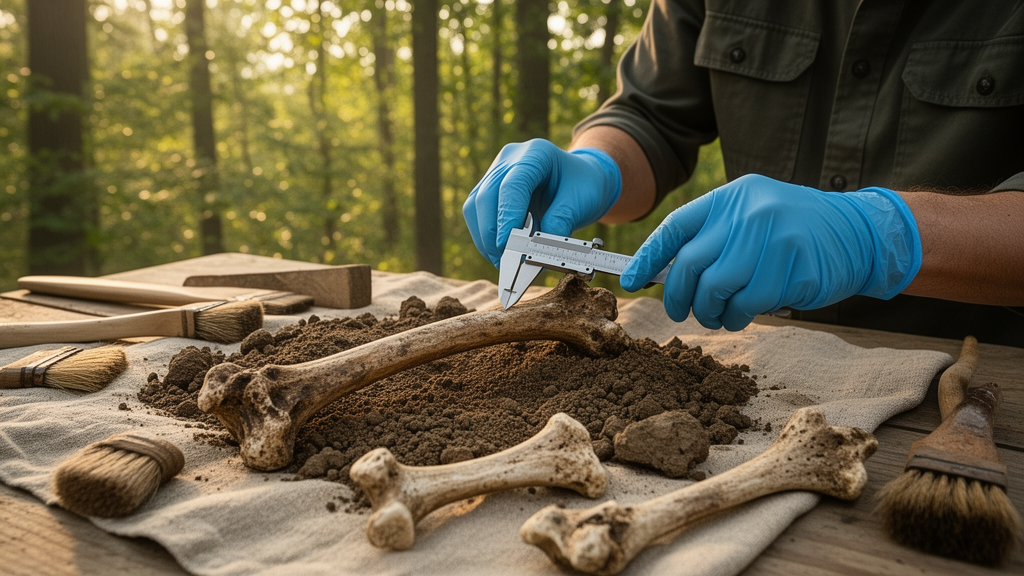
A standardized dry bone scoring system developed on buried domestic pig carcasses fails to capture the degradation patterns observed on human skeletal remains, according to an extensive taphonomic study analyzing historic mine assemblages from South Africa. Researchers tested the porcine-derived criteria on the excavated remains of sixty individuals from two distinct historic mining cemeteries, revealing statistically significant discrepancies across multiple categories of environmental degradation. The study demonstrated that species-specific differences in bone architecture, varying burial microenvironments, and cultural interments profoundly alter skeletal alterations over time. Because domestic pigs have historically served as the primary biological proxies for human taphonomy when cadaveric experiments are constrained by ethical or logistical hurdles, these findings establish critical empirical boundaries for forensic reconstructions and bioarchaeological interpretations in African taphonomic settings.
Taphonomy investigates the post-mortem physical and environmental processes that dictate how soft tissue decomposes and how bones degrade from death until recovery. While taphonomic frameworks originated in palaeontological analyses of fossil preservation, the discipline has expanded into forensic medicine to clarify how variable conditions alter skeletal remains. In terrestrial environments, factors including soil pH, groundwater percolation, ambient temperature, humidity, and subterranean fauna govern bone degradation. Pig remains are frequently chosen in forensic experimentation because their torso volume, skin, and organ layouts resemble human anatomy. However, mammalian skeletal microstructure differs fundamentally between the two species. Domestic pig skeletons consist predominantly of plexiform bone tissue organized in laminar arrangements, whereas human cortical bone comprises dense Haversian systems characterized by cylindrical osteon units. These microstructural architectures respond differently to diagenetic dissolution, physical loading, and long-term environmental stress.
To evaluate the applicability of animal taphonomy frameworks to humans, the researchers examined skeletal assemblages recovered from two distinct South African industrial contexts: the Koffiefontein diamond mine in the Free State Province and the Witwatersrand Deep gold mine in Gauteng. The Koffiefontein site represents an arid to semi-arid landscape characterized by roughly 300 millimetres of annual rainfall, sandy soils rich in alkaline minerals, and uncoffined paupers’ burials dating to late nineteenth- and early twentieth-century diamond mining operations. The thirty selected Koffiefontein skeletons had rested in unmarked, approximately six-foot-deep graves for over a century. By contrast, the Witwatersrand Deep cohort comprised thirty indentured Chinese miners excavated in 1951 from an unmarked cemetery in Boksburg. These individuals were buried in wooden coffins in a temperate Highveld climate with approximately 700 millimetres of annual rainfall, where historic gold mining dumps produced extensive acid mine drainage and groundwater acidification.
The evaluation applied an adapted regional inventory modeled after the Total Body Score framework, segmenting each skeleton into six anatomical zones: the head and neck, the trunk, and independent left and right upper and lower limbs. Each bone was scored across six primary taphonomic alterations established in previous porcine Highveld field studies: depositional soil staining, subaerial or subterranean bone weathering, plant root activity, adipocere formation, acidic soil corrosion, and animal scavenging. When comparing the thirty Koffiefontein individuals to the baseline sample of thirty-nine buried pigs, researchers documented statistically significant divergences across almost every alteration. Depositional soil staining, plant activity, and adipocere formation showed statistically significant divergence across all anatomical regions at the p < 0.001 threshold, while acidic soil corrosion and bone weathering demonstrated regional significance at p < 0.024 and p = 0.026 respectively, with animal scavenging being the lone unaltered category exhibiting parity.
Disparities in weathering and mechanical degradation highlighted the structural differences between porcine and human bone. Among the human remains from Koffiefontein, 76.7 percent exhibited bone cracking, and 16.7 percent of the combined limb zones displayed severe fragmentation, compared to only 2.6 percent in the buried pig cohort. Porcine bones, composed of laminar plexiform architecture, resist brittle fracturing differently than human Haversian bone, which exhibits lower fracture resistance under cumulative physical diagenesis. Burial duration and position also governed these physical modifications. While the baseline pig carcasses had undergone six years of subterranean exposure on their right sides, causing localized unilateral decomposition, the historic human remains had rested supine for more than a century. The long post-mortem interval exposed the human skeletons to protracted mechanical settling and moisture fluctuations, demonstrating that short-term animal experiments cannot replicate century-scale skeletal degradation.
Subterranean botanical interaction also diverged markedly between species assemblages due to grave depth and vegetative regimes. Approximately 97 percent of the pig carcasses, interred at shallow depths of roughly one metre beneath open grasslands, presented severe root infiltration and invasive cortical damage. In contrast, 66.5 percent of the Koffiefontein human individuals showed superficial dendritic root etching, and only 5.5 percent exhibited deep structural root destruction. The historic human graves were excavated to depths of nearly two metres within disturbed mine grounds where mining operations and semi-arid conditions severely limited floral colonization. The differences in canal density and tensile strength between human lamellar bone and porcine plexiform bone further altered the susceptibility of cortical surfaces to microscopic root infiltration and chemical etching.
Chemical degradation patterns in surrounding sediments drove stark variations in cortical corrosion and soft tissue preservation. In the baseline porcine study, 66.7 percent of the animal skeletons exhibited partial to extensive corrosion from moderately acidic Highveld soils with pH levels between 4.30 and 4.57. Conversely, 86.7 percent of the Koffiefontein skeletons exhibited no acidic corrosion. Koffiefontein’s diamond deposits reside within Kimberlite pipes rich in alkaline carbonate minerals, such as calcium and magnesium, which buffer groundwater and neutralize subterranean acids. Furthermore, while 87.2 percent of the buried pig sample produced adipocere, or grave wax, through anaerobic fat hydrolysis in saturated soils, zero Koffiefontein individuals showed adipocere formation. Instead, four Koffiefontein individuals exhibited natural mummification across multiple anatomical regions, reflecting rapid desiccation facilitated by large-grained, well-draining sandy sediment in an arid microclimate.
Depositional soil staining exhibited the most pronounced discordance between animal criteria and human remains, necessitating substantial modifications to the original porcine scoring system. Porcine remains displayed extensive dark and black discolouration caused by localized cadaveric decomposition islands, where decomposing soft tissue introduced fluids and elevated organic matter into the immediately surrounding sediment. In the century-old human burials, however, organic decomposition fluids had dissipated long ago, and black staining was entirely absent. Instead, human skeletal elements displayed a diverse spectrum of mineral discolouration, including mottled reddish-brown hues, yellowish-brown tones, and striking green, pink, and purple stains. These unique chromatic alterations arose from decomposing grave goods, including copper bracelets, rings, buttons, and metal buckles, representing cultural depositional variables that never occur in animal research models.
When the authors applied the amended scoring criteria to contrast the Koffiefontein diamond mine remains against the Witwatersrand Deep gold mine assemblage, environmental and cultural variables proved decisive. Skeletal completeness differed significantly between the two human populations (p < 0.035), with Koffiefontein individuals averaging 81.3 percent preservation compared to just 37.8 percent among the Witwatersrand Deep cohort. Witwatersrand Deep skeletons suffered severe bone weathering (83.3 percent) and pervasive acidic soil corrosion (73.3 percent), driven by sulfuric acid generated from oxidizing pyrite in surrounding gold mine tailings. Furthermore, 96.7 percent of Witwatersrand individuals exhibited fungal growth within their wooden coffins, where trapped air created early aerobic incubation chambers that decayed the bones before becoming anaerobic, in direct contrast to uncoffined arid interments.
The study also documented widespread purple and blue discolouration on 40 percent of the Witwatersrand Deep skeletons, which correlated with extensive structural fragility and cortical breakdown. The authors connected this phenomenon to soil cobalt and permanganate ions, as well as the microbial secretion of purple acid phosphatases, specifically tartrate-resistant acid phosphatase. Under the acidic conditions created by acid mine drainage, the iron active sites in these enzymes reduce, generating distinctive purple staining while reflecting enzymatic osteoclastic resorption that compromises archaeological bone integrity. Reliability testing confirmed that while the amended scoring criteria achieved substantial to near-perfect intra- and inter-observer agreement, evaluating subjective visual markers like soil staining remains challenging across weathered assemblages.
Ultimately, the researchers concluded that while porcine scoring systems offer a baseline framework for quantifying taphonomic changes, they are fundamentally inadequate for human remains without extensive, human-specific modifications. Porcine proxies fail to account for the structural properties of human Haversian bone, long post-mortem intervals, cultural grave goods, wooden coffin microenvironments, and region-specific soil chemistry such as mine drainage or alkaline kimberlite. Establishing standardized, regionally validated taphonomic metrics is essential for accurately reconstructing post-mortem intervals and context in forensic death investigations and bioarchaeology. The authors emphasize that forensic investigators cannot directly extrapolate animal degradation curves to human casework without accounting for burial microenvironments, surrounding geology, and the cultural parameters of human interment.
Subject of Research: Porcine taphonomic scoring criteria applied to human skeletal remains from South African mines
Article Title: Assessing the suitability of a new porcine dry bone scoring method for South African burial taphonomy when applied to two posthumous human skeletal samples
Article References: Jackson, N., Landsman, C., & Meyer, A. (2026). Assessing the suitability of a new porcine dry bone scoring method for South African burial taphonomy when applied to two posthumous human skeletal samples. International Journal of Legal Medicine. https://doi.org/10.1007/s00414-026-04059-7
Image Credits: AI Generated
DOI: 10.1007/s00414-026-04059-7
Keywords: taphonomy, forensic anthropology, skeletal decomposition, porcine proxy, human bone, Haversian bone, plexiform bone, Koffiefontein mine, Witwatersrand Deep, burial microenvironment, acid mine drainage, bone weathering, adipocere, mummification, soil staining, bioarchaeology, Total Body Score
News Source: Ophelia Keating. (November 17, 2026). Pig Skeletal Taphonomy Models Fail to Accurately Predict Human Bone Preservation. Scienmag.