An international research team has resolved a longstanding puzzle in solid-state physics by demonstrating that quantum electron tunneling directly replenishes the charge of nitrogen-vacancy defect centers in diamond. The findings, published in Physical Review Letters, explain how these vital components of quantum technology regain operating electrons from neighboring nitrogen atoms without requiring thermal activation. By identifying the exact quantum transfer pathway, the study clarifies how defects restore their charge state across vast time intervals ranging from nanoseconds to hours.
Nitrogen-vacancy centers, commonly designated as NV centers, arise in diamond crystals where a nitrogen atom occupies a lattice site adjacent to an empty carbon vacancy. When holding a borrowed extra electron, the NV center functions as a robust qubit capable of operating at room temperature for quantum computing and quantum communication networks. Additionally, the defect serves as a nanoscale magnetic sensor that researchers can probe with lasers to measure delicate magnetic fields within living biological cells and integrated semiconductor microchips.
Despite their broad utility in quantum instrumentation, NV centers can operate only when holding an extra electron acquired from elsewhere in the diamond lattice. During normal experimental operation, the center frequently loses this charge, and some centers never capture an electron at all. Although dispersed nitrogen atoms were recognized as the electron source, nitrogen binds its electrons tightly. In conventional semiconductors, ambient room-temperature heat provides sufficient thermal energy to liberate trapped charges into the lattice, but thermal release does not occur for tightly bound nitrogen electrons in diamond crystals.
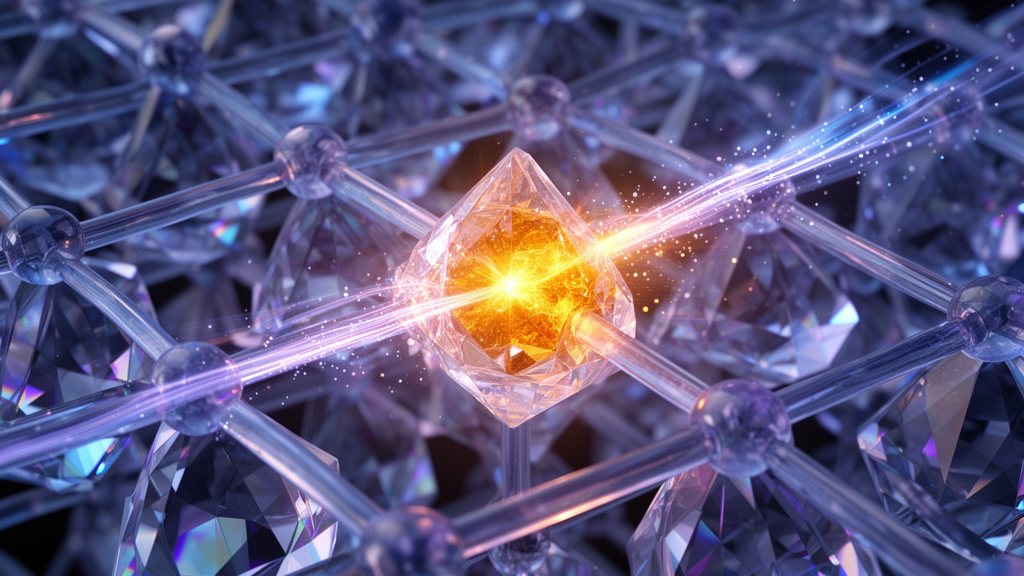
Using quantum-mechanical simulations alongside optical measurements, researchers from Germany, Lithuania, and the United States established that electrons bypass thermal activation by tunneling directly through the energy barrier separating nitrogen donors from the NV defects. Classical physics dictates that an electron cannot surmount this barrier, yet quantum tunneling permits the particle to traverse the forbidden energy landscape directly, creating an efficient charge transfer shortcut through the crystal.
Tunneling alone cannot accomplish the transfer because moving the electron releases a substantial packet of energy that must be absorbed to satisfy fundamental energy conservation laws. The team’s theoretical calculations revealed that the donor nitrogen atom provides the necessary absorption mechanism. In diamond, the neutral nitrogen defect possesses one broken covalent bond with adjacent carbon atoms. When donating its electron to the NV center, this missing bond promptly reforms, channeling the excess energy directly into localized crystal vibrational motion.
The theoretical model explaining these microscopic dynamics was developed through quantum-mechanical simulations conducted by Lukas Razinkovas and the late Audrius Alkauskas of the Center for Physical Sciences and Technology in Vilnius, alongside Chris Van de Walle of the Materials Department at the University of California, Santa Barbara. Their calculations established why nitrogen atoms prove remarkably efficient at accepting the specific quantity of energy emitted during the electron jump.
To experimentally verify the theoretical predictions, the team needed to monitor charge dynamics across unprecedented temporal spans. Standard time-resolved pump-probe experiments apply an initial pump pulse to disturb the system and a delayed probe pulse to track relaxation, but conventional setups stop recording after a few nanoseconds. Because the tunneling probability drops exponentially as donor-acceptor distance increases, electrons require timescales extending from billionths of a second to hours to complete the journey.
Ronald Ulbricht of the Max Planck Institute for Polymer Research designed a specialized two-laser experimental configuration to bridge this temporal gap. In this setup, a pulsed red laser ejects electrons from the NV centers, while a continuous, very weak secondary laser beam passes through the diamond to an optical detector. As the depleted centers gradually regain electrons through tunneling, their optical absorption increases, enabling the detector to record charge recovery continuously from nanoseconds out to seconds and separate fast internal relaxation from slow charge transfer.
Experimental tests across diamonds with varying nitrogen concentrations corroborated the tunneling framework. In nitrogen-rich crystals, NV centers regained their lost charge significantly faster due to the proximity of donor atoms. Conversely, temperature variations produced no measurable change in recovery kinetics. Heating the diamond samples from temperatures near absolute zero up to room temperature failed to alter the rate of return, ruling out heat-assisted promotion and confirming the temperature-independent nature predicted by the quantum tunneling model.
Calculations demonstrated that a nitrogen atom located within two nanometers—roughly a dozen atomic spacings—restores an adjacent NV center within a few nanoseconds, whereas separations exceeding five nanometers prolong the process to multiple hours. Because nitrogen impurities are randomly distributed throughout synthetic diamond, real crystals exhibit charge recovery distributed across this wide time spectrum. In diamonds containing dense nitrogen populations, nearly all NV centers recover within fractions of a second, whereas in high-purity crystals with only one nitrogen per million carbon atoms, models indicate most centers remain uncharged after an hour.
Because an NV center remains inactive while awaiting charge replenishment, temporal fluctuations in charge state can degrade the operational reliability of quantum sensors and processors. The study authors noted that identifying the tunneling mechanism offers concrete strategies to stabilize diamond quantum devices through the engineered placement of nitrogen or alternative impurity atoms. Furthermore, tightly bound defect states govern behavior in LED phosphors, radiation detectors, and microchip insulation layers, making these tunneling insights broadly applicable across modern materials science.
A central theoretical achievement of the investigation was resolving how electron replenishment obeys fundamental energy conservation laws during the quantum jump. When an electron tunnels across the crystal lattice, the transfer discharges a significant burst of energy that the host diamond must absorb for the transition to occur. Theoretical calculations demonstrated that the donor nitrogen atom is ideally configured for this energy dissipation because it possesses one broken covalent bond with adjacent carbon atoms. As the electron departs toward the nitrogen-vacancy center, this missing bond promptly reforms, channeling the excess energy directly into vibrational motion within the crystal. Lukas Razinkovas, head of the Electronic Structure Theory Laboratory at the Center for Physical Sciences and Technology in Vilnius, highlighted the effectiveness of this donor mechanism, noting, “When the electron tunnels, it releases a large quantity of energy and the nitrogen atom turns out to be remarkably efficient at absorbing that particular amount.”
The theoretical model was formulated through an international collaboration involving Razinkovas, Chris Van de Walle, a distinguished professor in the Materials Department at the University of California, Santa Barbara, and Audrius Alkauskas of the Center for Physical Sciences and Technology. Alkauskas, who initiated the theoretical framework, passed away before the project was completed, and the resulting paper in Physical Review Letters is dedicated to his memory. Their simulations successfully explained the microscopic dynamics of charge restoration, demonstrating how electrons overcome the strong binding of neutral nitrogen defects by tunneling directly through forbidden energy barriers rather than relying on thermal release.
To evaluate the theoretical model, experimentalists needed to monitor charge dynamics across temporal spans far wider than standard optical diagnostics permit. Conventional time-resolved pump-probe techniques perturb a defect with an initial laser pulse and observe its response with a delayed second pulse, but typical setups cease recording after several nanoseconds. Because tunneling rates decrease rapidly over distance, tracking slow electron recoveries required an approach capable of observing the system a billion times longer. Ronald Ulbricht, a group leader at the Max Planck Institute for Polymer Research, created a two-laser system that monitors optical recovery continuously from nanoseconds to seconds. Describing the diagnostic setup, Ulbricht stated, “Most time-resolved optical studies of these centers stop a few nanoseconds after the laser pulse. Following the signal from nanoseconds to seconds lets us separate the fast relaxation inside the NV center from the slow return of the charge, and that slow part is the tunneling.”
The calculations confirmed that tunneling probability diminishes steeply as spatial separation grows, meaning minor differences in donor spacing produce major variations in recovery times. When a donor nitrogen atom is situated within roughly two nanometers of the nitrogen-vacancy center, corresponding to approximately twelve atomic spacings, the defect regains its charge in several billionths of a second. At distances exceeding five nanometers, the required transfer time prolongs to multiple hours. Because nitrogen atoms are distributed randomly throughout diamond crystals, real samples contain centers that recover across all intermediate timescales. In diamond with abundant nitrogen impurities, nearly all nitrogen-vacancy defects reacquire an electron within a fraction of a second. In contrast, in ultra-pure diamond containing only one nitrogen atom for every million carbon atoms, the theoretical model predicts that most defect centers remain uncharged even after one hour.
Beyond diamond technology, these findings provide broader insights into charge dynamics across solid-state physics, as Van de Walle emphasized: “Diamond is the case we could measure, but the question is much bigger than one defect in one material. Defects that hold their electrons tightly are everywhere: in the phosphors that make LEDs glow, in the crystals that detect radiation, in the insulating layers of electronic chips. Wherever such defects trade electrons without the help of heat, this is the mechanism to look at, and it helps us predict what the textbook picture simply could not.” Financial support for the research was provided by the Department of Energy Office of Science through the Basic Energy Sciences program and the Co-design Center for Quantum Advantage, alongside the Max Planck Society, the Lithuanian Research Council, and the European Union.
Subject of Research: Quantum tunneling mechanism of electron replenishment in diamond nitrogen-vacancy centers
Article Title: How electrons find their way to diamond's quantum defects
Article References: How electrons find their way to diamond's quantum defects. Original publication (Bibliographic details unavailable.)
Image Credits: AI Generated
DOI: Not provided
Keywords: diamond defects, nitrogen-vacancy center, quantum tunneling, qubit, quantum computing, magnetic sensor, Physical Review Letters, electron transfer, pump-probe spectroscopy, vibrational motion, charge state equilibration, Center for Physical Sciences and Technology, UC Santa Barbara, Max Planck Institute for Polymer Research, crystal lattice, semiconductor defects
News Source: Katie Riggs. (November 17, 2026). Quantum Tunneling Restores Essential Electrons to Diamond Defects for Quantum Devices. Scienmag.