A systematic concept analysis evaluating clinical and occupational literature has established five defining attributes that characterize nurses’ radiation protection behaviour, moving beyond traditional models that narrowly equate safety with personal protective equipment compliance. Conducted by researchers examining forty-two published studies across international and Chinese databases, the analysis addresses persistent ambiguity surrounding how protective practices are conceptualized, measured, and evaluated in healthcare settings. Ionizing radiation is utilized extensively across modern medicine, placing registered nurses who work in high-exposure environments, particularly interventional catheterisation laboratories and surgical operating theatres, among the occupational groups encountering substantial exposure risks. Historically, academic investigations have applied inconsistent terminology, frequently conflating observable safety actions with underlying knowledge, general attitudes, institutional compliance, or overall safety culture.
The methodological framework guiding the analysis was derived from Walker and Avant’s eight-stage concept analysis method, selected specifically for its iterative, reproducible approach to clarifying immature constructs and establishing empirical referents. To identify the breadth of scholarly uses, the research team searched seven electronic databases—including Web of Science, PubMed, Scopus, Embase, CINAHL, the China National Knowledge Infrastructure, and SinoMed—retrieving an initial yield of 3,979 records published between 2000 and 2026. Following the elimination of duplicates, 2,604 unique citations were screened under structured inclusion criteria informed by the Population, Interest, and Context framework, which captured registered nurses operating within interventional suites, catheterisation labs, surgical theatres, nuclear medicine, and diagnostic imaging units. Restricting eligibility to studies published in English and Chinese due to investigator language proficiency, the multi-stage screening ultimately retained forty-two studies. The investigators examined these publications to document historical developments across disciplines, catalog surrogate terms, outline distinguishing conceptual boundaries, and extract the defining attributes, antecedent conditions, observable consequences, and practical empirical referents that constitute the finished operational model.
Examining disciplinary perspectives revealed that the concept operates through markedly divergent assumptions depending on the professional field evaluating it. Within public and occupational health disciplines, the behaviour is positioned as a modifiable link along the exposure-health continuum, monitored through personal dose records and health surveillance. Conversely, nursing research has frequently reduced the phenomenon to linear knowledge-attitude-practice surveys or compliance audits, while interventional and surgical nursing literature frames actions as practical adjustments embedded in team workflows and constrained by spatial limitations. These divergent perspectives contributed to two primary historical limitations: a disproportionate emphasis on self-protective behaviours that systematically marginalized patient protection, and an ongoing tendency to conflate actual protective actions with cognitive antecedents such as perceived risk or theoretical comprehension, leaving valid behavioural assessment fragmented across healthcare environments.
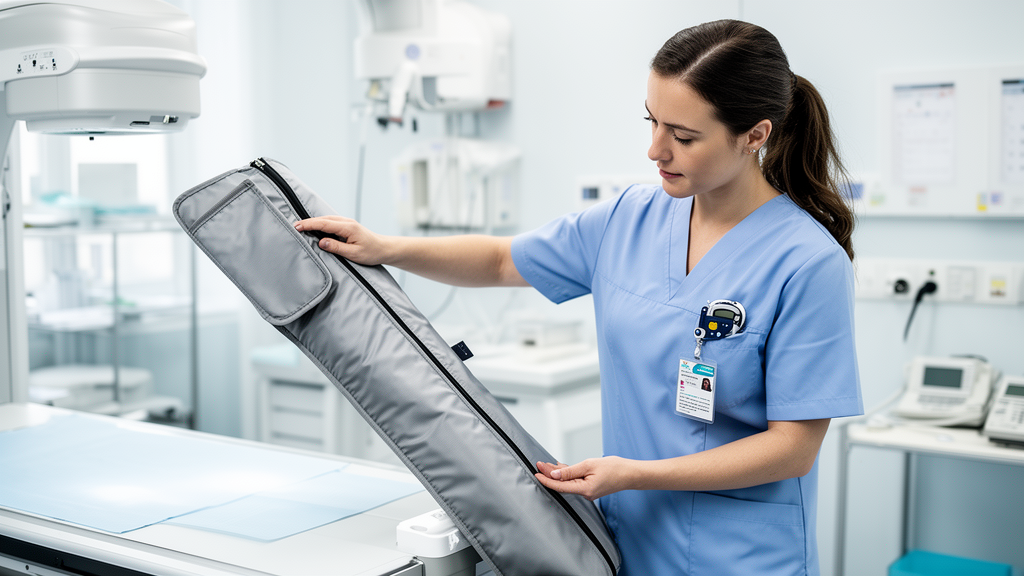
The first core attribute established by the analysis is self-protective behaviour, defined as the proactive, sustained, and observable actions nurses take to minimize their personal radiation dose during clinical exposures. This attribute encompasses the correct selection and continuous wearing of personal protective equipment, such as lead aprons, thyroid collars, and protective lead eyewear, alongside strict execution of the time-distance-shielding triad and consistent dosimeter management. Across the included literature, self-protection represents the most universally acknowledged dimension, yet empirical surveys consistently document substantial deficits in daily compliance. For example, cited surveys indicated that only 23.3 percent of nurses routinely wore protective equipment, while other observational evaluations documented lead apron adherence rates as low as 7.4 to 7.7 percent during procedures.
The second attribute, patient-protective behaviour, represents a critical conceptual expansion, capturing proactive measures executed to limit unnecessary diagnostic or therapeutic exposure to the patient. Rooted in the nursing profession’s fundamental obligation toward patient welfare, this dimension comprises covering non-irradiated anatomy with protective shielding, safeguarding highly radiosensitive organs including the thyroid, reproductive gonads, and ocular lens, and providing structured radiation safety education to patients and their families. While authoritative international guidelines consistently mandate patient dose optimization through justification and the ALARA principle, meaning as low as reasonably achievable, empirical studies demonstrate widespread omission in regular clinical practice. One multicentre survey reviewed within the evidence revealed that 64 percent of operating theatres entirely neglected shielding patients’ non-irradiated bodily regions during intraoperative radiography. Establishing patient protection as a co-equal attribute counters historical self-protection biases and prevents radiation safety from degenerating into a purely individualistic self-preservation exercise detached from clinical care.
The third attribute identified is organizational-environmental maintenance behaviour, which reflects the participative responsibilities nurses undertake to preserve and enhance the safety of their physical work environment. Illustrative quality improvement evidence showed that implementing structured management protocols increased lead apron hanging rates from 80 percent to 98 percent while reducing physical damage rates from 15 percent down to 2 percent. Furthermore, this attribute involves collaborative participation in spatial reconfigurations, such as repositioning nurse workstations, adjusting resuscitation carts, and deploying custom curved lead barriers to optimize shielding efficiency. Recognizing environmental maintenance confirms that individual protection is profoundly constrained by structural conditions, requiring nurses to actively participate in safety standards and quality assurance to maintain a functional safety ecosystem.
Fourth, the researchers established protective appraisal and team-coordination behaviour as an essential process-regulatory attribute governing real-time procedural environments. In high-tempo interventional and surgical suites, radiation protection cannot function as passive obedience; it demands continuous risk appraisal, multidisciplinary communication, and situational problem-solving. This attribute encompasses pre-procedural case evaluations where nurses review anticipated fluoroscopy projections and patient body habitus, initiate protection huddles with operators and radiographers, actively prompt physicians when fluoroscopy runs excessively long, and request pulsed imaging or tighter collimation. It also incorporates proactive learning through departmental debriefings, incident reviews, and educational participation. Grounded in evidence from qualitative team investigations and safety participation scales, this cognitive-collaborative dimension separates genuine protective practice from mechanical compliance under external supervision. The authors argue that without dynamic situational appraisal and interdisciplinary assertiveness, teams struggle to operationalize dose minimization strategies effectively when unforeseen procedural complexities arise.
The fifth attribute, occupational health self-management behaviour, addresses long-term wellbeing in radiation-exposed careers, expanding protection beyond immediate procedural boundaries. Because ionizing radiation carries cumulative deterministic and stochastic biological risks, this dimension incorporates attending mandatory occupational health examinations, undergoing specialized biological surveillance such as lens and thyroid screenings, proactively disclosing pregnancy or reproductive planning to adjust clinical assignments, and seeking institutional support for physical or psychological strain. Although quantitative measurement tools for this dimension remain scarce, health surveillance studies indicate that nurses completing routine occupational health examinations demonstrate higher overall safety practices. Establishing long-term self-management as an indispensable attribute completes the protective loop, linking real-time exposure avoidance with the sustainable preservation of the healthcare workforce throughout cumulative multi-year careers.
The analysis synthesized antecedents and consequences across individual, social, and structural levels, emphasizing that observed survey associations do not demonstrate direct causal relationships. Key antecedents fall into four primary categories: individual cognitive-affective factors such as radiation knowledge, risk perception, self-efficacy, and fear; perceived behavioural costs, notably the physical weight, ergonomic discomfort, and musculoskeletal burdens of heavy lead garments alongside severe time pressures; enabling resources, including equipment availability, layout optimization, and real-time dosimetry feedback; and organizational safety culture supported by administrative policies and collaborative interdisciplinary relations. Practice outcomes include enhanced radiation safety culture, though surveys reveal a persistent cognition-behaviour gap where high theoretical knowledge fails to guarantee protective execution due to structural workload barriers.
In evaluating practice implications, the authors emphasized that current clinical assessment instruments remain disproportionately focused on individual self-protection, leaving patient shielding, environmental upkeep, situational appraisal, and long-term health management critically unmeasured. The study notes several inherent limitations, including its restriction to English and Chinese publications from 2000 onward, which potentially omitted relevant findings published in other languages or earlier historical periods. By providing an integrated operational framework spanning five distinct attributes, the study establishes an evidence-based foundation for designing comprehensive multi-level measurement tools, restructuring nurse education around interactive simulation, and optimizing institutional radiation protection policies across evolving healthcare environments.
Subject of Research: Concept analysis of nurses' radiation protection behaviour in clinical radiation settings
Article Title: Nurses’ radiation protection behaviour: a concept analysis using Walker and Avant’s method
Article References: Han, S., Liao, Z., Lai, C., Huang, X., Liu, D., Yao, S., Zhuo, Y., Yang, M., & Zhang, S. (2026). Nurses’ radiation protection behaviour: a concept analysis using Walker and Avant’s method. Frontiers in Public Health, 14, Article 2019984. https://doi.org/10.3389/fpubh.2026.2019984
Image Credits: AI Generated
DOI: 10.3389/fpubh.2026.2019984
Keywords: radiation protection, nursing practice, concept analysis, Walker and Avant method, occupational health, patient radiation safety, interventional catheterisation, operating rooms, personal protective equipment, ALARA principle, dosimetry monitoring, radiosensitive organ shielding, workflow optimisation, radiation safety culture, occupational exposure, health self-management
News Source: Ophelia Keating. (November 17, 2026). Study Identifies Five Core Dimensions Defining Nurses’ Radiation Protection Practices. Scienmag.