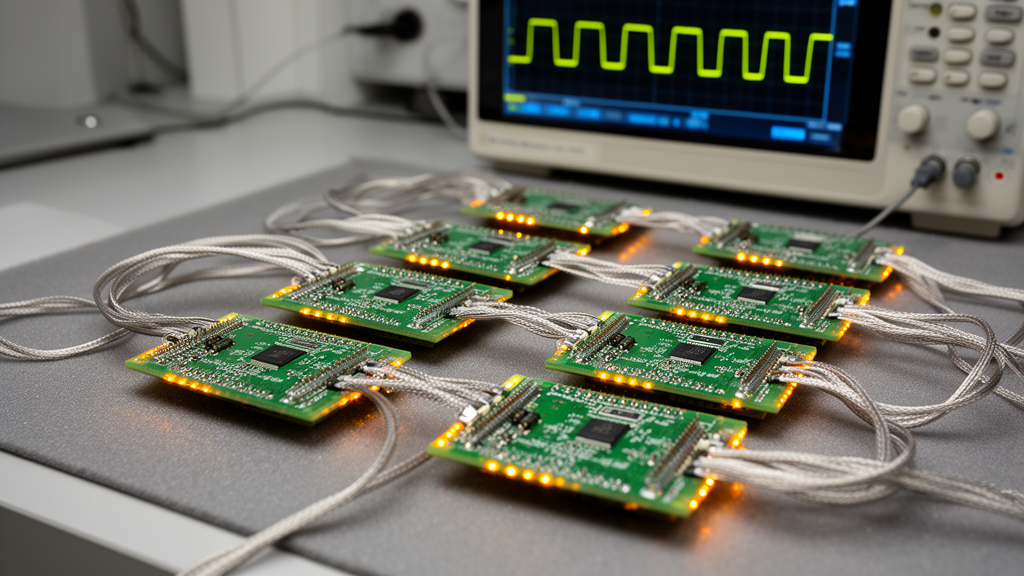
Vibration analysis and experimental structural dynamics testing in academic laboratories frequently confront a substantial economic barrier created by expensive commercial data acquisition systems. To resolve this logistical hurdle, researchers Oliver M. Zobel, Johannes Maierhofer, and Daniel J. Rixen have introduced OASIS-ERIS, an electrically refined open-source data acquisition architecture designed to interface with Integrated Electronics Piezo-Electric sensors while enabling direct physical inter-device synchronization. Detailed in HardwareX, the system delivers an open alternative to proprietary laboratory equipment, offering an estimated bill of materials cost of roughly one hundred sixty dollars, or one hundred forty euros, compared to commercial counterparts that cost thousands. The hardware design is fully open source under a Creative Commons Attribution 4.0 license, while its accompanying software suite is released under the permissive MIT license. Certified by the Open Source Hardware Association under UID DE000177, the project provides open manufacturing files, firmware, and user interfaces that enable educational institutions and research facilities to build, customize, and operate multi-channel physical measurement apparatuses without dependency on closed proprietary software ecosystems.
The engineering foundation of the OASIS-ERIS board is constructed around an Analog Devices AD7606C-18 analog-to-digital converter paired with an Espressif ESP32-S3 dual-core microcontroller equipped with wireless networking capabilities. The dedicated analog-to-digital converter provides eighteen bits of sampling resolution across eight simultaneous channels, eliminating phase skew between concurrent channel readings on a single board. Through a Serial Peripheral Interface, the system allows independent software configuration of each channel input voltage span among five discrete settings, including plus or minus two point five volts, five volts, six point two five volts, ten volts, and twelve point five volts, with respective voltage measurement resolutions spanning from nineteen microvolts up to ninety-five point thirty-six microvolts. The dual-core processor delegates data flow by assigning one processing core to read digitized samples from the converter across an Octal Serial Peripheral Interface into alternating RAM cache pages, while the second core transfers completed cache blocks directly onto an onboard micro Secure Digital card formatted with the exFAT filesystem, ensuring continuous high-speed data logging.
Significant electrical and mechanical modifications distinguish this iteration from its historical predecessors, including the original twenty-twenty-two OASIS board and the twenty-twenty-four OASIS-UROS revision. The physical front end replaces the bulky dual Bayonet Neill-Concelman connectors used previously, which weighed thirty-five grams each, with lightweight SubMiniature version B connectors that weigh approximately three grams apiece. This mechanical change reduces total hardware weight, including an optional three-dimensionally printed protective bottom casing, from roughly two hundred twenty grams down to approximately one hundred ten grams. To enhance signal reliability and simplify operational setup, the Integrated Electronics Piezo-Electric constant current sources have been redesigned around Texas Instruments LM334M integrated circuits configured to deliver a fixed current of approximately three milliamperes to attached transducers, discarding earlier potentiometer-based manual tuning schemes. An onboard high-voltage rail of twenty-four volts is generated by a Texas Instruments LM5157 boost converter that maintains a compact surface-mount footprint without needing electrolytic smoothing capacitors, complemented by a passive high-pass resistor-capacitor filter with a minus three decibel cutoff frequency set at zero point eight hertz.
The central technical innovation introduced in the system is an inter-device synchronization mechanism that coordinates arbitrarily chained boards without depending on software-based post-processing alignment or external network clock synchronization protocols. Conventional low-cost acquisition modules typically operate in isolation or require manual post-acquisition trace shifting, whereas OASIS-ERIS physically bridges hardware sampling clocks across devices using an external synchronization Bayonet Neill-Concelman port. This port connects directly to the conversion start pin of the onboard analog-to-digital converter as well as the microcontroller input-output pins on every linked module. When multiple units are connected, one board is designated as the synchronization source upon user command, while all supplementary boards function as synchronization sinks. The source transmits acquisition parameters, such as sampling frequency, record duration, storage identification tags, and trigger conditions, across a OneWire protocol bus over the shared synchronization cable before launching the physical conversion clock.
During active sampling, the synchronization source executes a hardware pulse-width modulation counter that drives the conversion start pins across all attached synchronization sinks simultaneously through standard coaxial cables. Because sampling occurs on the rising flank of the shared pulse-width modulated clock signal, clock propagation delays across physical cables remain on the order of nanoseconds, establishing synchronous digitization across all connected analog-to-digital converter channels. In triggered acquisition modes, where boards continuously record baseline vibration data while awaiting an amplitude threshold on the primary channel of the source unit, the continuous data stream is stored in raw binary formats alongside acquisition metadata files. When the source ends the sampling sequence by terminating the pulse-width modulation output, the sink boards detect clock cessation and mathematically trim their internal buffers so that remaining sample records align with the initial sample index of the source, resolving trigger latency without complex continuous bidirectional communication.
Software execution on the embedded microcontroller represents another major architectural overhaul, transitioning from an Arduino development environment to a direct C-plus-plus implementation based on Espressif IoT Development Framework version six point zero point zero. This migration facilitates direct low-level hardware control, elevating reliable streaming throughput and supporting Universal Serial Bus mass storage class device emulation over an integrated physical interface. Rather than relying on historical serial UART links limited to approximately one megabit per second, users can access raw binary files stored on the onboard micro Secure Digital card via a Universal Serial Bus one point one mass storage interface operating at up to twelve megabits per second. Host computers running Windows, macOS, or Linux communicate with the instrument through an extensible open-source Python stack comprising the core OASIS-API communication engine, an interactive terminal user interface named OASIS-TUI suited for remote Secure Shell environments, and a graphical user interface named OASIS-GUI that automates multi-board data retrieval, plotting, and file concatenation into unified Hierarchical Data Format five files.
Experimental validation of the inter-device synchronization mechanism was conducted by feeding an identical five-hertz ramp waveform, possessing an amplitude of plus or minus four volts and one hundred percent symmetry generated by a RIGOL signal generator, into the first channel of five linked OASIS-ERIS boards. Operating at a maximum hardware sampling frequency of one hundred kilohertz across ten-second recording intervals, the cross-correlation of recorded waveforms demonstrated an inter-device timing offset between the synchronization source and all four sink units ranging between zero and one discrete sample, representing a worst-case timing delay of ten microseconds. In triggered acquisition tests covering one-second sampling durations, cross-correlation showed zero sample offset across all test iterations, confirming perfect sample alignment. High-bandwidth oscilloscope observations evaluating the conversion start signals revealed that electrical pulse edges between the source unit and the most distant sink differed by only approximately two nanoseconds, indicating that the single-sample offset observed during untriggered runs stemmed from software task initialization rather than electrical clock skew.
To rigorously evaluate the system under demanding structural dynamics testing conditions, the research team conducted a full-scale experimental modal analysis campaign on a free-hanging aluminum benchmark structure suspended from elastic rubber cordage, comparing results directly against a commercial Müller-BBM PAK MKII dynamic signal analyzer. The excitation was delivered using a TIRAvib electromagnetic shaker driven by bandwidth-limited random noise routed through an analog filter array consisting of an eight-pole low-pass Butterworth filter set at five kilohertz and an eight-pole high-pass Butterworth filter set at two hertz to prevent excessive low-frequency structural excursions. Five interconnected OASIS-ERIS units gathered acceleration data from twelve Kistler triaxial accelerometers glued to the test structure, operating at sixteen kilohertz with an internal thirty-two-times oversampling factor, while the commercial reference platform gathered equivalent data at sixteen point three hundred eighty-four kilohertz across twenty repeated ten-second measurement sweeps.
Modal parameter extraction performed via the pyFBS software package utilizing poly-reference Least-Squares Complex Frequency and Least-Squares Frequency Domain identification algorithms demonstrated close alignment between the open-source hardware array and the industrial reference system across sixteen distinct structural modes identified between twenty and two thousand hertz. The calculated eigenfrequencies matched within narrow margins; the greatest relative divergence occurred at the first mode at one hundred seventy-four point three hertz compared to one hundred seventy-four point four hertz on the commercial unit, an absolute discrepancy of zero point one hertz that matches the baseline frequency resolution of the estimated frequency response functions. Similarly, damping ratio measurements exhibited close agreement, with a maximum absolute divergence of zero point zero three percent recorded on the first and tenth structural vibration modes. Furthermore, Cross-Modal Assurance Criterion evaluations demonstrated identical mode shape vectors across all sixteen structural resonances, validating that multi-board synchronization maintained absolute spatial phase integrity across distributed sensor positions.
Despite these favorable modal results, the experimental characterization identified operational boundaries where commercial equipment outperformed the open-source system. Specifically, frequency response function estimates generated using an Hv-estimator revealed that OASIS-ERIS exhibited elevated noise floors and coherence degradation in measurement degrees of freedom characterized by weak vibrational responses, such as the anti-resonance troughs near one point six kilohertz on specific accelerometer axes. The researchers noted that while the eighteen-bit converter provides sufficient dynamic range for general modal testing, faint signals near instrument noise thresholds would benefit from integrated programmable pre-amplifiers to optimize voltage digitization span. Additionally, transitioning from the present four-layer printed circuit board layout to a six-layer architecture with dedicated internal ground shielding planes could substantially mitigate parasitic electromagnetic coupling. Nevertheless, by demonstrating reliable hundred-kilohertz sampling, microsecond-level clock coherence across daisy-chained hardware, and seamless Python integration, OASIS-ERIS establishes a highly capable, cost-effective framework for modern experimental dynamic testing.
Subject of Research: Open-source data acquisition hardware and inter-device synchronization for piezoelectric sensor measurements in structural dynamics
Article Title: OASIS-ERIS: Open acquisition system for IEPE sensors — Electrically refined and inter-device synchronization
Article References: Zobel, O. M., Maierhofer, J., & Rixen, D. J. (2026). OASIS-ERIS: Open acquisition system for IEPE sensors — Electrically refined and inter-device synchronization. HardwareX, 28, Article e00855. https://doi.org/10.1016/j.ohx.2026.e00855
Image Credits: AI Generated
DOI: 10.1016/j.ohx.2026.e00855
Keywords: data acquisition, open-source hardware, IEPE sensors, structural dynamics, modal analysis, AD7606C-18, ESP32-S3, inter-device synchronization, frequency response function, piezoelectric transducers, OSHWA certified, vibration testing, KiCad PCB design, embedded systems, digital signal processing, cross-correlation
News Source: Denise Maddox. (November 17, 2026). Open Source Acquisition System Achieves Ten Microsecond Synchronization Across Multiple Sensor Boards. Scienmag.