Biomechanical engineering researchers have developed and tested a fully automated computational pipeline that builds patient-specific finite element models for total shoulder arthroplasty directly from routine preoperative clinical data. Published as a technology report in Frontiers in Bioengineering and Biotechnology, the framework combines deep learning neural networks, automated solid meshing algorithms, and numerical finite element solving to simulate post-surgical mechanical stresses on the scapula without requiring manual intervention. The development team, led by Pezhman Eghbali and Alexandre Terrier from the Laboratory of Biomechanical Orthopedics at Ecole Polytechnique Fédérale de Lausanne alongside clinical collaborators from Lausanne University Hospital and the ARTORG Center for Biomedical Engineering Research at the University of Bern, established the open-source pipeline to evaluate both anatomic and reverse shoulder replacement configurations.
Total shoulder arthroplasty represents a primary surgical intervention for individuals suffering from disabling, end-stage degenerative joint disorders, including severe osteoarthritis and complex rotator cuff tear arthropathy. While reverse configurations were originally restricted to patients with extensive rotator cuff deficiencies, clinical indications have substantially expanded in recent years. Across international registries, overall utilization has expanded rapidly, accompanied by excellent short-term pain relief and functional restoration; nevertheless, long-term implant durability remains challenged by reported clinical complication rates of 10.7 percent for anatomic implants and 8.9 percent for reverse replacements, driven primarily by aseptic glenoid component loosening and joint instability.
Computational biomechanics has traditionally deployed finite element analysis to quantify mechanical load transfer, stress concentrations, wear patterns, and fixation stability within the reconstructed glenohumeral joint. Previous investigations have examined glenoid stability, component orientation, screw configurations, and implant-bone interfacial stresses across various two-dimensional and three-dimensional representations. However, widespread clinical translation and large-scale computational cohort studies have been consistently impeded by the arduous manual labor required to reconstruct patient-specific bony surfaces from radiological cross-sections, position prosthetic CAD geometry, ream the virtual bone bed, define boundary constraints, and execute numerical simulations. Such manual construction is prone to user variability, error-prone boundary assignments, and protracted creation timelines. To overcome these barriers, the investigators sought to construct an end-to-end, automated Python-based architecture capable of ingesting routinely acquired preoperative computed tomography scans and commercial surgical planning datasets to generate verified numerical models.
The engineering workflow begins by ingesting three-dimensional computed tomography scans and clinical demographic profiles, including patient biological sex, age, height, and body mass. An initial deep learning segmentation architecture automatically processes the volumetric CT imaging to generate a discrete triangular surface mesh of the patient’s scapula and identify precise morphological landmarks. Simultaneously, another deep learning module evaluates the patient’s preoperative CT scans to determine muscle condition by quantifying the cross-sectional area and degeneration of the rotator cuff musculature. These automated geometrical outputs establish an anatomical coordinate system referenced to specific scapular bone landmarks, defining orthogonal postero-anterior, infero-superior, and medio-lateral axes aligned with the supraspinatus groove, with the local coordinate origin anchored at the projection of the spino-glenoid notch along the medio-lateral axis.
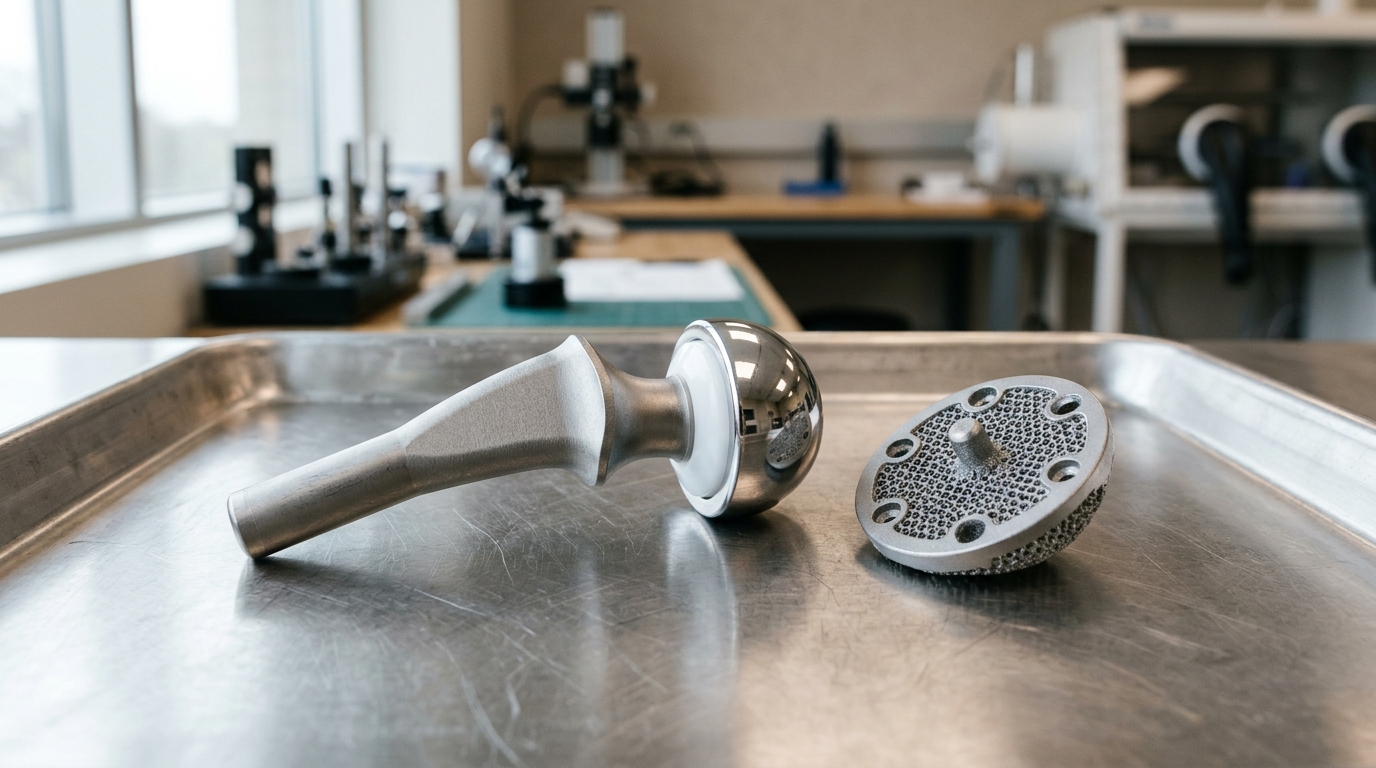
Following landmark determination, the pipeline integrates proprietary prosthetic computer-aided design files provided by the implant manufacturer, matching the specific component types, sizes, locations, and screw arrangements designated within the commercial preoperative planning software Blueprint. Using the open-source PyMesh library, the code automates virtual surgical bone reaming on the segmented scapular surface to prepare the seating interface. For anatomic models, an idealized 0.5-millimeter polymethylmethacrylate cement mantle is algorithmically deposited between the polyethylene glenoid component and the prepared bone bed. The integrated surface meshes are subsequently transformed into volumetric quadratic tetrahedral elements using the Gmsh meshing library. Mechanical properties are mapped across the model by modeling bone, metallic implants, and cement as linearly elastic materials with perfect interfacial bonding, reflecting an idealized long-term postoperative scenario characterized by solid osseointegration or optimal primary stability.
Heterogeneous bone stiffness is allocated directly from the underlying medical imaging data by converting local CT attenuation numbers, expressed in Hounsfield Units, into apparent bone mineral density, which is subsequently converted into localized Young’s modulus values across the tetrahedral mesh. A uniform Poisson’s ratio of 0.3 was applied to the scapular bone. Component material constants were extracted from validated biomechanical literature: the ultra-high-molecular-weight polyethylene anatomic implant was assigned a Young’s modulus of 720 megapascals and a Poisson’s ratio of 0.4, surrounded by a bone cement layer possessing an elastic modulus of 2 gigapascals and a Poisson’s ratio of 0.23. For reverse arthroplasty models, the glenoid baseplate, central post, and peripheral fixation screws were defined using titanium alloy properties, with a Young’s modulus of 110 gigapascals and a Poisson’s ratio of 0.3.
Boundary and loading constraints were imposed entirely through automated scripting. Structural boundary conditions constrained all nodes residing along the medial border of the scapula to zero displacement, isolating the region positioned medial to an anatomical plane intersecting the inferior angle and scapular spine triangle perpendicular to the medio-lateral axis. Joint kinetics were determined using a previously developed patient-specific deep learning musculoskeletal model that predicts the amplitude and directional vector of the glenohumeral joint reaction force during 90 degrees of arm abduction in the scapular plane. This neural network computes loading conditions based on the patient’s biological sex, body mass, height, implant inclination, version angles, prosthetic design, and the CT-derived rotator cuff muscle cross-sectional areas.
To transfer joint forces into the numerical model, distinct mechanical coupling strategies were implemented for each prosthetic type. In anatomic simulations, the total joint reaction force was mapped directly across the articular contact surface of the polyethylene implant using Hertzian contact theory, distributing nodal forces quadratically relative to distance from the contact center while ensuring that the vectorial sum matched the predicted joint load. In reverse arthroplasty configurations, the hemispherical metallic glenosphere was not discretized as a deformable continuum body; rather, the joint reaction force was applied to a discrete surface node and transmitted via rigid multi-point constraints to a master node located at the center of the glenosphere. This master node was rigidly linked to slave nodes around the baseplate perimeter and central screw hole, while inferior and superior locking screws were rigidly locked to the baseplate and peripheral compression screws were constrained along their primary structural axes.
The fully automated Python framework compiles these geometric, material, and kinematic inputs into complete job files for execution within the Abaqus 2023 implicit finite element solver, subsequently running automated post-processing routines to extract bone strain fields. Mechanical performance was evaluated by examining absolute maximum principal strain distributions within localized volumes of interest encompassing all peri-implant bone located within 10 millimeters of the hardware. For anatomic constructs, peri-implant bone was segmented into eight regional quadrants oriented at 45 degrees relative to implant axes, distinguishing superior, inferior, anterior, and posterior sectors around the central keel and backside surface. In reverse constructs, six anatomically matched regions were defined around the central screw, peripheral screws, and baseplate backside. Verification through automated mesh convergence showed solution variations below 1 percent using refined meshes averaging 400,000 quadratic tetrahedral elements and 2,000,000 degrees of freedom, while uncertainty analyses testing 10 percent perturbations in bone density and joint force magnitude demonstrated stable, proportional outputs not exceeding 10 percent deviation.
Technical feasibility was demonstrated on an institutional proof-of-concept cohort comprising ten patients, including five individuals who received anatomic implants and five who underwent reverse arthroplasty. Across the cohort, cumulative volume strain curves revealed that the median volume of peri-implant bone experiencing strains exceeding 1 percent—a threshold indicative of potential bone yielding—was 2.8 percent (interquartile range of 5.6 percentage points) for anatomic reconstructions and 1.9 percent (interquartile range of 5.1 percentage points) for reverse reconstructions. Markedly different mechanical hotspots emerged between designs: high bone strains clustered predominantly around the central keel in anatomic implants, whereas peak strains concentrated around the central and superior fixation screws in reverse arthroplasty.
The authors emphasized several methodological boundaries inherent to their initial proof-of-concept implementation. Biomechanical simulations were restricted to an isolated static abduction pose at 90 degrees rather than transient, dynamic multi-planar motions, and neglected direct rotator cuff muscle traction forces acting on scapular insertion sites. Furthermore, computational efficiency was achieved by assuming fully osseointegrated, bonded bone-implant interfaces, omitting frictional micromotion and long-term loosening dynamics. The ten-patient sample size was intentionally chosen to demonstrate software execution feasibility rather than power clinical association studies. Nonetheless, because the Python codebase has been documented and made publicly accessible on Zenodo under a permanent digital object identifier, the automated system establishes a practical pathway to run large-scale population-based virtual clinical trials across institutional patient registries to investigate implant geometry, screw placement strategies, and surgical risk factors.
Subject of Research: Automated patient-specific finite element modeling in total shoulder arthroplasty
Article Title: A workflow for automated generation of patient-specific finite element models in total shoulder arthroplasty
Article References: Eghbali, P., Goetti, P., Lante, E., Becce, F., Satir, O. B., Pistorius, L., Büchler, P., Pioletti, D. P., & Terrier, A. (2026). A workflow for automated generation of patient-specific finite element models in total shoulder arthroplasty. Frontiers in Bioengineering and Biotechnology, 14, Article 1986849. https://doi.org/10.3389/fbioe.2026.1986849
Image Credits: AI Generated
DOI: 10.3389/fbioe.2026.1986849
Keywords: total shoulder arthroplasty, finite element analysis, biomechanics, computational modeling, deep learning, anatomic shoulder arthroplasty, reverse shoulder arthroplasty, scapula, rotator cuff, preoperative planning, bone strain, orthopedic biomechanics, CT segmentation, musculoskeletal modeling, glenoid implant, implant fixation, in silico medicine
News Source: Gregory Coleman. (November 17, 2026). Automated Computational Framework Models Patient Bone Strains in Total Shoulder Arthroplasty. Scienmag.