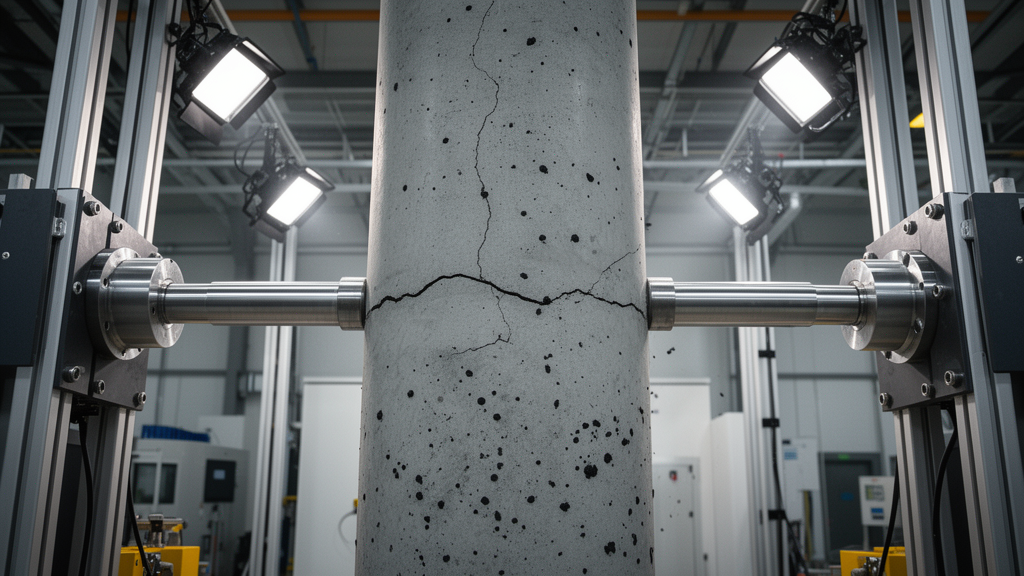
A comprehensive finite element investigation into structural resilience has demonstrated that replacing conventional concrete binder matrix constituents with rubberized engineered cementitious composites significantly enhances the energy dissipation capacity of reinforced concrete columns subjected to low-velocity lateral impacts. Conducted by an international team of engineering researchers, the study modeled the dynamic mechanical response of scaled structural columns subjected to lateral collisions, revealing that incorporating recycled tire rubber particles into an engineered cementitious composite matrix can increase total impact energy absorption by as much as 76 percent.
Reinforced concrete columns function as foundational load-bearing components across contemporary civil infrastructure, maintaining the overall stability of multistory buildings, industrial facilities, and elevated transportation networks. However, these vital structural supports remain inherently vulnerable to severe lateral impact forces generated by unexpected vehicular collisions, including passenger vehicles striking support pillars in parking garages or heavy freight trucks colliding with bridge piers. Beyond vehicular accidents, columns can face dynamic lateral shocks from falling rock masses, flood-borne debris, or intentional vehicle strikes. Because conventional concrete possesses high compressive strength but limited tensile capacity, dynamic point impacts induce severe localized stress concentrations that trigger rapid brittle cracking, surface spalling, core crushing, and potentially catastrophic progressive collapse of entire structural frames.
To overcome the brittle failure mechanisms typical of conventional concrete, the research team focused on engineered cementitious composites, an advanced class of fiber-reinforced materials recognized for exceptional tensile ductility and distinct strain-hardening behavior under mechanical load. When reinforced with fine rubber particles recovered from recycled automotive scrap tires, the resulting composite couples ecological waste diversion with enhanced structural damping and elasticity. The dispersed rubber aggregates within the cementitious paste provide viscoelastic properties that dampen dynamic shock waves, whereas the microfibers embedded in the engineered cementitious matrix bridge tensile microcracks, preventing localized crack coalescence and distributing damage across a broader deformation zone. While previous empirical studies evaluated localized rubberized composite applications in beams, barrier rails, and retrofit jackets, numerical data examining the combined mechanical behavior of rubberized composite columns under dynamic impact remained scarce.
To resolve this gap, the researchers formulated an advanced three-dimensional finite element framework using the Abaqus computational platform, simulating both static displacement-controlled loading and dynamic lateral collision scenarios under explicit time integration. Concrete and composite matrices were discretized using eight-node reduced-integration brick elements equipped with enhanced hourglass control, while the longitudinal and transverse reinforcing steel rebar cages were simulated using two-node spatial truss elements embedded within the surrounding cementitious matrix. To realistically capture post-elastic degradation under high-strain dynamic deformation, the researchers implemented the Concrete Damage Plasticity constitutive formulation. This formulation accounted for nonlinear tensile cracking, compressive crushing, and strain-rate sensitivity through empirical dynamic increase factors, while maintaining system kinetic energy distortions and artificial hourglass energy below strict stability thresholds.
The numerical modeling methodology was verified by reproducing experimental drop-hammer tests conducted on reinforced concrete columns with varying rubber proportions subjected to a 300-kilogram solid steel pendulum impactor released from multiple inclination angles. Across test simulations matching column geometries of 100-millimeter square cross-sections and 800-millimeter unsupported heights, the finite element calculations tracked the physically observed crack emergence, crack spread, and dynamic reaction histories. The explicit numerical predictions closely matched experimental peak impact loads and temporal displacement profiles, showing a minor overestimation of approximately 4.8 percent for dynamic peak impact forces and 4.5 percent for mid-height displacement values. This close correspondence confirmed that the homogenized damage plasticity model reliably captured the interplay of dynamic material response and structural inertia.
The parametric matrix evaluated four primary operational variables: volumetric rubber substitution ratios ranging from 0 to 20 percent, lateral impact velocities spanning 1.5 to 3.5 meters per second, longitudinal steel reinforcement ratios between 1.0 and 2.0 percent, and transverse stirrup spacings varying from 50 to 150 millimeters. A constant vertical axial pre-load corresponding to 25 percent of ultimate axial capacity was maintained at the column head throughout the lateral impact events to reproduce realistic service-level gravity stresses encountered in operational bridge piers and building columns.
The first phase of the parametric study focused on columns featuring a free-top boundary condition, representative of cantilevered bridge piers and isolated parking garage supports. In these cantilever models, increasing the rubber content from 0 to 20 percent caused the initial cracking load to drop by 24 percent from 11.36 kilonewtons to 8.65 kilonewtons, alongside a 28 percent decline in ultimate lateral load capacity from 20.41 kilonewtons to 14.69 kilonewtons. Conversely, this same increase in rubber volume expanded mid-height lateral displacement by 28 percent from 125.14 millimeters to 159.79 millimeters and propelled total absorbed energy from 1165.12 kilonewton-millimeters to 1815.38 kilonewton-millimeters, marking a 56 percent net improvement in energy dissipation that reflected the composite’s superior capacity to sustain extensive inelastic deformation without experiencing brittle fracture.
The second phase evaluated identical structural columns subjected to restrained-top boundary conditions, which correspond to bridge piers rigidly connected to bridge decks or structural columns framed into continuous multistory flooring systems. Restrained columns exhibited consistently superior performance across all parametric metrics, displaying cracking and ultimate load capacities 15 to 18 percent higher than their free-top counterparts, while experiencing 40 to 60 percent lower mid-height displacements. In these restrained specimens, increasing the rubber content from 0 to 20 percent reduced peak capacity from 22.55 kilonewtons to 17.01 kilonewtons, yet drove mid-height displacement upward by 69.2 percent and produced a substantial 76.1 percent surge in total absorbed energy, climbing from 920.56 kilonewton-millimeters to 1620.85 kilonewton-millimeters as top restraint activated double-curvature bending and compressive arching action.
The computational analysis also systematically quantified how dynamic collision velocity and structural steel detailing interact with composite performance. Elevating the lateral impact velocity from 1.5 to 3.5 meters per second intensified damage propagation across both boundary configurations, precipitating a 15 to 18 percent drop in ultimate load capacity while driving lateral deflections up by 25 to 59 percent. Conversely, increasing the longitudinal reinforcement ratio from 1.0 to 2.0 percent enhanced ultimate column capacity by 12 to 16.6 percent and reduced peak displacements by 10.8 to 28.1 percent by confining concrete microcracking to localized impact regions. Furthermore, tightening transverse stirrup spacing from 150 millimeters down to 50 millimeters increased ultimate resistance by 40.4 to 48.0 percent, effectively preventing catastrophic mid-height shear splitting and promoting controlled localized compressive crushing.
Based on their comprehensive parametric dataset, the researchers formulated practical structural design guidelines, recommending an optimal rubber content between 10 and 15 percent by volume to balance the moderate sacrifice in peak load capacity with substantial gains in ductility and impact energy dissipation. Additionally, the authors advised specifying a minimum longitudinal reinforcement ratio of 1.29 percent combined with transverse stirrup spacing not exceeding 80 millimeters to ensure robust core confinement in columns fabricated with rubberized composite matrices. Emphasizing that their current conclusions rest on validated macro-scale continuum simulations, the authors underscored that full-scale experimental testing across varied structural geometries remains essential before these sustainable composites can be formally integrated into standard structural impact codes.
Subject of Research: Finite element analysis of rubberized engineered cementitious composite columns under low-velocity lateral impact
Article Title: Dynamic Response of Rubberized Engineered Cementitious Composite Columns Under Low-Velocity Lateral Impact
Article References: Ghalla, M., Bahrami, A., Youssf, O., Rahman, S. M. A., Sobuz, M. H. R., Kabbo, M. K. I., & Fayed, S. (2026). Dynamic Response of Rubberized Engineered Cementitious Composite Columns Under Low-Velocity Lateral Impact. International Journal of Concrete Structures and Materials, 20(1), Article 108. https://doi.org/10.1186/s40069-026-00985-3
Image Credits: AI Generated
DOI: 10.1186/s40069-026-00985-3
Keywords: rubberized engineered cementitious composites, reinforced concrete columns, low-velocity impact, finite element modeling, concrete damage plasticity, structural resilience, energy dissipation, crumb rubber, dynamic increase factor, ductility enhancement, bridge piers, lateral impact response, shear reinforcement, stirrup spacing, recycled waste tires, crack propagation, double-curvature bending
News Source: Denise Maddox. (November 17, 2026). Rubberized Engineered Cementitious Composites Boost Column Impact Energy Absorption in Simulations. Scienmag.