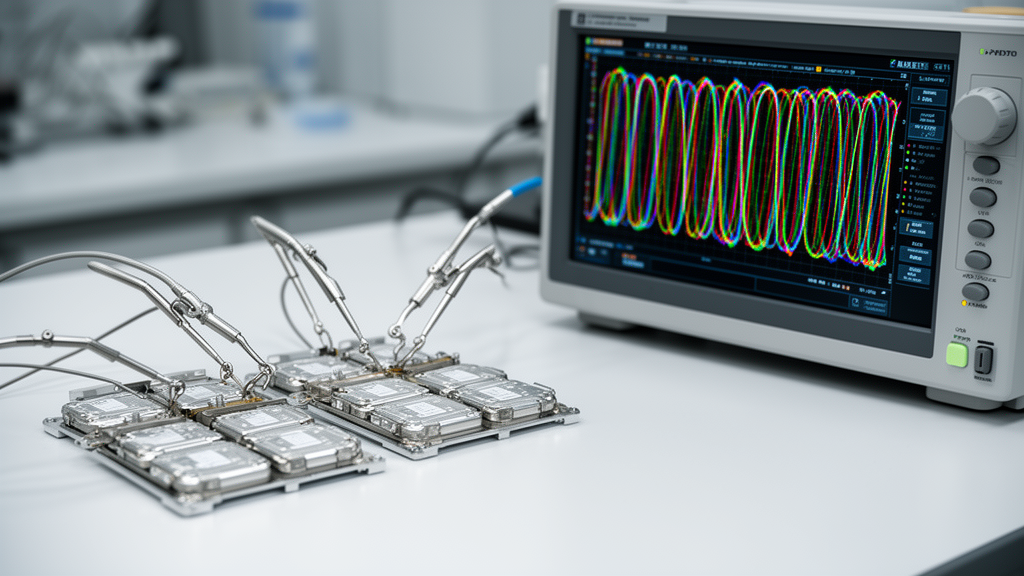
Electrochemical impedance spectroscopy features can sharply differentiate nominally identical lithium-ion cells while simultaneously failing to predict remaining useful life across unseen cells, according to an evaluation conducted by researchers Samer Yaghi, Mohammed A. Awadallah, and Mohammed Alhanjouri. Examining laboratory records from four commercial-format 18650 cells cycled under controlled room-temperature conditions, the investigators tested whether internal resistance metrics transfer across different individual batteries. Their analysis revealed that while electrolyte resistance and charge-transfer resistance capture individual cell identity far more distinctly than discharge capacity, those same impedance parameters provide virtually no prognostic utility when applied to a cell that a predictive model has never encountered during training.
The study directly addresses a persistent assumption in battery management system design, where researchers frequently propose electrochemical impedance spectroscopy as a sensitive early indicator of cell degradation. Battery management systems typically estimate state of charge and state of health from terminal voltage measurements alongside equivalent-circuit parameters, but existing literature rarely compares those parameters across multiple individual cells to determine whether between-cell differences exceed within-cell variations. When prognostic machine-learning algorithms are trained on a limited collection of cells, engineers often presume that the learned degradation trajectories will generalise effectively to other batteries of the exact same specification. The authors noted that previous experimental studies frequently reported per-cell trajectories without verifying whether differences between cells exceeded baseline operational variation or whether equivalent-circuit parameter co-movements were consistently coupled across independent units.
To rigorously investigate whether impedance features transfer, the research team analysed experimental records from the NASA Prognostics Center of Excellence battery dataset. The dataset includes charge, discharge, and impedance measurements from four 18650 lithium-ion cells designated as B0005, B0006, B0007, and B0018, all operated at room temperature. Each cell underwent discharge cycles at a constant current of 2 A, while periodic impedance spectra were acquired through frequency sweeps ranging from 0.1 Hz to 5 kHz. End of life was defined according to standard industry practice as a 30 percent fade from the 2 Ah rated capacity, representing a threshold of 1.40 Ah. Rather than fitting equivalent-circuit models using nonlinear least squares—a method that in earlier preliminary analyses frequently caused parameters to converge artificially against numerical boundaries—the team read electrolyte resistance and charge-transfer resistance directly from the recorded impedance fields without circuit optimisation.
The experimental records exhibited distinct operational characteristics and uneven measurement frequencies across the four individual cells. Cells B0005, B0006, and B0018 crossed the designated 1.40 Ah end-of-life threshold at discharge cycles 125, 109, and 97, respectively. Cell B0007 did not reach the threshold during testing, reaching a minimum recorded capacity of 1.4005 Ah at cycle 166—just 0.46 mAh above the boundary—before recovering slightly to 1.4325 Ah at its final cycle, making it a right-censored observation. Furthermore, measurement density varied substantially across the units: cells B0005, B0006, and B0007 each contained 278 impedance records mapped across 168 discharge cycles, yielding 141 distinct impedance readings across 149 mapped discharge cycles. In contrast, cell B0018 contained only 53 impedance sweeps across 132 discharge cycles, resulting in 49 distinct impedance readings mapped onto its operational record.
Addressing the temporal autocorrelation inherent to consecutive discharge cycles, the researchers applied linear mixed-effects models with random intercepts for each cell to evaluate parameter separation. Successive cycles within individual cells exhibited significant lag-one autocorrelation between positive 0.65 and 0.90, rendering traditional one-way analysis of variance and Kruskal–Wallis tests statistically invalid for independent inference. The mixed-effects analysis showed that electrolyte resistance yielded an intraclass correlation of 0.899 and an effect size eta-squared of 0.600, while charge-transfer resistance produced an intraclass correlation of 0.854 and an eta-squared of 0.480. In stark contrast, discharge capacity demonstrated an intraclass correlation of only 0.646 and an eta-squared of 0.038. At the independent cell level, the coefficient of variation was 13.6 percent for electrolyte resistance and 9.6 percent for charge-transfer resistance, compared to merely 2.8 percent for discharge capacity.
Pairwise statistical evaluations further confirmed that impedance properties isolate individual batteries with remarkable clarity. Using Holm-corrected Mann–Whitney comparisons, every pair of cells exhibited a difference in electrolyte resistance with a Cliff’s delta above 0.68, except for the comparison between B0005 and B0007, which yielded a delta of 0.144. Conversely, three out of the six cell pairs showed no statistically significant differences in discharge capacity. Across all four cells, electrolyte resistance spanned 35.9 to 79.1 mΩ, while charge-transfer resistance ranged from 60.1 to 106.7 mΩ. Fixed-effect regression slopes indicated that electrolyte resistance increased at an average rate of 1.207 times 10 to the negative fourth ohms per cycle, charge-transfer resistance climbed at 1.523 times 10 to the negative fourth ohms per cycle, and capacity declined at 4.053 times 10 to the negative third ampere-hours per cycle.
To evaluate predictive generalisation, the authors implemented a complete four-fold leave-one-battery-out cross-validation scheme using a 200-tree random forest regressor. Features included electrolyte resistance, charge-transfer resistance, discharge capacity, cycle index, mean operating voltage, mean temperature, and discharge duration, all standardised strictly on the training folds. Across the four validation folds, remaining useful life predictions yielded an overall mean root mean square error of 19.05 cycles, a median error of 19.41 cycles, and an average coefficient of determination of 0.668. However, prediction accuracy varied six-fold depending on which battery was held out, with root mean square errors ranging from 5.13 cycles for the most accurate fold up to 32.24 cycles for the least accurate, demonstrating that cross-cell reliability fluctuated dramatically across individual battery units.
A rigorous feature ablation revealed that the machine-learning model’s predictive success depended almost entirely on capacity measurements rather than impedance features. Removing capacity from the training features increased the model’s mean root mean square error from 19.05 cycles to 25.18 cycles. When the random forest was trained exclusively on electrolyte resistance and charge-transfer resistance, its mean prediction error degraded to 33.20 cycles, producing a mean coefficient of determination of negative 0.020—a performance level no better than predicting a simple mean remaining lifespan. By comparison, a completely training-free linear extrapolation based solely on observed discharge capacity reached a mean root mean square error of 22.19 cycles, performing competitively against complex models trained across multiple cells. Feature importance evaluations confirmed that capacity accounted for 0.791 of the model weighting, compared to 0.128 for charge-transfer resistance and 0.039 for electrolyte resistance.
The researchers also investigated the internal relationship between electrolyte and charge-transfer resistance, revealing that broad pooled correlations mask substantial underlying heterogeneity among individual batteries. When pooling all 579 cycles carrying impedance data across the four cells, regressing charge-transfer resistance against electrolyte resistance produced a slope of 1.071 with a strong coefficient of determination of 0.937. However, examining cells individually produced separate coefficients of determination of 0.894 for B0005, 0.966 for B0006, 0.959 for B0007, and only 0.146 for B0018, with individual linear slopes ranging from 0.53 to 1.53. Partialling out the confounding effect of cycle progression reduced the correlations to positive values of 0.783, 0.750, 0.655, and 0.242, demonstrating that a substantial portion of the apparent association stemmed from parallel ageing rather than a direct physical coupling.
The study highlights notable practical limitations regarding data scale, sampling resolution, and operational scope. The findings are based entirely on four commercial 18650 cells of a single chemistry tested under unvarying constant-current laboratory conditions at room temperature, precluding direct extrapolation to dynamic load cycles, diverse chemical formulations, or fluctuating thermal environments. The authors also noted that the uneven density of impedance sweeps and the right-censoring of cell B0007 introduce specific statistical constraints, with sensitivity tests showing that plausible label assignments for B0007 altered overall mean prediction errors between 17.53 and 23.95 cycles. Ultimately, the authors concluded that because impedance parameters encode unique cell-specific baselines rather than universally transferable degradation trajectories, prognostic claims for battery management systems must routinely incorporate rigorous multi-cell cross-validation and feature ablation tests.
Subject of Research: Evaluation of electrochemical impedance features for lithium-ion battery remaining useful life prediction
Article Title: Cross cell evaluation of electrochemical impedance features for lithium ion battery remaining useful life prediction
Article References: Yaghi, S., Awadallah, M. A., & Alhanjouri, M. (2026). Cross cell evaluation of electrochemical impedance features for lithium ion battery remaining useful life prediction. Discover Electrochemistry, 3(1), Article 101. https://doi.org/10.1007/s44373-026-00184-5
Image Credits: AI Generated
DOI: 10.1007/s44373-026-00184-5
Keywords: lithium-ion batteries, electrochemical impedance spectroscopy, remaining useful life, battery degradation, electrolyte resistance, charge-transfer resistance, battery management systems, random forest regressor, leave-one-battery-out, 18650 cells, NASA battery dataset, linear mixed-effects models, intraclass correlation, capacity fade, feature ablation, cross-cell validation
News Source: Faith Mcneil. (November 17, 2026). Battery Impedance Features Identify Cells but Fail at Predicting Remaining Lifespan. Scienmag.