Passive cooling jackets engineered from nano-enhanced phase change materials offer only modest peak-temperature reductions during heavy lithium-ion battery discharge and fail to prevent operating temperatures from crossing common safety thresholds, according to a comprehensive numerical investigation published in the Journal of King Saud University – Engineering Sciences. Researchers Faris Alqurashi and Muhammed Anaz Khan developed a two-dimensional finite-volume conduction framework coupled with an apparent-heat-capacity formulation to track transient melting dynamics across paraffin jackets bonded to a prismatic cell. The simulations revealed that dispersing graphene nanoplatelets at a primary loading of five weight percent lowered the maximum cell temperature by only 0.6 degrees Celsius during a 2 C discharge and by 0.9 degrees Celsius during a 3 C discharge under a 30 degrees Celsius ambient environment. When the discharge rate reached 3 C across ambient conditions ranging from 25 to 35 degrees Celsius, or when a 2 C discharge operated in a 35 degrees Celsius environment, internal peak temperatures consistently surpassed the standard 55 degrees Celsius reference threshold, demonstrating that passive composite jackets provide limited thermal relief during demanding electrical transients.
Maintaining lithium-ion cells within stable thermal boundaries remains a foundational challenge for both electric-vehicle powertrains and stationary energy-storage installations. Sustained cell operation above approximately 50 to 55 degrees Celsius significantly accelerates capacity fade and electrical impedance growth, while severe localized hot spots risk triggering self-sustaining exothermic side reactions that culminate in thermal runaway. Because internal heat generation scales faster than linearly with discharge current, compact modules subjected to elevated C-rates experience intense internal temperature spikes and pronounced spatial gradients. While active cooling systems circulate chilled liquids or forced air to evacuate high thermal loads, they introduce parasitic power draw, bulky fluid ducting, pumps, and mechanical failure risks. Passive thermal management using phase change materials provides an attractive alternative by utilizing the latent heat of solid-liquid transitions to absorb transient thermal spikes at nearly constant temperatures without moving parts. However, pure organic paraffin waxes suffer from notoriously low baseline thermal conductivities near 0.2 watts per meter-kelvin, which prevents heat from penetrating deeply into the material before rapid discharges conclude.
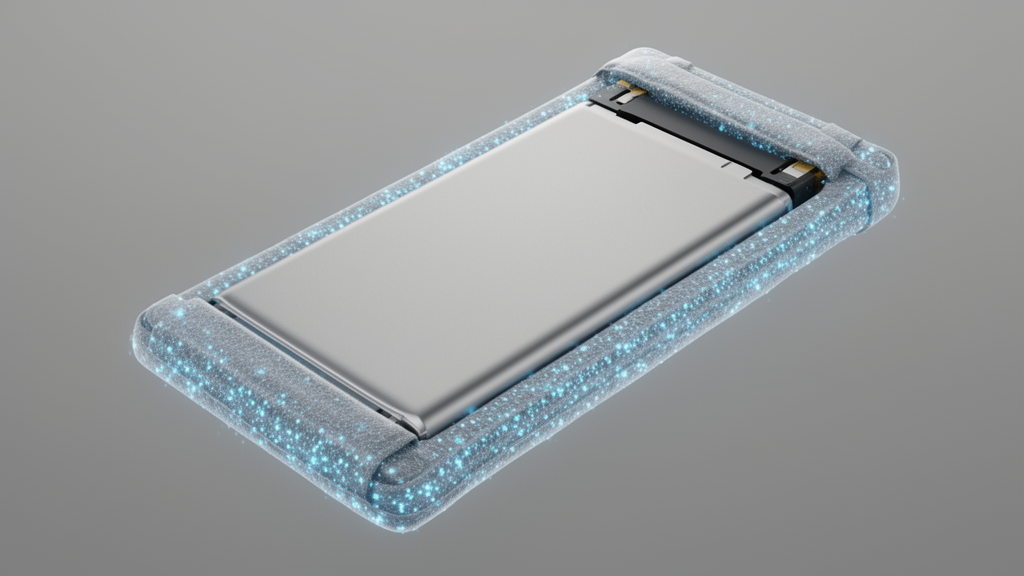
To evaluate whether nanoparticle additives can overcome this conductive bottleneck, the authors examined a conjugate geometry incorporating an explicit prismatic cell flanked on its large vertical faces by two twelve-millimeter-thick composite jackets. The modeled cell measured 70 millimeters in width, 150 millimeters in height, and 27 millimeters through its thickness, establishing a combined interface contact area of 0.021 square meters across the large faces. Heat generated inside the homogenized cell body conducts through the interfaces into the jackets, while natural convection removes heat from the external jacket surfaces into ambient air at a heat transfer coefficient of 20 watts per square meter-kelvin. The top and bottom edges of the assembly were treated as adiabatic boundaries. By retaining the cell inside the computational domain with its own distinct volumetric thermal mass and properties, the numerical framework predicted actual internal cell temperatures rather than approximate phase change interface values, while treating out-of-plane width consistently to enforce rigorous thermal accounting.
The composite jacket formulations incorporated organic paraffin RT42, which exhibits a nominal melting point of 42 degrees Celsius, blended with varying mass fractions of graphene nanoplatelets, copper oxide, or alumina nanoparticles. Dispersed particle mass fractions of 2, 5, and 10 percent were converted into corresponding volume fractions to establish effective composite densities, volumetric heat capacities, and latent heats through volume-fraction mixture rules. Effective thermal conductivity was evaluated using the classical Hamilton-Crosser relation, assigning an empirical shape factor of six to simulate planar graphene nanoplatelets and a factor of three for near-spherical metal oxide particles. The researchers designated five weight percent as the primary realistic design loading, classifying the ten weight percent graphene formulation as an extrapolative upper reference because dilute mean-field equations omit microstructural particle agglomeration, non-ideal latent heat degradation, and physical percolation networks.
Internal thermal loads within the 50 ampere-hour prismatic cell were governed by a Bernardi-type heat-generation model comprising irreversible joule heating across an internal resistance of 0.9 milliohms and reversible entropic heat exchange. The entropic coefficient was set to an illustrative exothermic value of negative 0.30 millivolts per kelvin evaluated at a reference temperature of 45 degrees Celsius. Under these specifications, constant-current discharge rates of 1 C, 2 C, and 3 C imposed heat-generation rates of 7.0, 18.5, and 34.6 watts for their physical durations of 3600, 1800, and 1200 seconds, with the reversible entropic term contributing 68, 51, and 41 percent of total generated heat, respectively. To reproduce realistic current-collector concentration effects without fully resolving three-dimensional tab hardware, the volumetric heat source was distributed non-uniformly along the cell height using a normalized parabolic profile weighted toward the top tab region, establishing genuine two-dimensional thermal and melting profiles across the computational plane.
The transient conduction problem throughout the cell and phase change jackets was discretized using a two-dimensional finite-volume method on a structured mesh, placing control-volume faces directly along material interfaces with harmonic-mean face conductivities. Latent heat absorption within the jackets was implemented via an apparent-heat-capacity formulation, smoothing the liquid fraction across a four-kelvin interval centered at 42 degrees Celsius using a hyperbolic tangent function to avoid solving complex moving-boundary interface coordinates. Grid- and time-step independence analyses conducted on a reference 2 C discharge at 30 degrees Celsius verified that a medium grid of 1672 control volumes and a five-second time increment converged peak cell temperatures to within 0.05 kelvin, jacket-averaged molten fractions to within 0.003, and melt-front penetration positions to within 0.03 millimeters.
Rigorous numerical verification established the integrity of the finite-volume solver prior to parametric evaluation. When benchmarked against the exact two-phase Neumann similarity solution for an analytical Stefan melting problem, the finite-volume code tracked the advancing phase change boundary to within 0.15 millimeters and reproduced the analytical temperature profile with a root-mean-square error of 0.17 kelvin and a maximum local deviation of 0.39 kelvin. Furthermore, a-posteriori global energy accounting demonstrated that the total energy balance closed to within 0.05 percent across all discharge rates for the primary five weight percent graphene composite, confirming that cumulative heat generation matched the integrated sum of sensible cell storage, sensible jacket storage, latent phase transition storage, and exterior convective losses. Latent heat uptake accounted for an increasingly dominant share of total energy absorption at elevated discharge rates, whereas convective losses were proportionally larger during prolonged, low-rate discharges.
Alongside the primary finite-volume solver, the study developed a physics-informed neural network to solve a one-dimensional through-thickness melting sub-problem across a single twelve-millimeter composite jacket subjected to a constant 2 C-equivalent heat flux of 883 watts per square meter. The deep learning surrogate comprised six fully connected hidden layers containing 64 hyperbolic tangent units, utilizing automatic differentiation to incorporate the dimensionless partial differential equation residual and convective boundary losses directly into its objective function. An exact hard constraint enforced initial conditions by multiplying the neural output by dimensionless time, with training carried out using 1000 Adam optimization steps followed by L-BFGS refinement. When verified against a one-dimensional finite-volume reference, the physics-informed network achieved a temperature root-mean-square error below 0.32 kelvin across all evaluated transient snapshots, with a maximum absolute discrepancy of 0.40 kelvin at the conclusion of discharge. The authors emphasized that the neural network served strictly as an isolated numerical verification exercise for one-dimensional melting and did not generate any of the two-dimensional battery cooling data.
Detailed comparative analyses across filler types revealed that pure paraffin RT42 allowed the cell to reach a maximum temperature of 55.3 degrees Celsius at the end of a 2 C discharge in a 30 degrees Celsius ambient environment, slightly surpassing the 55 degrees Celsius baseline threshold. Adding five weight percent graphene nanoplatelets suppressed this peak to 54.7 degrees Celsius, achieving a modest reduction of 0.6 degrees Celsius, whereas identical loadings of alumina and copper oxide yielded final peaks of 55.1 and 55.2 degrees Celsius, respectively. Increasing graphene content to the extrapolative ten weight percent loading lowered the peak to 54.1 degrees Celsius, delivering a 1.2 degrees Celsius reduction. Across an expanded operating envelope spanning 25, 30, and 35 degrees Celsius ambient temperatures, the primary five weight percent graphene jacket achieved peak reductions of 0.3 to 0.4 degrees Celsius at 1 C, 0.5 to 0.7 degrees Celsius at 2 C, and 0.8 to 0.9 degrees Celsius at 3 C. However, even with graphene enhancement, the cell reached 57.9 degrees Celsius at 2 C under a 35 degrees Celsius ambient, and exceeded 62, 65, and 69 degrees Celsius across all 3 C ambient cases, confirming that passive composite jackets cannot ensure thermal safety under aggressive duty cycles.
Investigation of melting dynamics showed that the phase change material never melted completely during the discharge transients, maintaining a stable internal melt front while outer regions remained relatively cool. At the end of a 2 C discharge at 30 degrees Celsius ambient, the jacket-averaged liquid fraction reached 0.343 for pure paraffin, 0.354 for five weight percent graphene, and 0.368 for the ten weight percent composite, while the time required to attain an average liquid fraction of 0.25 decreased from 24.4 minutes in pure paraffin to 23.5 minutes with five percent graphene. Meanwhile, spatial interface uniformity along the cell-jacket boundary exhibited an end-of-discharge standard deviation of approximately 2.0 kelvin and a peak-to-peak temperature variation of 5.7 kelvin. Variations in the calculated interface uniformity index across nanoparticle loadings remained below 0.05 percent, a magnitude smaller than the numerical grid resolution. The researchers concluded that within the constraints of an illustrative tab-weighted heat generation profile, nanoparticle addition produced no numerically resolvable improvement in surface temperature uniformity.
A systematic sensitivity analysis highlighted that the modest thermal improvements offered by nano-enhanced jackets are easily overshadowed by underlying electrothermal modeling choices and physical boundary uncertainties. Eliminating the reversible entropic heat term dropped the predicted peak cell temperature from 54.7 to 43.6 degrees Celsius, representing an 11.1 degrees Celsius downward shift that dwarfs the sub-degree gains achieved by nanoparticle additives. Similarly, introducing realistic interfacial contact resistances between the cell casing and the composite jacket increased peak internal temperatures by 0.2 to 0.8 degrees Celsius, largely canceling the conductive advantage of the graphene filler. The authors also cautioned that their conduction-only framework neglected buoyancy-driven liquid natural convection, which scaling estimates suggest could influence melting front behavior if vertical aspect ratios and melt thicknesses expand. Because the research constitutes a deterministic numerical verification rather than an experimentally validated campaign, all reported temperatures remain theoretical model predictions, with the complete finite-volume and neural network code base made publicly available via Zenodo to support independent replication.
Subject of Research: Numerical verification of nano-enhanced phase change material jackets for lithium-ion battery thermal management
Article Title: Transient thermal management of nano-enhanced phase change material jackets for lithium-ion batteries: a two-dimensional finite-volume numerical study with one-dimensional PINN verification
Article References: Alqurashi, F., & Khan, M. A. (2026). Transient thermal management of nano-enhanced phase change material jackets for lithium-ion batteries: a two-dimensional finite-volume numerical study with one-dimensional PINN verification. Journal of King Saud University – Engineering Sciences, 38(7), Article 53. https://doi.org/10.1007/s44444-026-00127-w
Image Credits: AI Generated
DOI: 10.1007/s44444-026-00127-w
Keywords: lithium-ion batteries, phase change materials, battery thermal management, nano-enhanced PCM, graphene nanoplatelets, finite volume method, physics-informed neural networks, paraffin RT42, transient heat transfer, Stefan problem, thermal runaway, prismatic cells, apparent heat capacity, numerical verification, heat generation modeling, latent heat
News Source: Faith Mcneil. (November 17, 2026). Nanoparticle-Enhanced Phase Change Jackets Modestly Reduce Prismatic Battery Peak Temperatures. Scienmag.