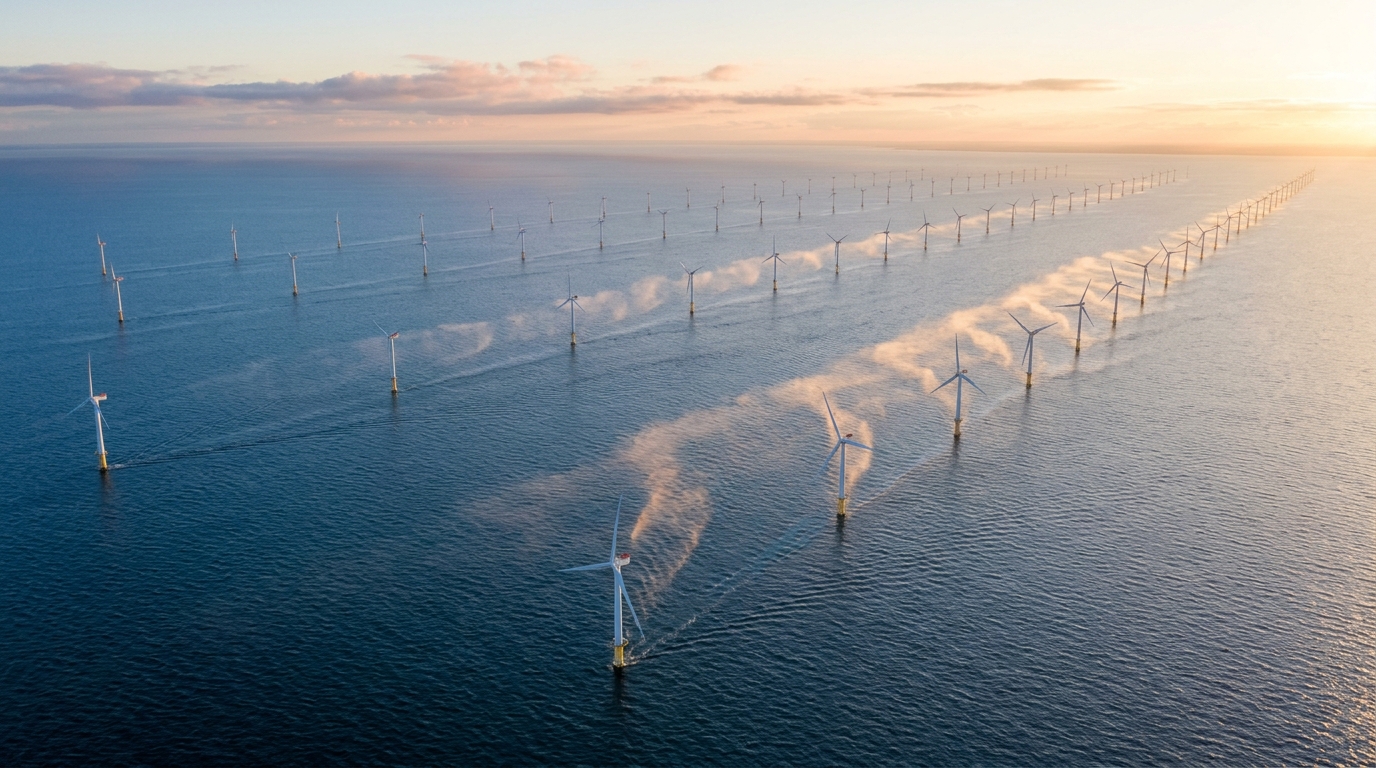
Differences in software implementation alone can introduce power prediction bias spreads of up to 4 percent in engineering wake models, matching the magnitude of discrepancies caused by selecting different wake models themselves. While discrepancies between predicted and observed wind farm power are routinely attributed to flaws in wake-model physics or inadequate calibration, wake modelling is only the final stage in a complex processing chain. Variations in power assessments can also originate from reconstructed inflow conditions, atmospheric sampling, and the specific software tools used to execute calculations.
To isolate these distinct sources of discrepancy, researchers evaluated the complete offshore wake modelling sequence from wind-resource assessment through to final power prediction. The analysis utilized operational SCADA data collected from two offshore facilities, the Westermost Rough and Anholt wind farms. These operating records were processed through two independently designed filtering workflows and complemented by profiling LiDAR observations alongside 1-kilometer-resolution Weather Research and Forecasting numerical simulations.
The reconstructed inflow states were applied to two engineering wake models, the Jensen model and the TurbOPark model, both configured to account for ambient turbulence intensity. To determine implementation-specific discrepancies, simulations were conducted across three widely used wake-modelling software platforms: FLORIS, PyWake, and FOXES. The WindIO data standard was employed to enforce identical input parameters across every software implementation.
Evaluating the data processing stages demonstrated that while the two SCADA-filtering workflows produced nearly interchangeable wind speed time series with biases of 0.04 meters per second or less and correlation coefficients near unity, they differed in wind direction by up to 7.27 degrees at the Anholt farm due to differences in northing calibration procedures. When supplied with identical inputs, the TurbOPark model exhibited bias spreads reaching 4 percent depending solely on software implementation, whereas the Jensen formulation yielded consistent results across all three software packages.
The study demonstrated that overall farm-level bias is an insufficient metric for validating model accuracy because error compensation across multiple turbines can yield near-zero farm-wide bias. These misleadingly low aggregate figures concealed binned farm-mean errors of plus or minus 5 percent and farm mean absolute errors exceeding 20 percent during atmospheric states characterized by very stable stratification or strong inflow heterogeneity, highlighting the necessity of evaluating root-mean-square error, correlation, and turbine-level metrics.
At the turbine scale, individual power prediction errors demonstrated a clear spatial correlation with wind speedup distributions, underscoring the requirement for wake assessments to account for localized wind speed gradients. These findings support shifting validation practices away from aggregate annual energy production metrics toward time-series and atmospheric condition-binned assessments, while reinforcing the need for heterogeneity-aware physics and shared community standards such as WindIO.
Subject of Research: Evaluation of wake-modelling workflows, software implementation bias, and atmospheric sensitivity in offshore wind farms
Article Title: Correlating wake-model performance to the atmospheric state: a SCADA-based analysis at two offshore wind farms
Article References: Lejeune, M., Vollmer, L., Coudou, N., Alcayaga, L., & Munters, W. (2026). Correlating wake-model performance to the atmospheric state: a SCADA-based analysis at two offshore wind farms. https://doi.org/10.5194/wes-2026-164
Image Credits: AI Generated
DOI: 10.5194/wes-2026-164
Keywords: offshore wind farms, wake modelling, SCADA data, Westermost Rough, Anholt wind farm, TurbOPark, Jensen model, FLORIS, PyWake, FOXES, WindIO, profiling LiDAR, WRF simulations, turbulence intensity, northing calibration, inflow heterogeneity, atmospheric stability
News Source: Denise Maddox. (November 17, 2026). Offshore Wind Wake Predictions Vary Up to Four Percent Across Software Implementations. Scienmag.