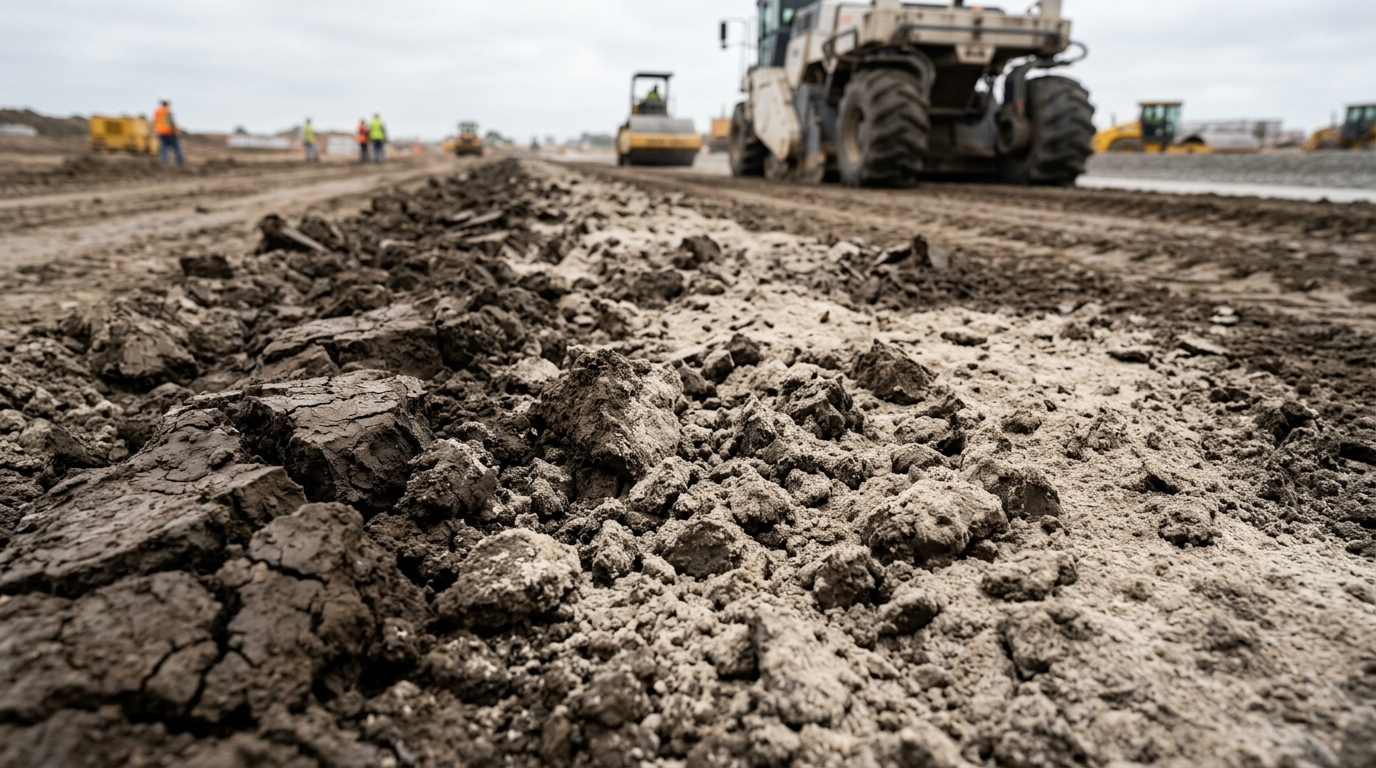
Sodium-silicate-activated sugarcane bagasse ash significantly improves the engineering properties and subgrade performance of expansive soil, according to a laboratory investigation published by researchers Thaneti Lilly Rani, Chappidi Hanumantha Rao, and Priyaranjan Sharma. Testing demonstrated that combining expansive clay with an optimum mixture of twelve percent sugarcane bagasse ash and 1.5 percent sodium silicate raised the California Bearing Ratio from an untreated baseline of 1.79 percent up to 9.42 percent.
The authors examined expansive soil because it is frequently used as a pavement subgrade material despite typically being unsuitable due to high plasticity, severe swelling potential, and poor load-bearing capacity. Agricultural and industrial byproducts are increasingly explored as sustainable alternatives to conventional chemical stabilizers. Baseline evaluations of the untreated CH soil confirmed these engineering deficiencies, recording a low California Bearing Ratio of 1.79 percent, a high plasticity index of 52.3 percent, and a high free swell index of 110 percent.
To determine stabilizing efficacy, the laboratory program tested sugarcane bagasse ash dosages ranging from zero to twenty percent alongside sodium silicate concentrations spanning zero to two percent. Specimen performance was monitored across curing periods of zero, seven, and twenty-eight days. The researchers tracked how these additive dosages and curing durations altered the index properties, compaction characteristics, strength parameters, and structural integrity of the soil under static and dynamic conditions.
Introducing sugarcane bagasse ash alone produced marked reductions in both soil plasticity and swelling behavior. Incorporating twelve percent ash lowered the plasticity index to 35.91 percent and decreased the free swell index to 65 percent. Adding sodium silicate activator yielded further performance gains, driving the minimum plasticity index down to 12.05 percent and the minimum free swell index down to 38 percent following twenty-eight days of curing. Compaction assessments also revealed enhanced densification, as the maximum dry density rose from 1.58 grams per cubic centimeter to 1.87 grams per cubic centimeter while the optimum moisture content decreased.
Performance under mechanical stress improved considerably under the optimum mix of twelve percent sugarcane bagasse ash and 1.5 percent sodium silicate. In cyclic plate load testing, the stabilized soil exhibited greater resistance under repetitive loading cycles. The ultimate load capacity climbed from 630 kilopascals in the untreated soil to 1400 kilopascals in the stabilized material, while total settlement dropped by 26.3 percent, demonstrating an improved ability to mitigate pavement rutting tendencies.
Microstructural investigations corroborated these macroscopic mechanical gains, showing pronounced differences in matrix architecture. While untreated specimens displayed poor particle arrangement, loose packing, and inadequate densification, the stabilized samples developed dense particle packing and enhanced structural coherence. Furthermore, multiple linear regression analysis demonstrated robust statistical correlations between the measured engineering properties and the stabilization variables, yielding R-squared values ranging from 0.79 to 0.97. Overall, the researchers concluded that sodium-silicate-activated sugarcane bagasse ash provides an effective and sustainable stabilization method for expansive subgrade soils.
Subject of Research: Expansive soil stabilization using sodium-silicate-activated sugarcane bagasse ash
Article Title: Engineering performance and microstructural characteristics of sodium silicate-activated bagasse ash for expansive soil stabilization
Article References: Rani, T. L., Rao, C. H., & Sharma, P. (2026). Engineering performance and microstructural characteristics of sodium silicate-activated bagasse ash for expansive soil stabilization. Discover Materials. https://doi.org/10.1007/s43939-026-01041-3
Image Credits: AI Generated
DOI: 10.1007/s43939-026-01041-3
Keywords: expansive soil, sugarcane bagasse ash, sodium silicate, soil stabilization, pavement subgrade, California Bearing Ratio, plasticity index, free swell index, cyclic plate load test, maximum dry density, optimum moisture content, microstructural analysis, multiple linear regression, rutting resistance, sustainable construction materials, CH soil, curing duration
News Source: Denise Maddox. (November 17, 2026). Activated Bagasse Ash Boosts Expansive Soil Subgrade Strength and Load Capacity. Scienmag.