Researchers have shown that heparan sulfate proteoglycans actively organize transmembrane semaphorin and plexin signaling complexes at the plasma membrane to tune cellular responses. Heparan sulfate proteoglycans reside at the cell surface and extracellular matrix, where they modulate diverse signaling pathways across biological systems. In neural tissue, semaphorins and their plexin receptors operate as a primary guidance system governing axonal trajectories. While earlier evidence implicated proteoglycans in modulating these axon guidance proteins, the mechanistic role played by the domain architecture of heparan sulfate at the cell surface previously remained unresolved.
Heparan sulfate chains display a distinct structural organization characterized by alternating less sulfated N-acetyl-rich regions and highly sulfated N-sulfo-rich clusters. In experiments examining fruit fly signaling components, investigators found that Drosophila transmembrane semaphorins Sema1a and Sema1b, along with their cognate receptor PlexA, directly bind heparan sulfate. Rather than interacting uniformly across the polysaccharide chain, these transmembrane guidance molecules preferentially associate with the less sulfated N-acetyl-rich domains.
This binding preference distinguishes transmembrane guidance cues from previously characterized soluble counterparts. Earlier investigations reported that secreted semaphorins typically favor interactions with highly sulfated N-sulfo-rich clusters along heparan sulfate chains. By contrast, the transmembrane semaphorins evaluated in this study exhibited an affinity pattern directed toward N-acetyl-rich sequences, demonstrating that distinct classes of guidance ligands engage distinct biochemical microdomains within the same cell-surface proteoglycan landscape.
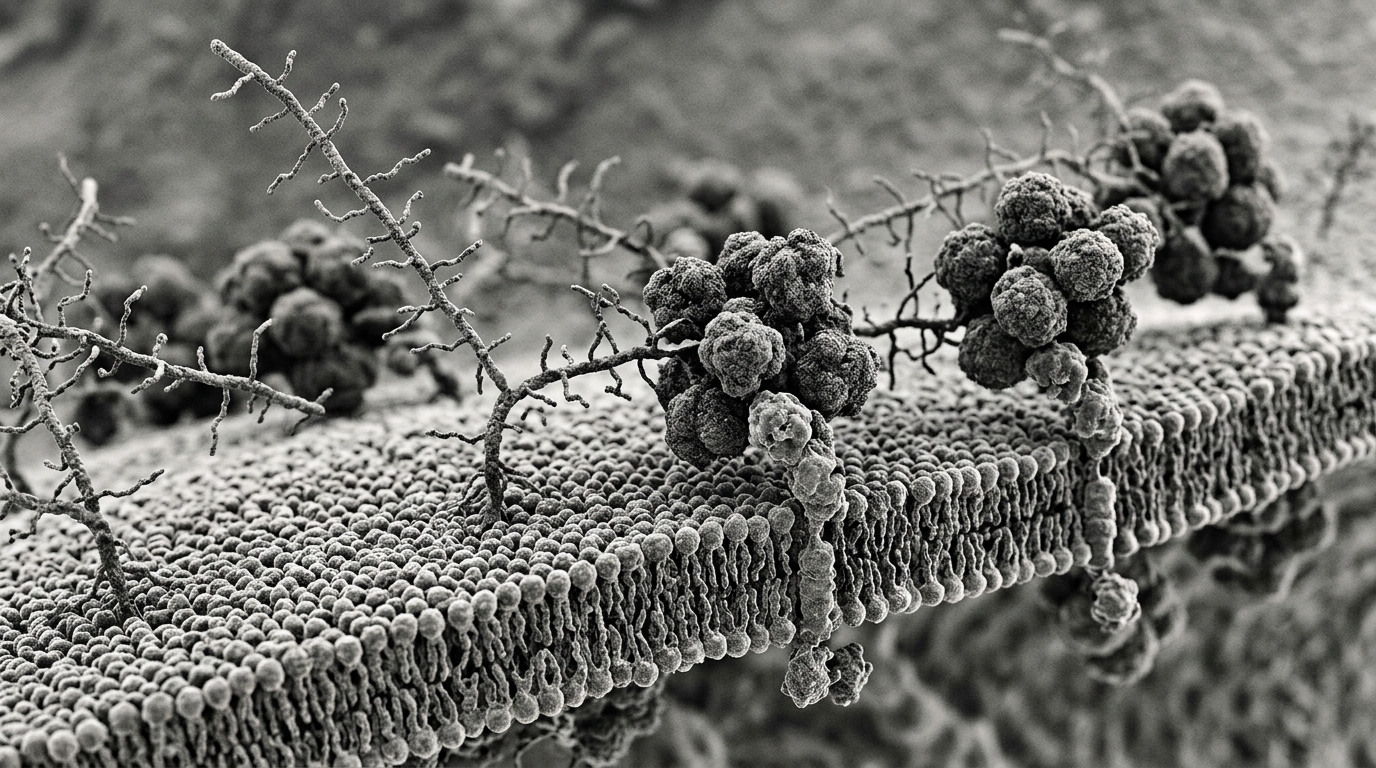
Engagement with N-acetyl-rich domains directly alters the biophysical behavior of the guidance cues on the membrane. Specifically, interaction with these less sulfated heparan sulfate regions promotes nanoscale clustering of Sema1a molecules at the cell surface. Concurrently, this association reduces the lateral mobility of Sema1a across the plasma membrane, an effect consistent with both elevated local surface density and longer dwell times for the clustered signaling molecules.
To assess the physiological significance of this organization, the researchers analyzed signaling responses in Drosophila neuronal cells. When enzymatic degradation was used to strip cell-surface heparan sulfate, the Sema1a-dependent cellular contraction response was significantly attenuated. This experimental outcome demonstrates that cell-surface heparan sulfate functionally modulates Sema1a reverse signaling, establishing that the physical clustering mediated by the polysaccharide directly affects downstream mechanical output.
The authors extended their analysis to evaluate whether similar regulatory mechanisms operate within vertebrate signaling pathways. In assays analyzing mouse PlexinD1, the receptor demonstrated greater spatial overlap with N-acetyl-rich heparan sulfate regions than with N-sulfo-rich domains, matching the organizational pattern observed in invertebrate models. Furthermore, cell-surface glycosaminoglycans were found to potentiate PlexinD1-dependent cell collapse triggered by Sema3E, confirming that heparan sulfate coordinates membrane dynamics and signaling outputs across both invertebrate and vertebrate systems.
Subject of Research: Heparan sulfate organization of transmembrane semaphorin and plexin signaling
Article Title: Heparan sulfate organizes transmembrane semaphorins at the cell surface to tune plexin signaling
Article References: Sobol, M., Cockova, Z., Nourisanami, F., Blazikova, M., Vlasak, J., Kowalska, K., Koziskova, N., & Rozbesky, D. (2026). Heparan sulfate organizes transmembrane semaphorins at the cell surface to tune plexin signaling. Cellular and Molecular Life Sciences. https://doi.org/10.1007/s00018-026-06529-y
Image Credits: AI Generated
DOI: 10.1007/s00018-026-06529-y
Keywords: heparan sulfate, heparan sulfate proteoglycans, transmembrane semaphorins, plexin signaling, PlexA, Sema1a, Sema1b, PlexinD1, Sema3E, axon guidance, plasma membrane, nanoscale clustering, lateral mobility, N-acetyl-rich domains, N-sulfo-rich domains, glycosaminoglycans, neuronal cell contraction, cell collapse
News Source: Drew Townsend. (November 17, 2026). Heparan Sulfate Clusters Transmembrane Semaphorins to Regulate Cell Surface Plexin Signaling. Scienmag.