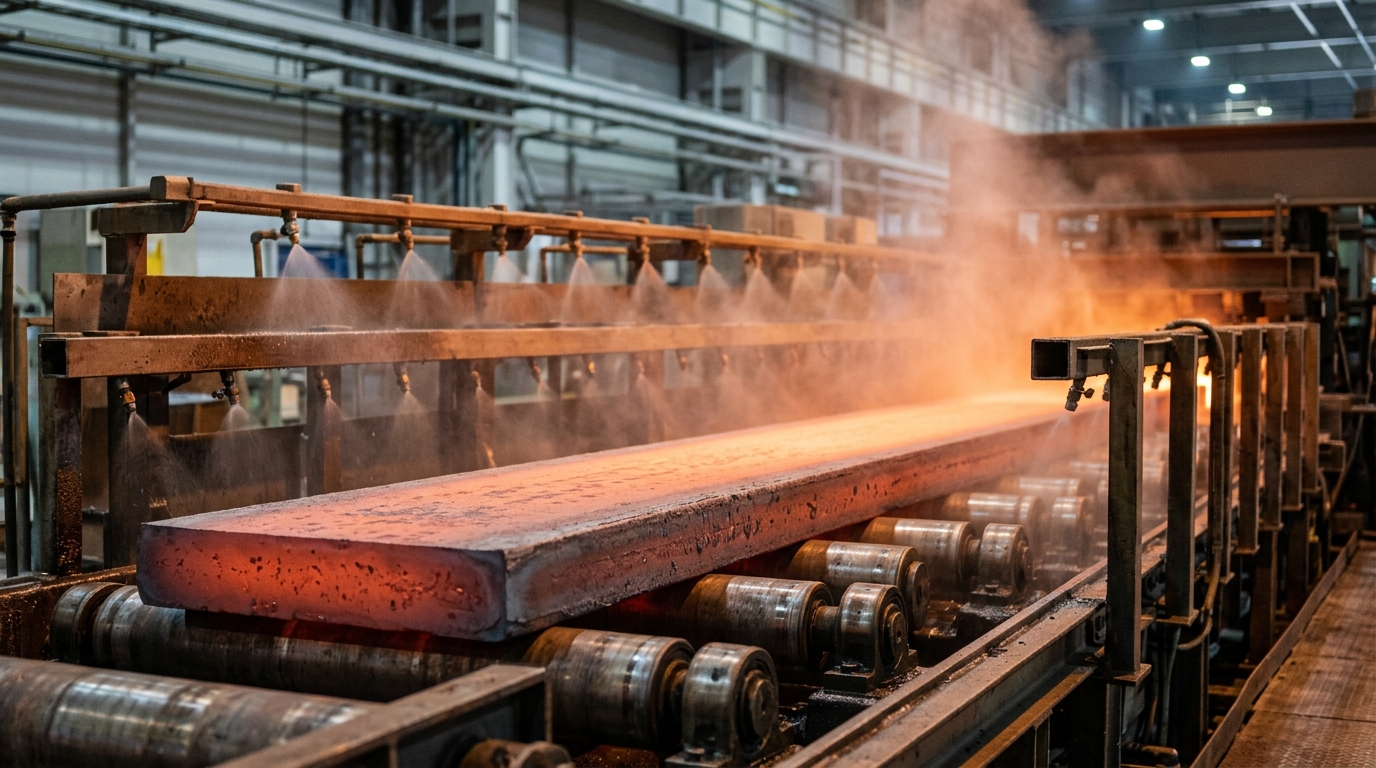
A comprehensive metallurgical review published in the Journal of Materials Science: Materials in Energy establishes that crack formation during steel solidification is fundamentally governed by high solid fractions between 0.90 and 0.99 near the mold meniscus alongside critical thermal gradients, requiring strict integration across primary reduction, electric arc furnace melting, ladle refining, and casting operations to eliminate product defects. The investigation synthesizes global operational data and theoretical transport models across modern steel processing chains, demonstrating that downstream structural integrity cannot be treated as an isolated casting phenomenon. Instead, thermodynamic, fluid-flow, and mass-transfer conditions established during primary reduction and secondary refining directly dictate subsequent phase transformations, inclusion morphology, and mechanical reliability. By systematically analyzing cross-stage variable interactions, the review identifies how industrial steelmakers can mitigate persistent structural vulnerabilities while transitioning toward low-carbon operating configurations, providing an empirical and theoretical framework that links chemical management in molten baths to the final crystallographic behavior of solidifying steel.
The structural vulnerability of solidifying steel originates in thermal regimes where dendritic arms coalesce into an impermeable network, trapping residual solute-rich liquid within restricted intercellular spaces. In continuous casting machines, which produce roughly eighty percent of North American steel, the thermal contraction of the solidifying shell directly dictates contact pressure against water-cooled copper mold plates. For low-carbon steel grades cast at speeds of 1.3 meters per minute, peak mold heat transfer ranges between 3100 and 3500 kilowatts per square meter, whereas high-carbon steels exhibit elevated peak transfers between 3450 and 4400 kilowatts per square meter under equivalent geometry.
These solidification challenges are heavily compounded by upstream decisions in primary reduction, particularly as the industry explores decarbonization alternatives to conventional blast furnace and basic oxygen furnace infrastructure. While traditional blast-furnace operations consume roughly eight hundred kilograms of coal to yield one ton of crude steel and simultaneously generate 1.9 tons of carbon dioxide, emerging direct reduction iron processes utilizing green hydrogen promise carbon emission reductions reaching ninety percent. However, primary chemical substitutions propagate complex metallurgical penalties into subsequent melting units. Hydrogen-reduced iron sponge lacks the native carbon concentrations found in pig iron, elevating the melting point of pure iron to 1811 Kelvin and promoting the agglomeration of unmelted solid clusters known as ferrobergs. Metallurgical analyses confirm that an operational charge containing eighty percent hydrogen-reduced hot briquetted iron and twenty percent scrap nearly doubles electric arc furnace slag volume while suppressing the phosphorus distribution ratio, obligating operators to inject supplemental carbon and calcium oxide to restore dephosphorization performance comparable to full-scrap charges.
Chemical carry-over between stages also exerts severe consequences on dissolved gas management and final microstructural performance. Unpurged dissolved nitrogen subsequently forms Cottrell atmospheres around mobile dislocations during cold processing, exacerbating strain aging and compromising product ductility unless fixed through titanium microalloying to precipitate stable titanium nitride particles. Furthermore, hydrogen contamination introduced through raw material moisture or carrier gases demands stringent thermal dehydration of lime and dolomite flux additions. Dissolved hydrogen easily permeates ferritic crystal lattices via interstitial diffusion, saturating internal defect traps and precipitating hydrogen-induced cracking within martensite-austenite constituents of high-strength low-alloy and naval linepipe steels. Secondary vacuum degassing reactors operating at pressures below one millibar achieve essential dehydrogenation down to five parts per million while facilitating denitrification below twenty parts per million and ultra-low carbon levels under fifteen parts per million.
Within the melting vessel, physical transport phenomena dictate energy efficiency and refractory survival under intense operating environments. Thermal conductivity in molten steel declines as bath temperature increases, exacerbating thermal stratification and requiring active gas or electromagnetic stirring to homogenize liquid metal before tapping. Radiative heat transfer generated by electric arcs scales with the fourth power of absolute temperature according to the Stefan-Boltzmann relationship, requiring durable refractory linings composed of magnesite, magnesia-carbon bricks, dolomite, silica, and alumina that withstand bath temperatures reaching 3200 degrees Fahrenheit over campaigns lasting up to twenty thousand heats. Vessel shells and roofs rely on specialized water-cooling tubular panels coated with ceramic-pigmented inorganic silicone paints, demanding shell water circulation rates of 170 liters per minute per square meter and roof rates of 190 liters per minute per square meter. To suppress internal panel calcification, corrosion, and severe pressure differentials above three pounds per square inch, cooling water chemistry must maintain neutral pH values between 6 and 8, dissolved solids below 140 parts per million, suspended solids under 18 parts per million, chloride ions below 90 parts per million, and silicon concentrations under 25 parts per million.
Refining efficiency inside the electric arc furnace and subsequent ladle stations depends critically on slag engineering and basicity adjustment. Basicity ratios of calcium oxide to silicon dioxide exceeding 1.0 favor the concurrent extraction of phosphorus and sulfur from the bath into the molten slag layer. However, when slag basicity reaches or exceeds 1.5, the slag disintegrates into a fine dispersible powder upon cooling due to the polymorphic volume expansion of dicalcium silicate, impairing secondary handling and reprocessing. To optimize desulfurization, industrial furnaces inject powdered reagents such as calcium oxide, magnesium granules, and sodium carbonate, with specialized ladle furnace slags demonstrating sulfur extraction efficiencies of 82.6 percent, equivalent to 30.46 kilograms per metric ton of processed metal. Successful dephosphorization imposes an indispensable upstream constraint: the metal bath must be desiliconized below 0.15 percent silicon before phosphorus can be effectively partitioned into the slag phase. Advanced furnace variants like the Full-Multi-Refining Converter achieve total slag removal, overcoming the phosphorus limit of 0.010 percent observed in standard converter operations that retain thirty percent of slag volume.
Secondary metallurgy and inclusion engineering represent the vital transition zone where dissolved deoxidation products are converted into harmless phases before casting. When aluminum is introduced to deoxidize liquid steel containing between 400 and 800 parts per million of dissolved oxygen, it rapidly precipitates alumina inclusions that feature high interfacial tension against liquid iron. These rigid, angular alumina particles readily cluster, causing nozzle clogging during tundish discharge and serving as catastrophic stress concentrators in rolled products. To mitigate this hazard, ladle metallurgists deploy cored wire feeding containing calcium or rare earth metals such as cerium and lanthanum. Introducing 0.026 percent cerium chemically alters alumina inclusions into rounded rare earth oxysulfides while refining their diameter below five micrometers. Similarly, balanced additions of 0.021 percent niobium and 0.042 percent cerium activate multiple strengthening mechanisms, including grain boundary pinning and precipitation hardening, whereas industrial mischmetal treatments composed of 0.060 percent cerium, 0.025 percent lanthanum, and 0.024 percent neodymium consistently modify inclusions when applied at 0.2 kilograms per hundred kilograms of liquid steel.
Fluid dynamics and thermal insulation within the tundish and mold assemblies ultimately govern whether remaining inclusions float into protective slag covers or freeze into final steel matrices. Flotation follows Stokesian mechanics, yet physical models indicate that buoyancy forces alone separate merely ten percent of non-metallic particles measuring twenty micrometers in diameter, necessitating flow control devices such as dams, weirs, stopper rods, and ceramic mullite filters to lengthen residence times. Simultaneously, mold lubrication powders applied to the molten meniscus provide essential thermal resistance, decreasing heat transfer by five to eighteen percent for steels with carbon contents above 0.1 percent. Innovative methods such as feeding internal steel strips reduce meniscus temperatures by up to twenty Kelvin, homogenizing localized thermal gradients and curbing dangerous solute convection currents.
Macrosegregation patterns during solid-phase transformation exhibit distinct spatial variations depending on the selected pouring methodology. In bottom-pour ingot casting, directional cooling against insulating ceramic molds encourages progressive crystallization from exterior walls inward. Deploying electromagnetic stirring within continuous casting blooms broadens the central equiaxed crystal zone and suppresses shrinkage porosity, but tangential liquid flow drags segregated solutes into surrounding channels, creating depleted white band defects. These white bands exhibit altered chemical composition that diminishes local hardenability and distorts thermal response during subsequent induction heat treatment, proving that excessive or poorly synchronized electromagnetic agitation introduces secondary quality hazards while attempting to resolve primary segregation.
The review concludes that achieving sustainable, high-efficiency steel manufacturing requires balancing rapid decarbonization strategies with rigorous thermochemical control across the entire process sequence. Replacing pulverized coal with 27.5 kilograms of heated hydrogen per ton of iron reduces carbon dioxide output by 21.4 percent, while advanced closed systems like vacuum arc remelting eliminate volatile combustion emissions entirely without generating synthetic slag waste. Nevertheless, industrial adoption of hydrogen reduction, molten salt electrolysis, and automated digital controls remains constrained by elevated capital costs, energy conversion losses, and raw material chemical variability. Advanced numerical simulations require coupling with compressible multiphase flow solvers and real-time sensor networks, including point-gap mold monitors and optical emission spectrometry, to validate theoretical predictions under production conditions. Ultimately, the systematic alignment of primary reduction feedstocks, slag basicity kinetics, precise gas degassing, and controlled mold extraction forms an indispensable metallurgical bridge, enabling global producers to satisfy exacting defect standards while achieving deep industrial decarbonization.
Subject of Research: Metallurgical process integration across primary reduction, ladle refining, and solidification for defect control and decarbonization
Article Title: Next-generation steelmaking: process integration and technological advances in primary reduction, ladle metallurgy, and solidification
Article References: Campos Becerra, L. H. (2026). Next-generation steelmaking: process integration and technological advances in primary reduction, ladle metallurgy, and solidification. Journal of Materials Science: Materials in Energy, 2(1), Article 31. https://doi.org/10.1007/s44308-026-00044-z
Image Credits: AI Generated
DOI: 10.1007/s44308-026-00044-z
Keywords: steelmaking, ladle metallurgy, continuous casting, solidification defects, primary reduction, direct reduced iron, electric arc furnace, vacuum degassing, secondary refining, slag basicity, dephosphorization, desulfurization, rare earth elements, electromagnetic stirring, process integration, decarbonization, green steel
News Source: Denise Maddox. (November 17, 2026). Integrated Steelmaking Controls Minimize Solidification Cracks and Support Green Process Transitions. Scienmag.