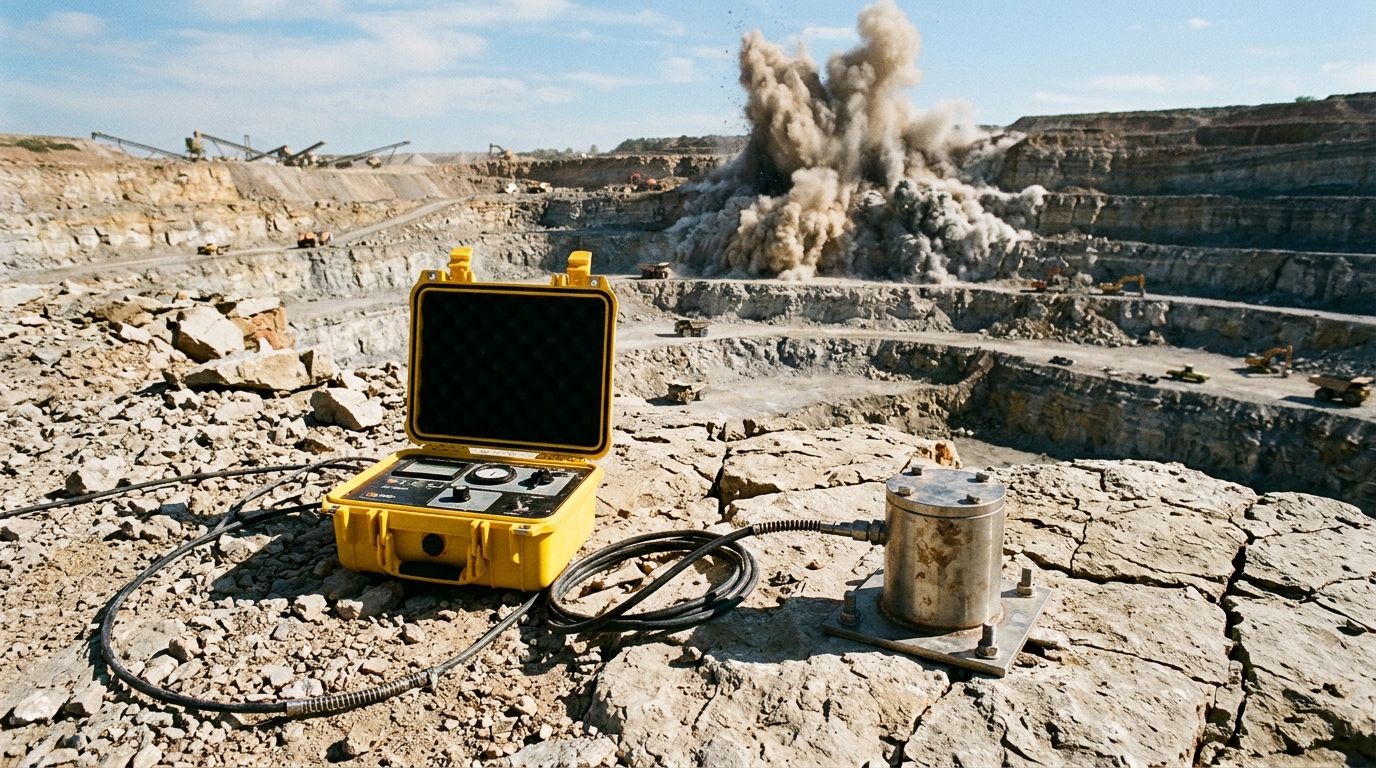
A hybrid artificial intelligence framework integrating an enhanced swarm intelligence algorithm with random forest regression has demonstrated superior precision in estimating blast-induced ground vibrations during open-pit mining operations. According to research published in the Journal of Engineering and Applied Science by a team of engineering researchers, the newly developed multi-strategy improved greylag goose optimization random forest model attained a coefficient of determination of 0.9641, a root mean square error of 0.3100, and a mean absolute error of 0.2574 on an independent testing dataset. By coupling decision-tree ensembles with four systematic mathematical improvements to the bio-inspired greylag goose metaheuristic, the investigators resolved longstanding optimization bottlenecks that historically degraded machine learning predictions of peak particle velocity. The resulting model markedly outperformed classical empirical formulas and unoptimized machine learning baselines while maintaining rigorous transparency regarding how individual blast design parameters govern surface vibration intensities across rock masses.
Excessive blast-induced vibrations frequently jeopardize the structural integrity of neighboring civilian infrastructure, trigger slope instability across engineered pit walls, and cause profound environmental disturbances for adjacent residential communities. Peak particle velocity serves as the globally recognized engineering metric for assessing blast vibration severity and regulating site safety thresholds. Accurately predicting this velocity plays an important role in vibration safety evaluation and the optimization of blasting parameters. Nevertheless, mining engineers encounter immense analytical difficulties when forecasting peak particle velocity because rock mass blasting involves severe physical nonlinearities, non-stationary wave dynamics, and intricate coupling mechanisms between explosive detonation energy, multi-layered geological discontinuities, and three-dimensional propagation pathways.
For decades, mining operations have primarily relied on traditional empirical equations, most notably the formulas developed by the United States Bureau of Mines and Ambraseys, to approximate ground vibration attenuation. Although these empirical equations are simple to calculate in field offices, their mathematical formulation restricts input variables to a small set of parameters, typically confined to monitoring distance and explosive charge weight per delay. This structural simplification prevents empirical models from capturing the complex multi-factor interactions that occur among borehole confinement, spatial firing geometry, and variable rock mass properties. Even when modified formulas incorporate localized geological indices, they exhibit poor generalization capabilities and fail to dynamically adjust to changing geotechnical conditions across benches. While data-driven machine learning algorithms like random forest can model high-dimensional nonlinear relationships without overfitting, their predictive performance remains fundamentally constrained by manual hyperparameter selection, demanding automated, gradient-free optimization frameworks.
To overcome the hyperparameter sensitivity inherent in random forest regression, the researchers engineered the multi-strategy improved greylag goose optimization algorithm. The standard greylag goose optimization framework mimics the cooperative behaviors of wild geese, utilizing dynamic flock formation, sentinel alerts, and collaborative foraging to balance search space exploration with local exploitation. However, standard iterations often suffer from uneven initial population distributions, monotonic search trajectories, and premature convergence into local minima. The research team introduced four complementary algorithmic strategies to mitigate these shortcomings: a compound Logistic-Tent chaotic map to establish uniform initial search diversity, a nonlinear exponential parameter control strategy that smoothly transitions the search radius from wide-area exploration to aggressive local exploitation, a lens opposition-based learning mechanism grounded in optical refraction principles to escape deceptive attraction basins, and an elite-guided local fine search perturbation that systematically refines candidate solutions around top-ranked individuals during terminal iterations.
Prior to deploying the enhanced metaheuristic on engineering datasets, the investigators verified the mathematical performance of the multi-strategy greylag goose optimization algorithm across twelve standardized benchmark functions. This validation suite comprised four unimodal functions designed to evaluate convergence rates, four multimodal functions structured with numerous deceptive local optima, and four fixed-dimensional functions assessing multidimensional stability. Across thirty independent experimental trials with a population size of thirty agents and a cutoff of one thousand iterations, the improved algorithm consistently converged to theoretical optimal values on all unimodal benchmarks with zero standard deviation, substantially outpacing standard greylag goose optimization, the seagull optimization algorithm, golden jackal optimization, the whale migration algorithm, and red-billed blue magpie optimization.
The engineering validation of the predictive framework was conducted using field-measured production records gathered from an active open-pit limestone quarry utilizing deep-hole bench blasting methods. Professional blasting vibration recording instruments operating at a sampling rate of two kilohertz monitored ground motions, capturing one hundred and nineteen high-quality, fully documented blasting events following signal preprocessing and outlier filtering. To capture the full physical evolution of ground motion across source energy release, propagation pathways, geometry, and operational techniques, six fundamental engineering variables were tabulated for each event: total charge quantity, maximum charge per delay, distance between blast source and monitoring station, drilling depth, minimum burden, and powder factor. Statistical screening revealed that monitoring distances spanned from 23.40 meters to 433.00 meters, while linear correlation analysis demonstrated a strong inverse correlation of negative 0.66 between monitoring distance and measured peak particle velocity, alongside an expected positive correlation of 0.81 between maximum charge per delay and drilling depth.
To construct the predictive framework, the researchers partitioned the field dataset into an eighty percent training partition and an independent twenty percent testing subset, standardizing features via Min-Max scaling calibrated strictly on training samples to prevent information leakage. Hyperparameter optimization targeted three core random forest variables: the total number of decision trees bounded between one and five hundred, the candidate feature subset size bounded between one and six, and the minimum leaf node sample size bounded between one and twenty. Evaluating population sizes of ten, twenty, forty, sixty, eighty, and one hundred agents across one hundred and twenty iterations, five-fold cross-validation root mean square error served as the objective fitness metric.
When evaluated against independent test records, the multi-strategy greylag goose optimized random forest model demonstrated definitive predictive superiority over all evaluated models. The optimized framework achieved a testing coefficient of determination of 0.9641, a root mean square error of 0.3100, a mean absolute error of 0.2574, a variance accounted for of 96.5823 percent, and a Willmott index of agreement of 0.9908. In direct comparison with an unoptimized baseline random forest model, the enhanced optimization reduced testing root mean square error by 49.21 percent, mean absolute error by 47.24 percent, and mean squared error by 74.19 percent, while elevating the coefficient of determination from 0.8609. The framework also outperformed back-propagation neural networks, support vector regression, and calibrated empirical formulas, while exhibiting comparable performance to the standard greylag goose random forest. Specifically, empirical formulas produced markedly inferior test coefficients of determination of 0.6561 for the United States Bureau of Mines equation and 0.7204 for the Ambraseys formulation, displaying systematic underestimation at elevated vibration amplitudes.
To demystify the internal decision logic of the optimized machine learning ensemble, the researchers applied cooperative game theory through Shapley additive explanations, evaluating global feature rankings alongside local sample dependencies. Global attribution analysis revealed that the distance between the blast source and the monitoring station represented the dominant governing factor in peak particle velocity prediction, contributing 59.5 percent of the overall model influence with a mean absolute Shapley value of 1.588. Maximum charge per delay and drilling depth followed with contributions of 10.2 percent and 9.7 percent, while powder factor and total charge quantity each contributed 7.6 percent, and minimum burden exerted the lowest influence at 5.5 percent. Beeswarm and feature dependence plots confirmed that monitoring distance displayed a steep inverse nonlinear relationship with vibration amplitude before flattening in far-field regions, maximum charge per delay exhibited an accelerating positive influence, drilling depth displayed diminishing positive marginal returns, and total charge quantity followed an inverted U-shaped pattern.
Computational efficiency assessments revealed that while the four algorithmic enhancement strategies increased the mean runtime of the optimization procedure to 392.39 seconds compared to 345.12 seconds for baseline greylag goose optimization, this 13.70 percent temporal increase remained highly competitive against other metaheuristics like red-billed blue magpie optimization, which averaged 660.12 seconds. Despite these strong predictive achievements, the authors noted several boundary constraints that define the scope of their conclusions. Because the experimental dataset was derived from one hundred and nineteen discrete blasting events conducted within a single open-pit limestone quarry characterized by relatively uniform lithology, the derived numerical weights cannot be directly extrapolated to radically different geologic formations without localized retraining. The researchers emphasized that applying this hybrid framework to different mining environments may require site-specific recalibration or retraining, recommending that future investigations incorporate multi-source data across diverse geological conditions to broaden model generalizability.
Subject of Research: Blast-induced peak particle velocity prediction using random forest optimized by multi-strategy greylag goose optimization
Article Title: Assessment of blast-induced peak particle velocity using random forest optimized by multi-strategy greylag goose algorithm
Article References: Yang, R., Zhang, G., Ye, Y., Chong, J., & Wang, Z. (2026). Assessment of blast-induced peak particle velocity using random forest optimized by multi-strategy greylag goose algorithm. Journal of Engineering and Applied Science, 73(1), Article 458. https://doi.org/10.1186/s44147-026-01327-6
Image Credits: AI Generated
DOI: 10.1186/s44147-026-01327-6
Keywords: peak particle velocity, random forest, greylag goose optimization, metaheuristic algorithm, open-pit mining, ground vibration, blast safety, SHAP analysis, hyperparameter tuning, chaotic mapping, lens opposition-based learning, bench blasting, limestone quarry, vibration attenuation, predictive modeling, machine learning regression
News Source: Denise Maddox. (November 17, 2026). Optimized Random Forest Model Accurately Predicts Blast Induced Ground Vibration Levels. Scienmag.