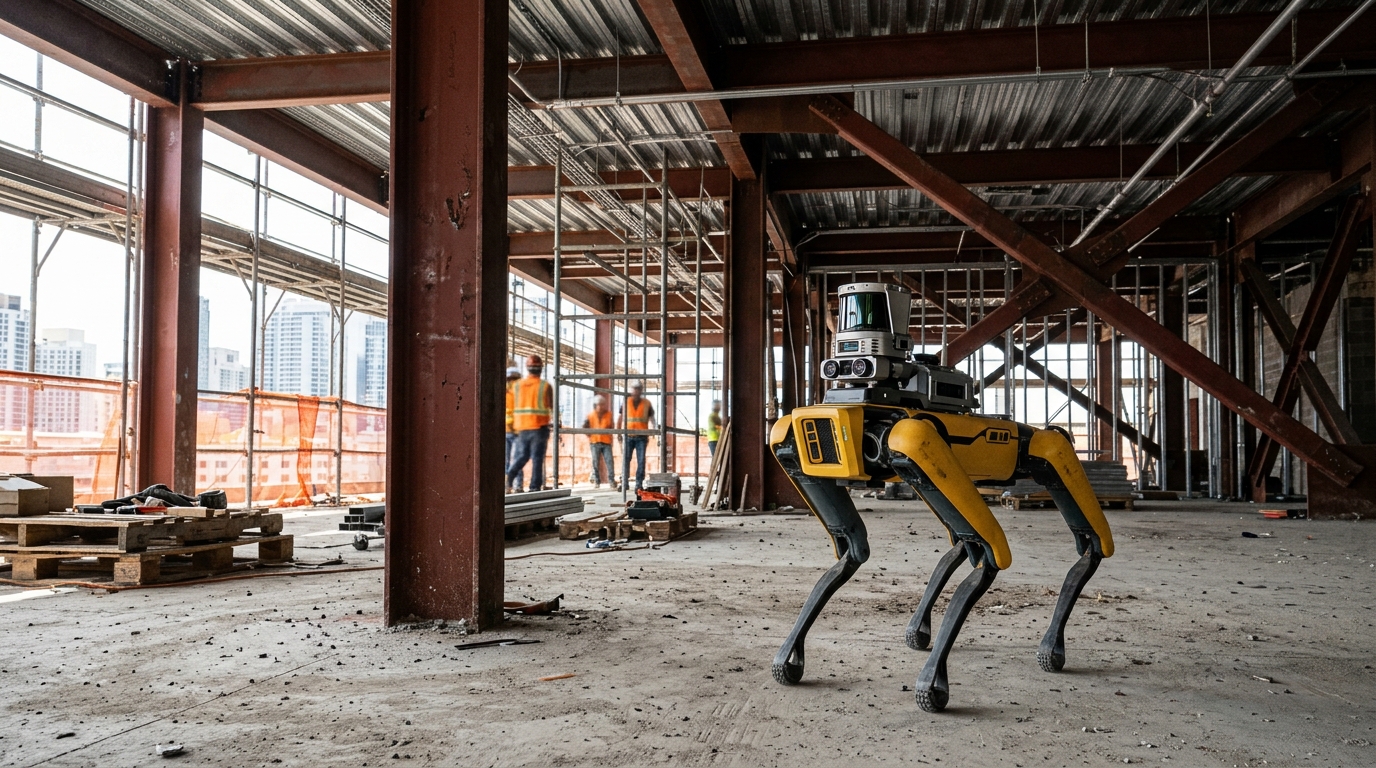
Robotic environmental perception in complex building environments took a measurable step forward as researchers introduced CRobot-SECOND, an enhanced three-dimensional point cloud object detection framework designed specifically for mobile safety inspection robots operating on active construction sites. Developed by an engineering team led by Jiarong Li, Chunyong Feng, Junqi Yu, and colleagues, the system pairs multi-frame point cloud input enhancement with a streamlined two-dimensional convolutional backbone. In experimental validation using actual construction site data, the architecture significantly improved the detection of construction workers and construction vehicles while reducing the underlying neural network’s computational footprint and accelerating inference frame rates beyond baseline standards.
Building construction sites represent notoriously hazardous and visually complex working environments where traditional manual safety inspections face persistent constraints in operational efficiency, inspection coverage, and the objective traceability of safety records. While autonomous mobile inspection robots carrying environmental sensors have emerged as promising solutions for site monitoring, path planning, and obstacle avoidance, their onboard perception capabilities encounter severe technical hurdles. Unlike autonomous driving vehicles that utilize dense multi-channel sensors and substantial onboard compute clusters, mobile inspection robots typically rely on sparse, low-channel Light Detection and Ranging units and operate within strict limits on payload, battery consumption, processing capacity, and heat dissipation.
A critical engineering obstacle in deploying three-dimensional LiDAR detection on such platforms is the severe sparsity of low-channel point clouds over long distances, coupled with frequent dynamic interference. While accumulating multiple consecutive temporal LiDAR frames can supplement geometric details, direct frame superposition in active work zones inevitably introduces prominent motion ghosting and spatial tearing artifacts as workers and heavy machinery move between sweeps. At the algorithmic level, established three-dimensional voxel detectors like Sparsely Embedded Convolutional Detection rely heavily on standard two-dimensional convolutions across large Bird’s-Eye-View feature maps, generating substantial computational redundancy that strains embedded robotic hardware.
To overcome these coupled physical and computational bottlenecks, the investigators structured CRobot-SECOND as a unified perception pipeline encompassing two cooperative improvements: a ground-constrained point cloud fusion method with motion compensation and a lightweight, attention-augmented Bird’s-Eye-View backbone. The front-end fusion algorithm addresses input sparsity by aligning adjacent low-channel LiDAR frames without blurring moving objects. It first limits processing to an operational Region of Interest radius of 30 meters, eliminating distant sensor noise, before extracting stable ground geometric planes using the Random Sample Consensus algorithm to estimate reliable inter-frame coordinate transformations.
Because the construction ground plane remains structurally stable across consecutive frames, separating ground returns allows robust coarse-to-fine registration through initial sample consensus and Iterative Closest Point refinement. The workflow employs a dual-threshold scheme where a strict threshold of 0.2 meters extracts highly reliable ground surfaces for pose calculation, followed by a looser 0.5-meter threshold that retains ground continuity during final frame assembly. For dynamic non-ground elements, the pipeline applies Density-Based Spatial Clustering of Applications with Noise, computes spatial cluster centroids across adjacent sweeps, and matches clusters within a 1.5-meter association threshold to compute localized translation compensation vectors before merging the point clouds.
Once point clouds are enriched and dynamic ghosting suppressed, the data enters an optimized detection network built upon the voxelized representation and three-dimensional sparse convolutions of the SECOND detector. To minimize computational latency without sacrificing spatial resolution, the researchers replaced standard dense convolutions in the network’s two-dimensional Bird’s-Eye-View feature extraction stages with Partial Convolution modules. Configured with a channel division factor of four, the module applies three-by-three spatial convolutions to only one-quarter of the feature channels while transferring the remaining three-quarters through identity mappings, subsequently mixing channel information via a one-by-one point-wise convolution.
To counteract any loss of fine-grained spatial representation caused by partial-channel processing, the team embedded the Simple Parameter-Free Attention Module at the conclusion of each Bird’s-Eye-View stage. SimAM calculates spatial energy functions across feature channels based on statistical variance, assigning higher attention weights to distinctive regions such as distant, partially occluded workers or low-contrast equipment without adding trainable parameters or computational layers. The entire detector is jointly optimized using a unified multi-task loss combining focal loss for classification, Smooth L1 loss for three-dimensional bounding box spatial regression, and dedicated direction classification loss to eliminate orientation ambiguities.
Empirical evaluation was carried out using a specialized ground inspection robot platform equipped with a forward stereo depth camera and an upper-mounted 16-channel 3D LiDAR providing a 360-degree horizontal field of view across a range of 0.2 to 150 meters. The experimental dataset comprised 3,000 raw LiDAR frames captured across two distinct sessions at an active construction site, separated by a 60-second operational break. Non-overlapping chronological frame pairs underwent quality screening, yielding 1,496 valid fused point clouds divided strictly by session: 1,196 fused samples containing 8,143 annotated targets served as the training set, while 300 independent fused samples containing 2,061 targets formed the validation set.
Quantitative analysis confirmed that the proposed front-end fusion routine increased the average number of valid points per frame from 20,358 in raw single frames to 40,701 in fused frames, expanding three-dimensional voxel spatial occupancy by 14.1 percent from 1,956 to 2,232 occupied voxels. High registration consistency was maintained throughout this densification, achieving an inter-frame overlap metric of 0.9933, a root mean square alignment error of 0.0649 meters, a mean absolute error of 0.0813 meters, and a Chamfer distance of 0.1629 meters, demonstrating that the process filled spatial occlusions without generating spurious geometric deviations.
Across five independent random training seeds evaluated on the validation benchmark, CRobot-SECOND delivered consistent accuracy improvements over the original SECOND baseline detector. For construction workers, the mean 3D average precision rose from 53.09 percent to 57.77 percent, representing an average paired increase of 4.69 percentage points. For construction vehicles, mean 3D average precision improved from 81.08 percent to 82.84 percent, achieving an average paired gain of 1.76 percentage points. The overall category-averaged 3D average precision increased from 67.08 percent to 70.31 percent, with positive gains documented across all five runs, while standalone detector network inference speed climbed from 75.19 Hz to 92.08 Hz.
Component ablation and complexity profiling conducted on a laboratory workstation revealed that introducing Partial Convolution reduced the baseline model parameters from 5.31 million down to 2.26 million, while profiler-measured floating-point operations dropped by roughly 65.3 percent from 61.13 GFLOPs to 21.21 GFLOPs.
Practical deployment timing assessments showed that while the detection network operated efficiently at 92.08 Hz with an inference latency of 10.86 milliseconds, total offline pipeline execution averaged 85.06 milliseconds per fused frame on the evaluation workstation, translating to a serial throughput of approximately 11.76 frames per second. CPU-based point cloud preprocessing constituted 74.20 milliseconds of this budget, with ground extraction and dynamic compensation representing the primary computational stages. The researchers highlighted that future work will focus on hardware-accelerated preprocessing, multi-site testing across varied weather conditions, temporal object tracking, and complete Robot Operating System integration to advance autonomous robotic inspection on complex jobsites.
Subject of Research: LiDAR-based 3D point cloud object detection for construction safety inspection robots
Article Title: CRobot-SECOND: an improved SECOND-based 3D point cloud object detection method for safety inspection robots in building construction sites
Article References: Li, J., Feng, C., Yu, J., Zhu, X., Du, P., Wang, K., Wang, B., & Dong, Z. (2026). CRobot-SECOND: an improved SECOND-based 3D point cloud object detection method for safety inspection robots in building construction sites. Low-carbon Materials and Green Construction, 4(1), Article 24. https://doi.org/10.1007/s44242-026-00122-z
Image Credits: AI Generated
DOI: 10.1007/s44242-026-00122-z
Keywords: 3D object detection, LiDAR point clouds, construction site safety, inspection robotics, CRobot-SECOND, SECOND baseline, partial convolution, SimAM attention, point cloud fusion, dynamic object compensation, ground-constrained registration, OpenPCDet framework, voxel representation, construction workers, construction vehicles, inference efficiency, bird's-eye view
News Source: Denise Maddox. (November 17, 2026). Optimized LiDAR Detection Enhances Robot Safety Inspection on Active Construction Sites. Scienmag.