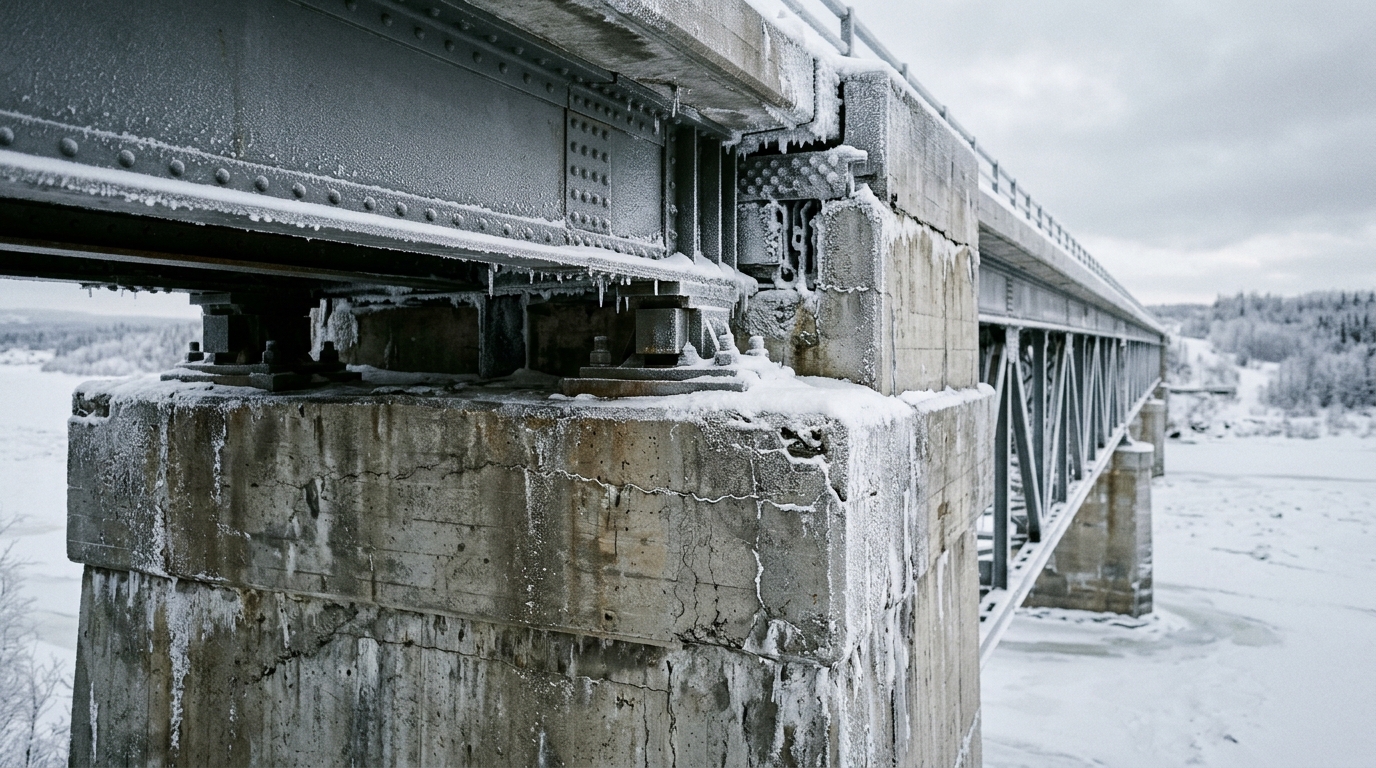
A newly developed intelligent recognition framework combining multi-stage progressive image restoration with an improved YOLOv11 detector has achieved an average precision of 0.905 in detecting structural bridge defects in cold regions. The experimental findings demonstrate that coupling targeted visual reconstruction with specialized deep learning models enables reliable localization and classification of surface flaws despite the severe environmental disturbances typical of cold climates.
In cold geographic zones, complex meteorological conditions frequently degrade the visual quality of bridge surface imagery. The natural phenomenon of uneven snow and ice coverage, combined with highly variable and uneven lighting during image acquisition, seriously obscures fine surface details. This deterioration weakens defect features at the moment images are collected, creating major detection accuracy hurdles for conventional intelligent monitoring models.
To address this feature degradation, the research team designed an integrated method that unifies a preprocessing front-end with an advanced detection network. The front-end couples a multi-stage progressive image restoration network, known as MPRNet, with a contrast limited adaptive histogram equalization algorithm. Operating together, these tools carry out gradual denoising across low-quality bridge images while simultaneously executing edge enhancement to restore obscured structural boundaries.
Following the image restoration phase, the framework directs enhanced surface imagery into an improved YOLOv11 detector tailored for multi-defect recognition. The authors upgraded the baseline architecture by incorporating an adaptive downsampling module alongside a multi-head self-attention mechanism. These architectural modifications allow the detector to capture subtle feature relationships, enabling precise localization and multi-class defect classification across complex bridge surfaces.
Experimental evaluations tested the framework across four typical structural defect categories: cracks, concrete spalling, steel corrosion, and damage to the protective layer. The integrated model demonstrated consistent performance across these diverse defect types, achieving an identification accuracy of 79.81 percent for surface cracks alongside a 73.25 percent recall rate for protective layer damage.
The inspection system was further evaluated under challenging thermal conditions to confirm its resilience in freezing environments. Testing conducted at low temperatures of minus 20 degrees Celsius revealed that the system maintained a startup success rate above 90 percent, while also preserving single-image defect detection accuracy exceeding 90 percent under the same subzero threshold.
Overall, the reported experimental outcomes indicate that combining progressive visual restoration with attention-enhanced object detection provides a dependable technical solution for cold-region infrastructure monitoring. By overcoming meteorological noise and maintaining operational stability in extreme cold, the methodology provides a practical engineering framework for bridge safety inspections and intelligent facility maintenance.
Subject of Research: Intelligent bridge defect recognition under cold-region meteorological conditions
Article Title: Intelligent recognition of cold-region bridge defects based on MPRNet and improved YOLOv11
Article References: Sun, M. (2026). Intelligent recognition of cold-region bridge defects based on MPRNet and improved YOLOv11. Discover Applied Sciences. https://doi.org/10.1007/s42452-026-09910-5
Image Credits: AI Generated
DOI: 10.1007/s42452-026-09910-5
Keywords: bridge defect recognition, cold regions, image restoration, object detection, MPRNet, YOLOv11, contrast limited adaptive histogram equalization, adaptive downsampling, multi-head self-attention, crack identification, concrete spalling, steel corrosion, protective layer damage, low-temperature inspection, edge enhancement, bridge safety inspection, defect feature degradation, progressive denoising
News Source: Denise Maddox. (November 17, 2026). Algorithm Achieves 0.905 Average Precision Identifying Cold Region Bridge Defects. Scienmag.