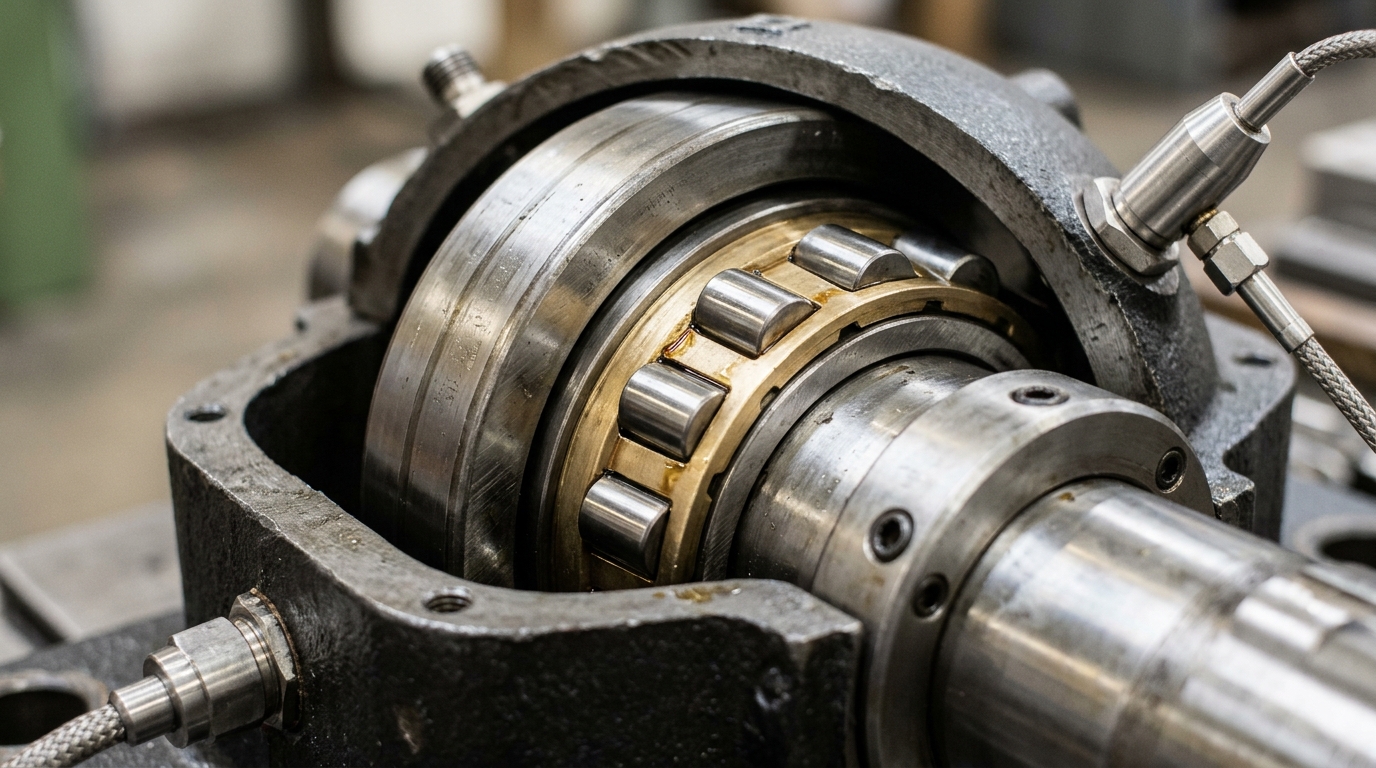
An Adaptive Hypergraph Neural Network combining graph convolutional networks with reinforcement learning has achieved 98.81 percent classification accuracy on the Paderborn rolling bearing benchmark and 95.23 percent accuracy on railway freight car bearing data. Reported experimental results demonstrate that the new framework significantly outstripped established machine learning and deep learning baselines across both diagnostic settings, improving diagnostic accuracy while reinforcing operational reliability.
Vibration signal analysis in rolling bearings serves as a foundational requirement for ensuring mechanical system reliability and substantially reducing overall maintenance expenditure. Even so, the vibration signatures produced by functioning mechanical components are fundamentally non-stationary, driven by operational velocity fluctuations and the complex structures of machinery. These combined physical factors pose substantial diagnostic challenges for conventional spectral analysis methods, which often struggle to reliably process non-stationary vibrational data.
While earlier graph-based methodologies have shown promise in capturing complex relational structures present in vibration datasets, traditional graph formulations suffer from notable topological shortcomings. Conventional graph representations typically fail to capture the intricate multi-node dependencies inherent in machinery vibrational characteristics, a structural constraint that particularly limits their practical diagnostic effectiveness when scaling to large-scale engineering datasets.
To address these modeling limitations, the investigation introduces an Adaptive Hypergraph Neural Network, abbreviated as AHNN, that innovatively unifies Graph Convolutional Networks with Reinforcement Learning algorithms. The proposed framework directly formulates hyper-space-time graphs to represent complex vibration signatures, enabling the network to express multifaceted vibrational relationships across mechanical components and capture high-order multi-node interactions that standard graph topologies cannot represent.
To govern these complex topological relationships, the architecture integrates a specialized reinforcement learning mechanism that dynamically optimizes graph connectivity patterns during operation. Operating within this framework, an autonomous agent interacts continuously with the analytical environment, intelligently adding or removing hyperedges based on direct feedback from classification performance, thereby iteratively assembling a far more discriminative hypergraph structure for defect identification.
Experimental benchmarking demonstrated the superior diagnostic performance of the AHNN framework against every evaluated baseline technique. The model achieved 98.81 percent accuracy on the Paderborn benchmark and 95.23 percent accuracy on railway freight car bearing data, surpassing support vector machines at 95.54 percent, convolutional neural networks at 93.86 percent, long short-term memory recurrent networks at 89.43 percent, and standard graph convolutional networks at 88.58 percent. Furthermore, the framework exhibited marked adaptability under limited data availability, remaining robust against noisy operational environments and data sparsity conditions.
Subject of Research: Rolling bearing defect detection using adaptive hypergraph neural networks
Article Title: Adaptive hyper-graph neural networks for enhanced defect detection in rolling bearings
Article References: Ma, J., Xuan, J., Zhang, Q., & Li, S. (2026). Adaptive hyper-graph neural networks for enhanced defect detection in rolling bearings. Applied Intelligence, 56(17), Article 561. https://doi.org/10.1007/s10489-026-07586-3
Image Credits: AI Generated
DOI: 10.1007/s10489-026-07586-3
Keywords: adaptive hypergraph neural networks, rolling bearings, defect detection, vibration signal analysis, graph convolutional networks, reinforcement learning, hyper-space-time graphs, Paderborn dataset, railway freight car bearings, non-stationary vibrations, spectral analysis, multi-node dependencies, hyperedge optimization, convolutional neural networks, long short-term memory, support vector machines, data sparsity, noise adaptability
News Source: Cassandra Pierce. (November 17, 2026). Adaptive Hypergraph Neural Network Reaches 98.81% Accuracy in Bearing Defect Detection. Scienmag.