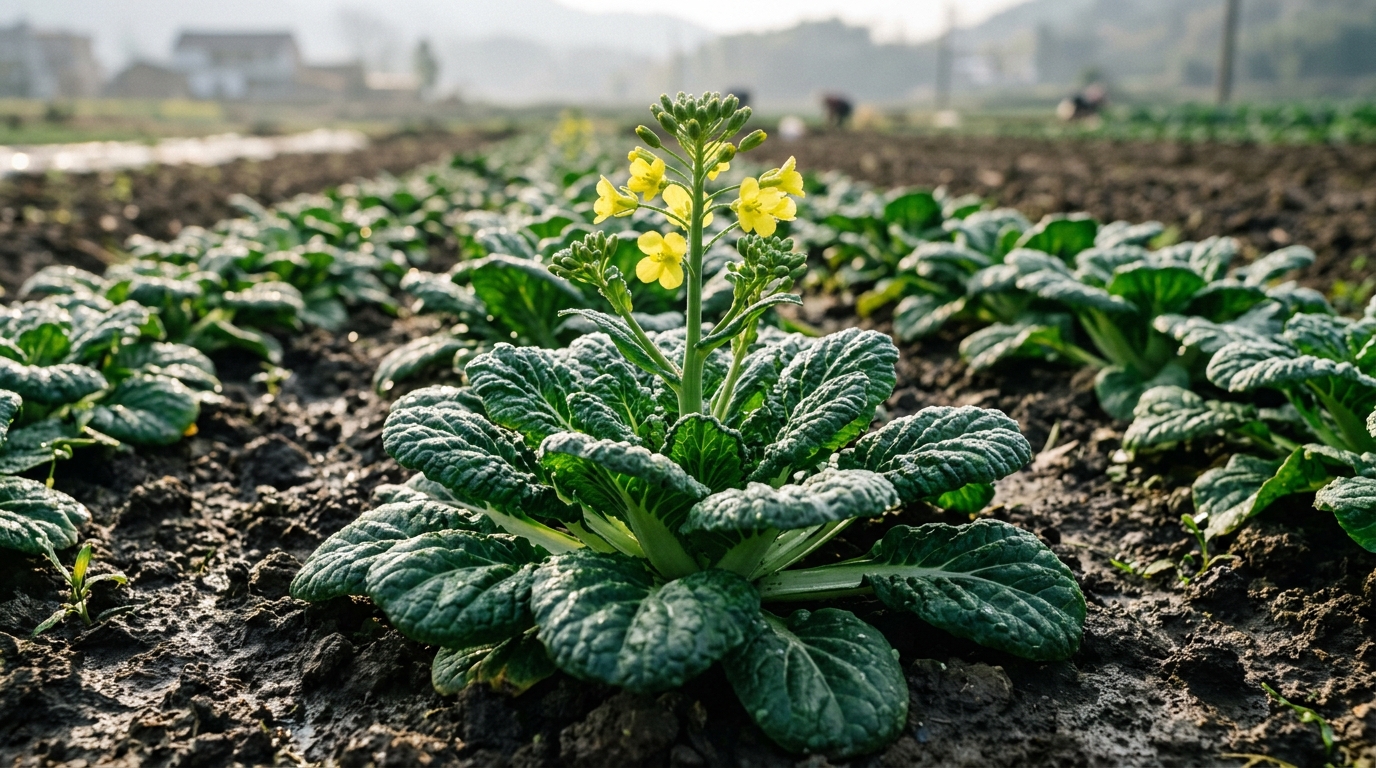
In many temperate agricultural species, the prolonged exposure to non-freezing winter cold, termed vernalization, acts as the primary physiological switch that transitions plants from a vegetative state characterized by leafy growth into a reproductive state marked by rapid stem elongation and floral bud development. In Brassica rapa subspecies, including the economically vital green leafy vegetable Wucai (Brassica rapa ssp. chinensis var. rosularis), premature bolting triggered by autumn and winter cold exposure presents an ongoing agricultural dilemma in major growing zones such as China’s Yangtze-Huaihe Basin. To dissect the underlying cellular mechanisms driving this low-temperature transition, a research team conducted a comprehensive multi-omics investigation tracking the transcriptomic, proteomic, and metabolic cascades that unfold within the shoot apices of cold-treated Wucai seedlings.
The experimental setup focused on thirty-day-old seedlings of the uniform Wucai inbred line HW, which were placed into a controlled environmental growth chamber maintained at a continuous chilling temperature of four degrees Celsius under a sixteen-hour light and eight-hour dark daily photoperiod. Researchers harvested shoot apical meristems and nascent leaf primordia across three defined intervals: prior to chilling exposure on day zero, designated as stage V0, after fifteen days of continuous vernalization, designated as V15, and after thirty days of chilling, designated as V30. These harvested apical tissues were instantly flash-frozen in liquid nitrogen and preserved at minus eighty degrees Celsius to maintain nucleic acid and peptide integrity.
To obtain an exhaustive overview of gene expression adjustments during cold acclimation, the researchers carried out high-throughput transcriptomic sequencing using an Illumina Hi-Seq platform. This sequencing effort generated approximately 152.62 gigabases of high-quality clean sequencing data across 510 million reads, with sequencing reliability confirmed by high mean Q20 and Q30 quality scores of 97.93 percent and 94.10 percent, respectively. The resulting sequence reads achieved a high alignment efficiency exceeding 83.53 percent when mapped directly against the version 3.0 Brassica rapa reference genome assembly, leading to the identification of 23,987 previously annotated genes alongside 833 novel genetic loci. In parallel, quantitative tandem mass tag proteomic profiling utilizing high-performance liquid chromatography coupled with tandem mass spectrometry identified 45,573 distinct peptides across 362,608 captured spectra, translating into 7,959 confidently annotated proteins and 107 novel proteins at a strict false discovery rate below one percent. Biological replicates demonstrated high Pearson correlation coefficients, establishing that the resulting molecular catalogs accurately reflected cellular adjustments under vernalization.
Comparative transcriptomic evaluations revealed dynamic changes across the treatment timeline, identifying 12,188 differentially expressed genes alongside 3,108 differentially expressed proteins among the three staged comparison groups. Specifically, the transition between stage V0 and V15 exhibited 9,627 differentially expressed genes with 4,924 upregulated and 4,703 downregulated, while the V15 to V30 stage transition showed 8,581 differential transcripts, and the cumulative V0 to V30 comparison registered 3,028 differential transcripts. At the translational level, the researchers identified 2,222 differentially expressed proteins between V0 and V15, 2,359 between V15 and V30, and 388 between V0 and V30. Across all three temporal comparisons, an overlapping core group of 818 differentially expressed genes and 105 differentially expressed proteins was consistently modulated, highlighting a conserved set of molecular adjustments that accompany the prolonged duration of cold treatment in the shoot apex.
To evaluate how closely transcript abundance mirrored translational protein output, the authors performed an integrated nine-quadrant correlation analysis on more than 7,700 matched mRNA-protein pairs across each developmental comparison. Overall concordance was relatively modest, yielding Pearson correlation coefficients of r = 0.27 between V0 and V15, r = 0.21 between V0 and V30, and r = 0.11 between V15 and V30. In the nine-quadrant distribution, approximately 40 percent of matched pairs occupied quadrant 5 representing non-differentially expressed targets during the early and cumulative comparisons, a proportion that surged to over 80 percent in the V15 to V30 comparison. Concordant pairs displaying at least a two-fold change in transcript levels paired with at least a 1.2-fold change in protein abundance were prevalent during initial exposure but dropped noticeably in the late chilling phase. This divergence indicates that while acute chilling immediately reprograms transcript and protein production in tandem, subsequent adaptation involves substantial post-transcriptional, non-coding RNA, and post-translational regulation.
Examining the 543 flowering-related genes annotated within the Brassica rapa genome revealed 117 vernalization pathway components, of which 28 differentially expressed genes and 6 differentially expressed proteins responded directly to the chilling treatment. Core floral repressors including homologs of FLOWERING LOCUS C (FLC), SHORT VEGETATIVE PHASE 1 (SVP1), and FLOWERING LOCUS M (FLM) were significantly downregulated over time, whereas cold-inducible activators such as VERNALIZATION INSENSITIVE 3 (VIN3) and VIN3-LIKE 2 (VIL2) exhibited marked upregulation. Whole-genome triplication in Brassica history has retained multiple paralogous copies of these factors, including three distinct copies of FLC and VIN3 that displayed divergent temporal kinetics. Curiously, both transcript and protein abundance for VERNALIZATION 1 (VRN1) homologs declined during chilling, diverging from the classical Arabidopsis model where VRN1 serves as a major inducer of apical transition, and suggesting that Wucai paralogs may have evolved specialized roles in general cold adaptation rather than strictly direct floral initiation.
Beyond dedicated vernalization integrators, the multi-omics analysis uncovered extensive restructuring of major transcription factor families that modulate stress signaling and floral timing. Members of the MYB, basic Helix-Loop-Helix (bHLH), basic Leucine Zipper (bZIP), WRKY, Ethylene Response Factor (ERF), and NAC families exhibited pronounced differential regulation, with 687, 293, and 624 transcription factor genes altered across the respective cold comparisons. Several transcription factors displayed opposing directions of change between mRNA levels and protein abundance, indicating complex layers of post-transcriptional modulation. Notably, MYB57 and bHLH3, factors commonly linked to jasmonic acid signaling, were downregulated at both the transcript and protein levels throughout vernalization. Conversely, the bZIP factor ABF4, along with bZIP59 and NF-YC9, showed marked upregulation. Given that ABF4 interacts with NF-YC complexes to activate floral integrator expression in model plants, their elevated expression implicates them in accelerating floral initiation under temperature stress.
Metabolic profiling demonstrated that vernalization triggered profound shifts in primary carbon partitioning and soluble sugar accumulation within the apical meristem. Gene Ontology and Kyoto Encyclopedia of Genes and Genomes enrichment analyses revealed that differentially abundant genes and proteins were concentrated in carbohydrate metabolism, secondary metabolite biosynthesis, and sugar-mediated signaling pathways. Quantitative metabolite profiling revealed that prolonged cold exposure caused substantial increases in the apical concentrations of total soluble sugars, sucrose, glucose, galactose, lactose, maltose, xylose, and arabinose. Enzymatic assays verified that the functional activities of sucrose synthase and sucrose phosphate synthase climbed steadily during chilling, matching the transcriptional upregulation of sucrose-responsive enzymes.
Nitrogen assimilation and free amino acid metabolism underwent equally pronounced restructuring during the low-temperature treatment, altering twenty-six distinct amino acid metabolites across the vernalization timeline. Metabolomic profiling showed that while many amino acid biosynthesis genes exhibited elevated transcript levels alongside modulated protein abundance, free amino acids accumulated steadily, with glycine, serine, arginine, and proline exhibiting the most substantial increases. Proline enrichment was particularly prominent and coincided with the marked transcriptional upregulation of Delta-1-pyrroline-5-carboxylate synthase (P5CS), a primary rate-limiting enzyme in proline biosynthesis. This external proline supplementation significantly elevated the expression of key floral pathway integrators BcFT and BcSOC1, successfully speeding up bolting and demonstrating a direct signaling connection between amino acid accumulation and the induction of flowering.
Hormonal quantification resolved dynamic changes across seventeen endogenous phytohormones, characterized by falling levels of trans-indole-3-acrylic acid, salicylic acid, and the ethylene precursor 1-aminocyclopropanecarboxylic acid, alongside pronounced increases in indole-3-acetic acid, kinetin, jasmonic acid, and brassinosteroids. Among brassinosteroid biosynthesis components, BcDET2, which encodes a critical rate-limiting steroid 5-alpha-reductase, was specifically upregulated at both the transcript and protein levels during cold exposure, coinciding with measurable surges in endogenous brassinolide, typhasterol, and 6-deoxocastasterone. Foliar applications of exogenous 24-epibrassinolide at concentrations up to 0.5 milligrams per liter accelerated bolting and flowering time, while simultaneously repressing BcFLC1 and inducing BcSOC1 and BcFT1 expression. Furthermore, heterologous overexpression of BcDET2 in Arabidopsis thaliana increased endogenous brassinosteroid pools and promoted early flowering, confirming that BcDET2-mediated brassinosteroid biosynthesis acts as a central hormonal accelerator of the vernalization response in Wucai.
Subject of Research: Molecular, metabolic, and hormonal regulation of vernalization-induced flowering in Wucai
Article Title: Integrative multi-omics analyses reveal transcriptional, metabolic, and hormonal regulation of vernalization-induced flowering in Wucai (Brassica rapa)
Article References: Tian, Y., Yang, D., Liao, N., Wang, K., Yang, Y., Zhou, X., Li, T., Wang, W., Tang, X., Wang, C., Yuan, L., & Chen, G. (2026). Integrative multi-omics analyses reveal transcriptional, metabolic, and hormonal regulation of vernalization-induced flowering in Wucai (Brassica rapa). Molecular Horticulture, 6(1), Article 72. https://doi.org/10.1186/s43897-026-00246-7
Image Credits: AI Generated
DOI: 10.1186/s43897-026-00246-7
Keywords: Brassica rapa, Wucai, vernalization, flowering transition, bolting, multi-omics, transcriptomics, proteomics, metabolomics, brassinosteroids, FLC, SOC1, FT, BcDET2, proline, sucrose metabolism, phytohormones
News Source: Alan Morgan. (November 17, 2026). Multi-Omics Analysis Explains Vernalization-Induced Early Flowering in Wucai Vegetable Crops. Scienmag.