Published in the Journal of NeuroEngineering and Rehabilitation, the randomized, sham-controlled crossover trial evaluated whether tailoring non-invasive electric fields to subject-specific functional neuroimaging and computational head models could selectively modulate cortical swallowing activity in healthy adults. Conducted by an interdisciplinary research team, the experiment combined whole-head magnetoencephalography source localization with finite-element head modeling and distributed constrained maximum intensity current optimization. Although exploratory within-condition evaluations detected isolated pre-to-post alterations in alpha, beta, and low-gamma oscillatory power during specific behavioral conditions, formal statistical modeling failed to establish differential neurophysiological responses across active stimulation intensities and sham protocols. The study demonstrated the technical feasibility and safety of integrating individualized functional neuroimaging with multi-electrode current steering, while highlighting substantial methodological complexities and physiological ambiguities that govern network-level non-invasive electrical brain stimulation.
Swallowing represents an intricate sensorimotor behavior coordinated by an extensive neural network spanning bilateral cortical regions, subcortical nuclei, and brainstem pattern generators. Non-invasive brain stimulation, particularly transcranial direct current stimulation, has emerged as a promising adjunctive rehabilitation strategy designed to facilitate synaptic plasticity, enhance motor learning, and promote adaptive reorganization within residual sensorimotor networks. Early neurophysiological investigations demonstrated that anodal direct current stimulation can increase the excitability of pharyngeal motor representations, modulate oscillatory brain rhythms, and improve behavioral precision on timed swallowing tasks, ultimately supporting functional clinical recovery in selected patient populations.
Despite encouraging findings, broader clinical adoption and reproducibility of transcranial direct current stimulation have been challenged by pronounced heterogeneity in treatment outcomes across trials and meta-analyses. Bipolar configurations deliver relatively diffuse electric fields across cranial tissues, frequently inducing unintended co-stimulation of non-target anatomical regions while diminishing spatial focality at the intended cortical target. Furthermore, standard montages fail to accommodate profound interindividual differences in cranial morphology, skull thickness, tissue conductivities, and functional representation topography, all of which alter the magnitude, orientation, and intracranial path of induced electrical currents. Defining therapeutic dosage purely by total injected current at the scalp level ignores how local electrical field vectors align with underlying cortical geometries. Because swallowing-related cortical representations are distributed bilaterally, dynamic, and variable between individuals, conventional fixed-montage protocols may inadequately engage target neural assemblies across diverse patient cohorts.
To overcome the architectural shortcomings of conventional bipolar stimulation, researchers engineered multichannel stimulation approaches incorporating subject-specific computational modeling. The present investigation applied a distributed constrained maximum intensity framework to generate individualized multi-electrode montages capable of maximizing directional electric field strength along a functionally defined cortical target dipole. Eight healthy adult volunteers, comprising four females and four males with a mean age of 29.6 years, completed the protocol in a randomized, sham-controlled crossover design. All enrolled volunteers were free of neurological, psychiatric, or otolaryngological disorders and were not receiving centrally acting pharmacological agents. Each participant underwent three separate stimulation sessions: low-intensity multichannel stimulation delivered at 1.5 milliamperes, high-intensity multichannel stimulation delivered at 4.0 milliamperes, and an inactive sham stimulation control.
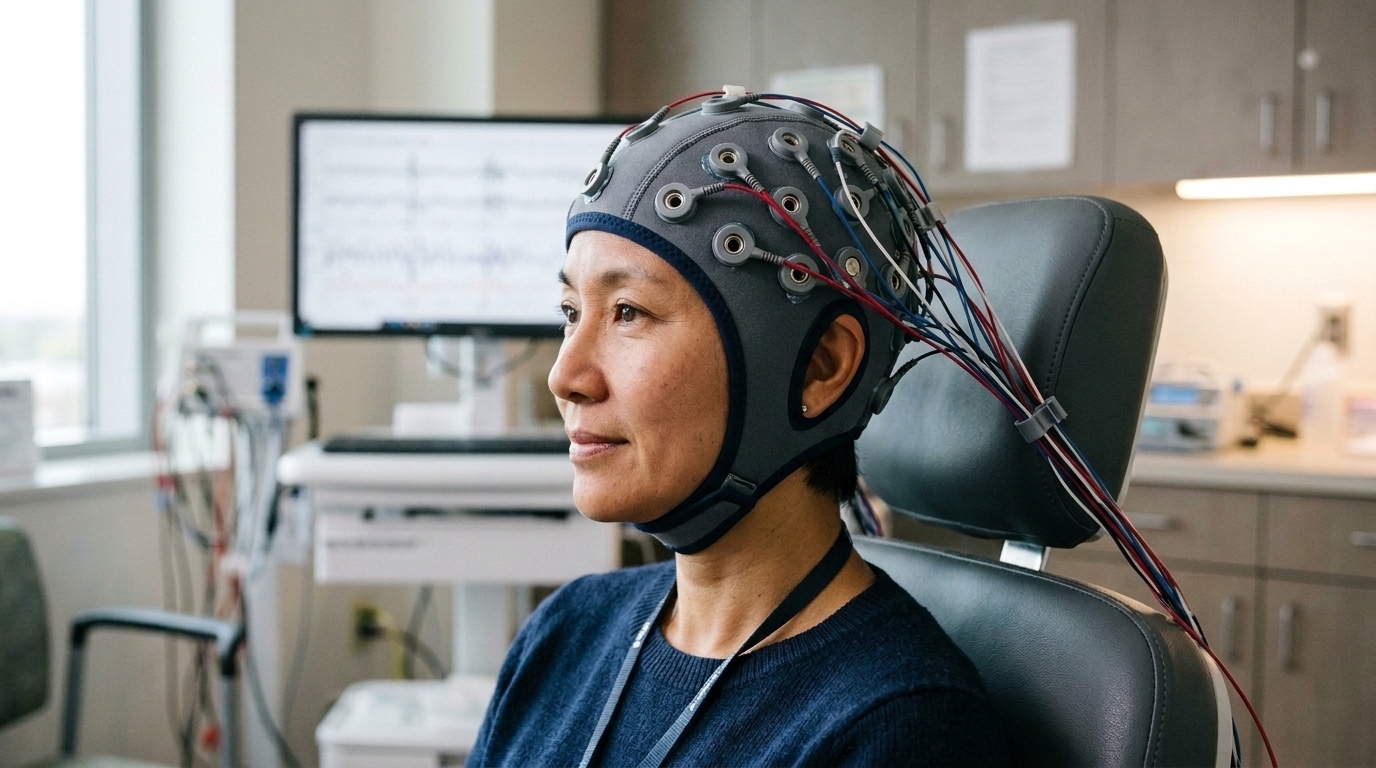
Cortical swallowing representations and intervention after-effects were systematically mapped using a 275-channel magnetoencephalography system with participants seated upright. Synchronous submental surface electromyography recorded muscle activation from the left and right submental muscle groups to identify swallow onset and peak muscular contraction. Cortical activity was mapped across two behavioral paradigms: an uncued voluntary swallowing task lasting fifteen minutes and a visually cued challenged swallowing task lasting ten minutes. The challenged paradigm required participants to initiate a swallow within a narrow 150-millisecond target interval following visual cues, delivering immediate computerized feedback regarding performance accuracy. Magnetoencephalography data were acquired at 600 Hertz and filtered across canonical frequency bands comprising theta, alpha, beta, low gamma, and high gamma ranges to quantify event-related desynchronization within predefined sensorimotor regions of interest.
Individualized stimulation montages were formulated through an integrated neuroimaging and computational pipeline combining structural magnetic resonance imaging with functional magnetoencephalography source localization. High-resolution anatomical scans, including T1-weighted, T2-weighted, and diffusion-weighted magnetic resonance sequences, were acquired to segment scalp, compact skull, spongy skull, cerebrospinal fluid, gray matter, and white matter compartments. Realistic hexahedral finite-element head models were constructed using calibrated skull conductivities to account for white matter anisotropy and cranial geometry. In parallel, functional source reconstruction using a linearly constrained minimum variance beamformer on a fine three-millimeter grid identified each participant’s primary right-hemispheric swallowing activation peak and dominant dipole orientation during baseline beta-band activity. Using numerical reciprocity and convex optimization, the computational framework selected active electrode positions from thirty-nine possible locations on a standardized montage cap. The algorithm satisfied strict physical safety parameters, limiting individual electrode currents below 2.0 milliamperes and total injected current to 4.0 milliamperes while optimizing directional field alignment.
Experimental stimulation was administered through an eight-channel direct current stimulator utilizing gel-filled silver and silver chloride electrodes applied according to each participant’s algorithmic montage. In active conditions, current was ramped up over thirty seconds, maintained at the target dosage of 1.5 or 4.0 milliamperes for nine minutes, and ramped down over thirty seconds, while sham stimulation delivered thirty seconds of initial ramped current without sustained delivery. During all stimulation periods, participants sucked on a lemon-flavored lollipop to engage sensory afferents, promote spontaneous swallowing, and activate the targeted network. Post-stimulation neurophysiological recordings commenced five minutes after stimulation cessation, maintaining an invariant task sequence where uncued swallowing occurred five to twenty minutes post-stimulation and challenged swallowing occupied twenty to thirty minutes post-stimulation. Blinding assessments conducted after post-intervention recordings revealed fair overall agreement between perceived and actual conditions, with correct condition guesses occurring in seventy-five percent of high-intensity sessions and fifty percent of both low-intensity and sham sessions.
The study’s primary efficacy hypothesis postulated that individualized multichannel stimulation would induce measurable frequency-specific modulation characterized by a significant Dose-by-Task-by-Time interaction within predefined cortical regions. A repeated-measures analysis of variance evaluated mean event-related desynchronization across the cortical swallowing network separately for theta, alpha, beta, low-gamma, and high-gamma bands, applying Holm adjustment across the five spectral ranges. Following statistical correction, the hypothesized three-way interaction failed to reach significance in any analyzed frequency band. Specifically, adjusted p-values were 1.000 for theta, 1.000 for alpha, 0.274 for beta, 1.000 for low gamma, and 1.000 for high gamma. An exploratory crossover sensitivity analysis accounting for participant, dose, and experimental period effects likewise demonstrated no significant session-order effects across reported frequency-task combinations. Consequently, the primary formal statistical model did not confirm that individualized multichannel stimulation elicited dose-dependent or task-dependent neuromodulatory effects beyond non-specific temporal variations in healthy volunteers.
Secondary and exploratory analyses within individual stimulation conditions revealed isolated neurophysiological and behavioral patterns that warrant nuanced interpretation. In uncorrected within-condition analyses of the challenged task, low-intensity 1.5-milliampere stimulation was accompanied by pre-to-post reductions in sensorimotor event-related desynchronization within alpha and beta frequency bands, whereas high-intensity stimulation and sham yielded no significant shifts. Conversely, within uncued voluntary swallowing, high-intensity 4.0-milliampere stimulation showed a pre-to-post difference in low-gamma band desynchronization that was absent under low-intensity or sham conditions. Spatial cluster-based permutation testing localized these exploratory spectral shifts predominantly within bilateral sensorimotor, premotor, and frontal cortices. Behaviorally, participants exhibited marked improvements in challenged-task hit rate over successive test intervals; however, this performance enhancement reflected a significant main effect of elapsed time rather than an interaction with stimulation dose. Submental electromyography showed an isolated peak-to-peak amplitude increase following low-intensity stimulation during challenged swallowing, though peripheral physiological parameters served primarily as exploratory control measures.
The authors underscored several crucial methodological limitations that necessitate treating the observed within-condition alterations as hypothesis-generating rather than definitive evidence of stimulation efficacy. The small sample of eight healthy young adults restricted statistical power, elevated the threshold for detecting subtle interactions, and precluded direct generalizability to neurologically impaired populations. Because uncued swallowing always preceded challenged swallowing, behavioral task condition remained completely confounded with elapsed post-stimulation time and measurement order. Furthermore, partial unblinding at 4.0 milliamperes suggests that cutaneous sensations, heightened attention, or arousal may have contributed to post-stimulation gamma fluctuations. Future research must expand sample sizes, incorporate counterbalanced task sequences, and deploy active non-individualized or conventional bipolar comparators to determine whether personalized electric-field optimization confers true therapeutic value over standard approaches. Validating this resource-intensive pipeline in clinical cohorts with post-stroke dysphagia will ultimately require testing whether neuroengineering-guided targeting produces clinically meaningful improvements in validated swallowing safety, airway protection, and nutritional outcomes.
Subject of Research: Neuroengineering-guided individualized multichannel transcranial direct current stimulation for cortical swallowing network modulation
Article Title: Frequency-specific cortical swallowing-network responses following neuroengineering-guided individualized multichannel tDCS
Article References: Muhle, P., Khan, A., Jung, A., Vogenauer, N., Wollbrink, A., Gross, J., Labeit, B., Dziewas, R., Wolters, C. H., & Suntrup-Krueger, S. (2026). Frequency-specific cortical swallowing-network responses following neuroengineering-guided individualized multichannel tDCS. Journal of NeuroEngineering and Rehabilitation, 23(1), Article 320. https://doi.org/10.1186/s12984-026-02214-0
Image Credits: AI Generated
DOI: 10.1186/s12984-026-02214-0
Keywords: transcranial direct current stimulation, multichannel tDCS, magnetoencephalography, cortical swallowing network, dysphagia rehabilitation, finite element method, computational head modeling, event-related desynchronization, D-CMI optimization, sensorimotor cortex, submental electromyography, alpha rhythm, beta oscillations, gamma oscillations, neuromodulation, crossover trial, stroke rehabilitation
News Source: Cassandra Pierce. (November 17, 2026). Personalized Multichannel Brain Stimulation Yields Inconclusive Swallowing Network Modulation in Trial. Scienmag.