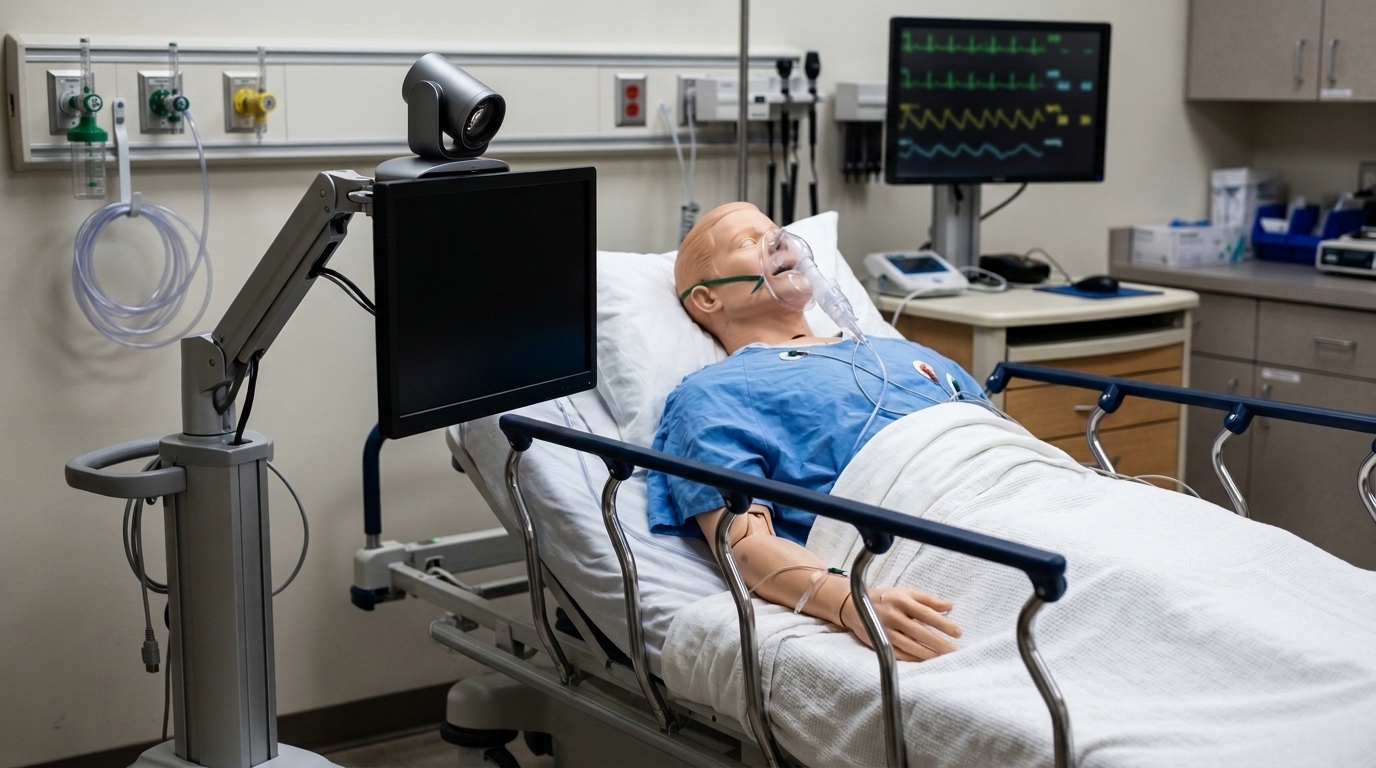
A pilot feasibility study has demonstrated that an adapted version of the Igroup Presence Questionnaire can be routinely administered to healthcare learners during manikin-based simulation courses. Published in BMC Medical Education, the investigation assessed whether a measurement instrument originally created for virtual reality environments could be contextually adapted to capture immersion and a learner’s subjective sense of being within physical simulated clinical scenarios.
In simulation education, presence refers to a learner’s subjective sense of being within a simulated situation, a psychological state that may meaningfully influence how participants engage with hands-on exercises. Although presence plays an acknowledged role in simulation learning, existing measurement tools were developed primarily for virtual environments. Because evidence supporting their use in physical, manikin-based healthcare simulation remains limited, investigators sought to identify an established instrument, adapt its wording, and assess whether it could be administered effectively during routine training courses.
To select a suitable instrument, researchers conducted a targeted literature search that identified twelve established presence and immersion questionnaires. An expert panel shortlisted five candidate instruments and appraised them against six predefined criteria across a two-round structured review. The panel ultimately selected the Igroup Presence Questionnaire based on its practical overall length, documented measurement properties, availability of published translations, and existing reference data.
The research team contextually adapted the selected instrument while carefully retaining its original 14-item format and proposed domain allocation. Most modifications replaced terminology specific to virtual environments, though several survey items required more extensive rewording to align with manikin-based clinical settings. Following this expert adaptation process, researchers administered the revised questionnaire after an obstetric-emergencies course and a crisis resource management course to test its practical administration.
Across both educational offerings, twenty of 34 course participants submitted completed or partial questionnaire responses, representing an overall response rate of 58.8 percent. Response rates differed across the cohorts, with nine of 18 participants responding in the obstetric-emergencies course and 11 of 16 participants responding in the crisis resource management course. Overall, nineteen respondents answered all 14 items, while one respondent omitted survey item SP3.
Participant responses were recorded using the questionnaire’s original scale ranging from minus three to plus three, which researchers recoded to a zero-to-six scale for descriptive reporting and summary. Spatial presence registered the highest median score in both courses. In the obstetric-emergencies course, spatial presence yielded a median of 3.40 with an interquartile range of 3.05 to 3.75 across eight respondents. In the crisis resource management course, spatial presence reached a median of 4.80 with an interquartile range of 3.60 to 5.20 across eleven respondents.
Participants raised no spontaneous concerns regarding questionnaire wording during the pilot, although item clarity was not formally assessed. The research team deliberately performed no inferential between-course comparisons. The authors explicitly emphasized that this pilot investigation does not establish the formal validity or reliability of the adapted instrument, nor does it support comparative evaluations between separate simulation courses.
The study team concluded that the adapted questionnaire can be successfully administered in routine manikin-based simulation courses. Nevertheless, the investigators noted that cognitive interviews with intended respondents and further evaluation in a larger, multicenter sample remain necessary before presence scores can be employed to evaluate simulation design.
Subject of Research: Feasibility of adapting the Igroup Presence Questionnaire for manikin-based healthcare simulation
Article Title: Contextual adaptation of the igroup presence questionnaire for manikin-based simulation: a structured expert review and feasibility pilot study
Article References: Abramovich, I., Braun, Q., Crisan, I., Dussmann, P., Valeanu, L., & Dieckmann, P. (2026). Contextual adaptation of the igroup presence questionnaire for manikin-based simulation: a structured expert review and feasibility pilot study. BMC Medical Education. https://doi.org/10.1186/s12909-026-10844-0
Image Credits: AI Generated
DOI: 10.1186/s12909-026-10844-0
Keywords: Igroup Presence Questionnaire, manikin-based simulation, spatial presence, simulation feasibility, healthcare simulation, crisis resource management, obstetric emergencies, medical education, presence measurement, immersion questionnaire, expert review, scale adaptation, pilot study, questionnaire administration, learner engagement, simulation design
News Source: Courtney Benton. (November 17, 2026). Adapted Virtual Presence Tool Proves Feasible in Pilot Manikin Simulation Courses. Scienmag.