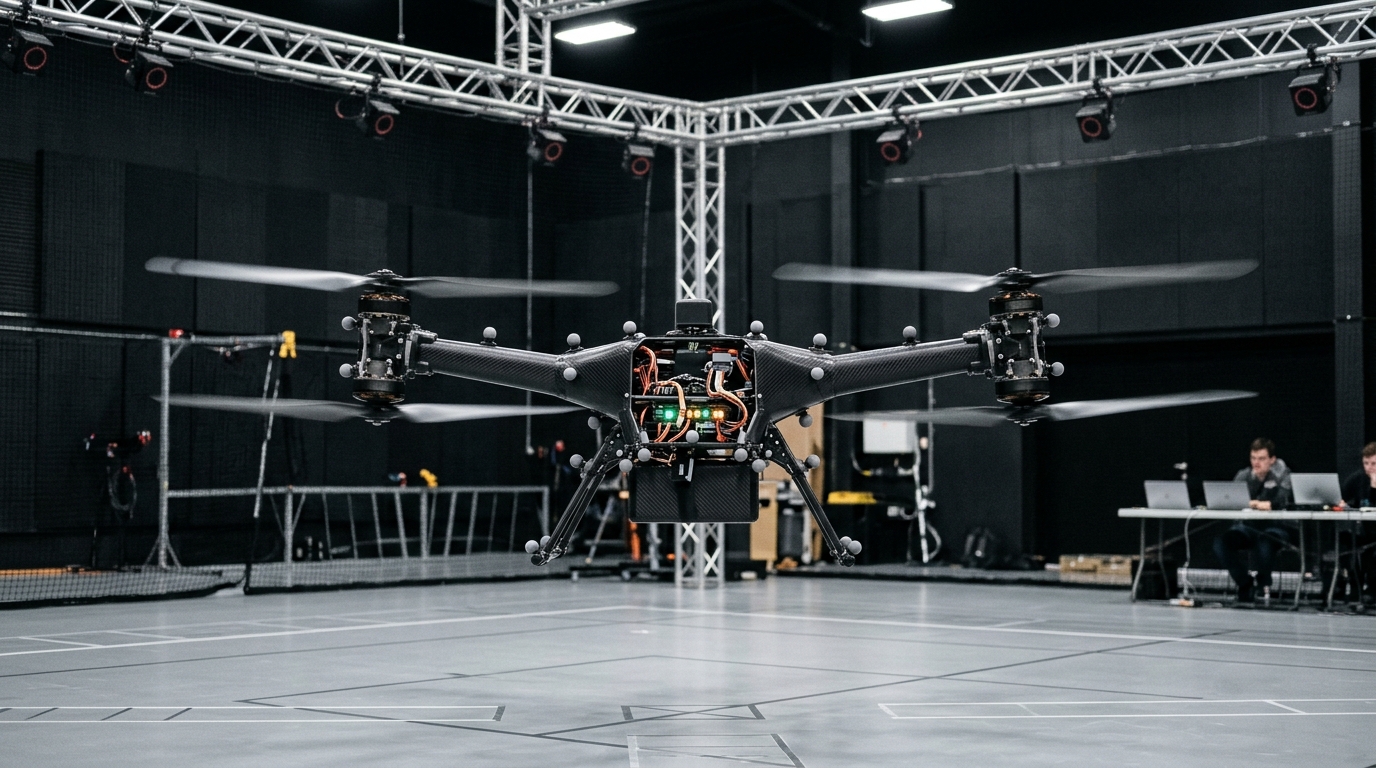
A trajectory-tracking control framework combining logarithmic sliding surfaces with a selective super-twisting algorithm has achieved centimetre-level tracking accuracy in simulations of planar vertical take-off and landing aircraft subject to wind disturbances. The study, published in the Journal of Intelligent and Robotic Systems, structures the system as a cascaded three-loop architecture designed to manage persistent external disturbances and input coupling inherent to planar vertical take-off and landing flight dynamics.
The controller formulation relies on logarithmic sliding surfaces to govern state trajectories while overcoming common limitations found in existing terminal sliding-mode strategies. The logarithmic surface removes the near-origin singularity of terminal sliding-mode designs while preserving finite-time convergence.
A key theoretical finding of the research is the selective application of the super-twisting algorithm, which is implemented exclusively within the altitude and attitude control loops. In their mathematical analysis of the horizontal virtual-control loop, the researchers proved that the integral gain required to meet the finite-time sufficient condition falls inside the gain region where the super-twisting integrator excites the cascade. Because no gain selection satisfies the theoretical guarantee without inducing oscillations, the selective placement represents a formal design-infeasibility result for the horizontal loop.
Under this selective architecture, the control scheme establishes distinct mathematical stability guarantees across the three interconnected loops. The analytical framework proves finite-time convergence of tracking errors for both the altitude and attitude dynamics. For the horizontal tracking error, where the super-twisting action was deliberately omitted, the analysis establishes a uniform ultimate bound rather than finite-time convergence. In addition, the authors confirmed the overall stability of the complete three-loop cascaded system in the presence of persistent disturbance inputs and dynamic cross-coupling.
The performance of the controller was evaluated through numerical simulations tracking a circular flight path subjected to wind disturbances. In these trajectory tests, the aircraft achieved centimetre-level tracking accuracy. Furthermore, the controller demonstrated reduced control effort when compared to both classical sliding-mode control and non-singular fast terminal sliding-mode control baselines, confirming lower actuation demands during disturbance rejection.
To validate the approach beyond mathematical simulation, the closed-loop system was tested across two independent physics engines: MuJoCo and a ROS 2 implementation in Gazebo using the DART physics engine. Both platforms evaluated the identical closed loop with 500-hertz discrete control, inertial-sensor-grade noise, and MIL-F-8785C Dryden turbulence over ten random seeds with theorem-certified gains. The relative configuration rankings and control energies were consistently reproduced across both physics engines.
Subject of Research: Trajectory tracking control for planar vertical take-off and landing aircraft
Article Title: Logarithmic Sliding Mode Control with Selective Super-Twisting Algorithm for Trajectory Tracking of a PVTOL Aircraft
Article References: Olguin-Roque, J., Saldivar, B., Eulopa-Hernandez, J.-F., Couder-Castañeda, C., Arizpe, P.-A., & Padilla-Pérez, D.-A. (2026). Logarithmic Sliding Mode Control with Selective Super-Twisting Algorithm for Trajectory Tracking of a PVTOL Aircraft. Journal of Intelligent & Robotic Systems. https://doi.org/10.1007/s10846-026-02493-8
Image Credits: AI Generated
DOI: 10.1007/s10846-026-02493-8
Keywords: PVTOL aircraft, trajectory tracking, logarithmic sliding mode control, super-twisting algorithm, cascaded control, finite-time convergence, command filter, roll-reference derivatives, altitude loop, attitude loop, horizontal virtual-control loop, uniform ultimate bound, MuJoCo, ROS 2, Gazebo, DART physics engine, Dryden turbulence, inertial-sensor-grade noise
News Source: Denise Maddox. (November 17, 2026). Selective Super-Twisting Controller Achieves Centimetre-Level Tracking in PVTOL Aircraft Simulations. Scienmag.