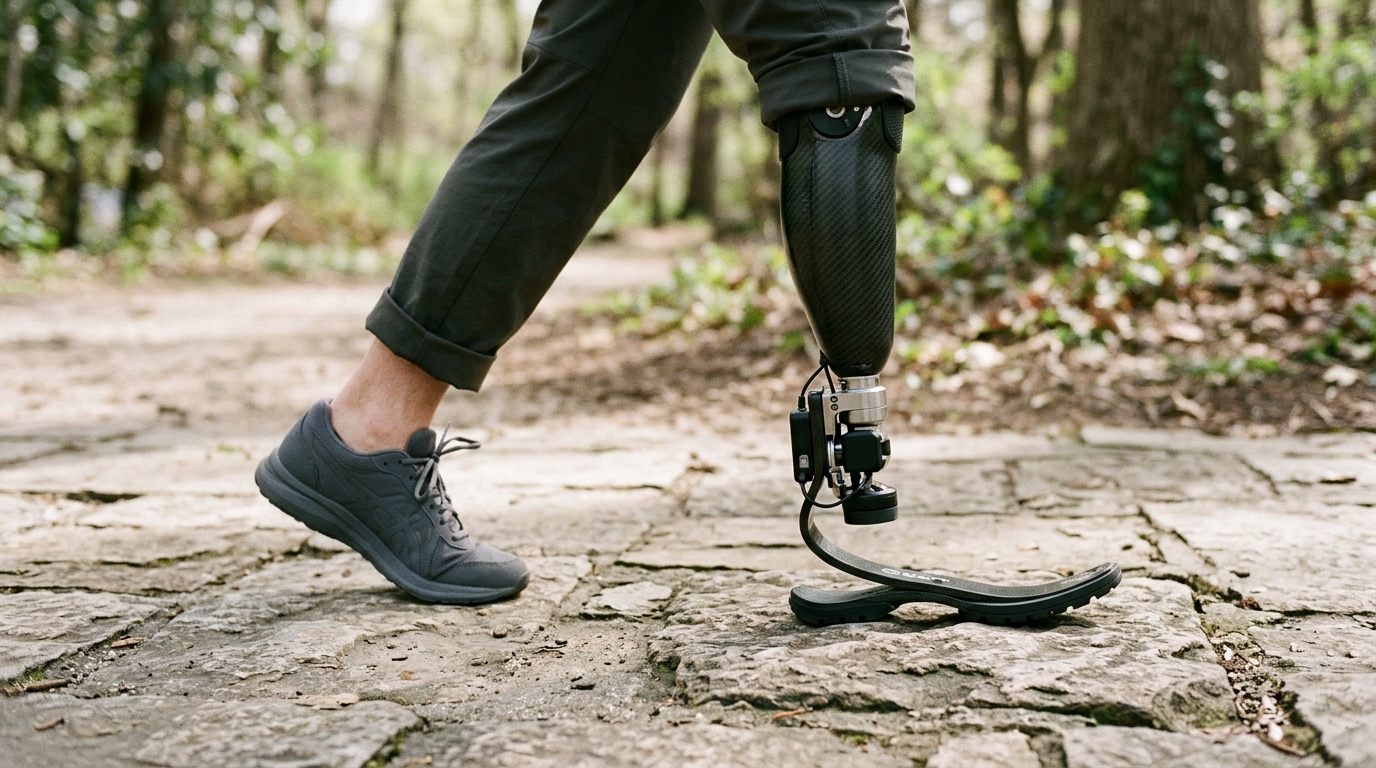
A 68-year-old individual with unilateral transtibial limb loss experienced enhanced propulsive symmetry and a marked reduction in weekly stumbles during a 9.5-month evaluation of an implanted lower limb sensory neuroprosthesis used in home and community settings. Published in the Journal of NeuroEngineering and Rehabilitation, the investigation assessed how providing real-time plantar sensory feedback through implanted nerve cuff technology influences daily functional performance, balance confidence, and gait mechanics. Rather than confining testing solely to controlled laboratory spaces, the research protocol enabled the participant to incorporate the neuroprosthetic system directly into normal everyday activities across uncontrolled real-world environments, with periodic laboratory visits scheduled to measure objective biomechanical outcomes and gather qualitative user feedback.
The underlying clinical challenge stems from the sensorimotor deficits that commonly accompany lower limb loss. When somatosensory signals from the missing foot are lost, individuals frequently adopt compensatory gait strategies to manage instability and navigate their surroundings. Over time, these compensatory movements can increase the risk of developing secondary comorbidities, diminish overall balance confidence, and negatively affect general functional capabilities and quality of life. Although contemporary prosthetic limbs feature sophisticated mechanical and structural advancements, commercial devices continue to lack direct sensory feedback mechanisms capable of restoring the somatosensation once delivered by the biological foot, leaving users without real-time tactile awareness of ground contact.
To examine whether long-term restored sensation could mitigate these functional limitations, investigators established a multi-phase longitudinal study registered under ClinicalTrials.gov identifier NCT03409133, which was originally registered on January 24, 2018. The trial design incorporated distinct monitoring intervals, transitioning from a baseline Pre-Active phase into an Active sensory neuroprosthesis phase, followed by a Post-Active phase where home sensory feedback was withdrawn. Over the 214 calendar days comprising the Active phase, the participant operated the sensory neuroprosthesis on 135 separate days, reflecting a 63.1 percent community usage rate. Comprehensive evaluations combined objective functional testing with subjective documentation, including usage diaries, tracking of stumbles and falls, and semi-structured qualitative interviews.
Biomechanical assessments demonstrated substantial improvements in walking mechanics when plantar sensory feedback was active. Prosthetic limb propulsive impulse rose significantly during the Active phase in comparison to both the Pre-Active baseline and the subsequent Post-Active period when plantar feedback was absent at home. Concurrently, propulsion symmetry comparing the prosthetic limb to the intact limb advanced from 4378 percent during the Pre-Active phase to between 89 and 95 percent during the Active phase. When home sensory feedback was subsequently ceased in the Post-Active evaluation, propulsion symmetry declined back to a range between 65 and 72 percent, indicating that restoration of plantar sensation directly bolstered balanced bilateral propulsion.
The intervention also yielded observable benefits in real-world balance stability and complex mobility tasks. Self-reported stumble frequency exhibited a sharp downward trend over the course of the intervention, dropping from seven stumbles per week at the conclusion of the Pre-Active phase to two stumbles per week by the end of the Active phase. In specialized functional testing involving four-inch stair negotiation conducted under obstructed visual feedback conditions, the participant demonstrated clear strategic adaptations. These included shifts in lead foot preference during stair ascent and a notable decrease in the compensatory reliance on heel probing during stair descent, accompanied by a broader decline in stair negotiation error frequency following the initial Pre-Active evaluation.
Standardized clinical mobility metrics presented a combination of stable scores and variable responses across the different testing conditions. During the Functional Gait Assessment, the participant maintained high mobility scores across the entire duration of the trial, achieving the highest performance levels during the Pre-Active 1 and Active 1 evaluation periods when the sensory neuroprosthesis was actively functioning. Conversely, the Timed Up and Go assessment, which recorded ground reaction force metrics alongside completion times and stance times, demonstrated variability across consecutive sessions while showing limited and inconsistent differences between active and inactive neuroprosthesis conditions.
Semi-structured interviews offered detailed user perspectives regarding the sensory stimulation and its practical integration into daily routines. The participant noted that plantar sensations calibrated at lower perceived intensities proved more comfortable and functionally useful throughout daily living. Prolonged community use of the sensory neuroprosthesis fostered confident perception of prosthetic foot-ground contact, allowing the participant to abandon previously required compensatory strategies such as applying excessive socket loading simply to infer foot placement. Based on these cumulative single-participant findings, the authors concluded that home and community use of an implanted sensory neuroprosthesis provides compelling evidence that restoring plantar somatosensation can decrease reliance on compensatory gait strategies, potentially lower fall risk, and bolster confidence in real-world settings.
Subject of Research: Long-term home and community evaluation of a lower limb sensory neuroprosthesis
Article Title: Impact of long-term home and community use of a lower limb sensory neuroprosthesis
Article References: Sheehan, A., Siu, R., Schmitt, M., Vala, J., Wright, J., Kim, D., Li, S., Graczyk, E., Triolo, R. J., & Charkhkar, H. (2026). Impact of long-term home and community use of a lower limb sensory neuroprosthesis. Journal of NeuroEngineering and Rehabilitation. https://doi.org/10.1186/s12984-026-02206-0
Image Credits: AI Generated
DOI: 10.1186/s12984-026-02206-0
Keywords: sensory neuroprosthesis, plantar sensory feedback, nerve cuff technology, transtibial limb loss, propulsive impulse, propulsion symmetry, gait compensation, stumble frequency, fall risk, stair negotiation, heel probing, Timed Up and Go, Functional Gait Assessment, somatosensation restoration, socket loading, lower limb loss, community use
News Source: Ophelia Keating. (November 17, 2026). Implanted Sensory Neuroprosthesis Improved Symmetry and Cut Stumbles in Case Study. Scienmag.