By embedding the fundamental heat-balance equations of indoor environments directly into the reward function of a Proximal Policy Optimization algorithm, researchers have developed a Physics-Informed Proximal Policy Optimization (PI-PPO) framework capable of learning stationary scheduling policies that apply over an indefinite horizon. This approach represents a departure from traditional optimization methods that require computational re-solving at every control step, offering a scalable solution for managing electricity costs under the kingdom’s specific two-tier tariff structure. The study focused on the performance of this system within the challenging environmental conditions of Jeddah, characterized by extreme summer heat and humidity, which necessitate continuous, high-capacity cooling that stresses both the residential electrical supply and the distribution grid.
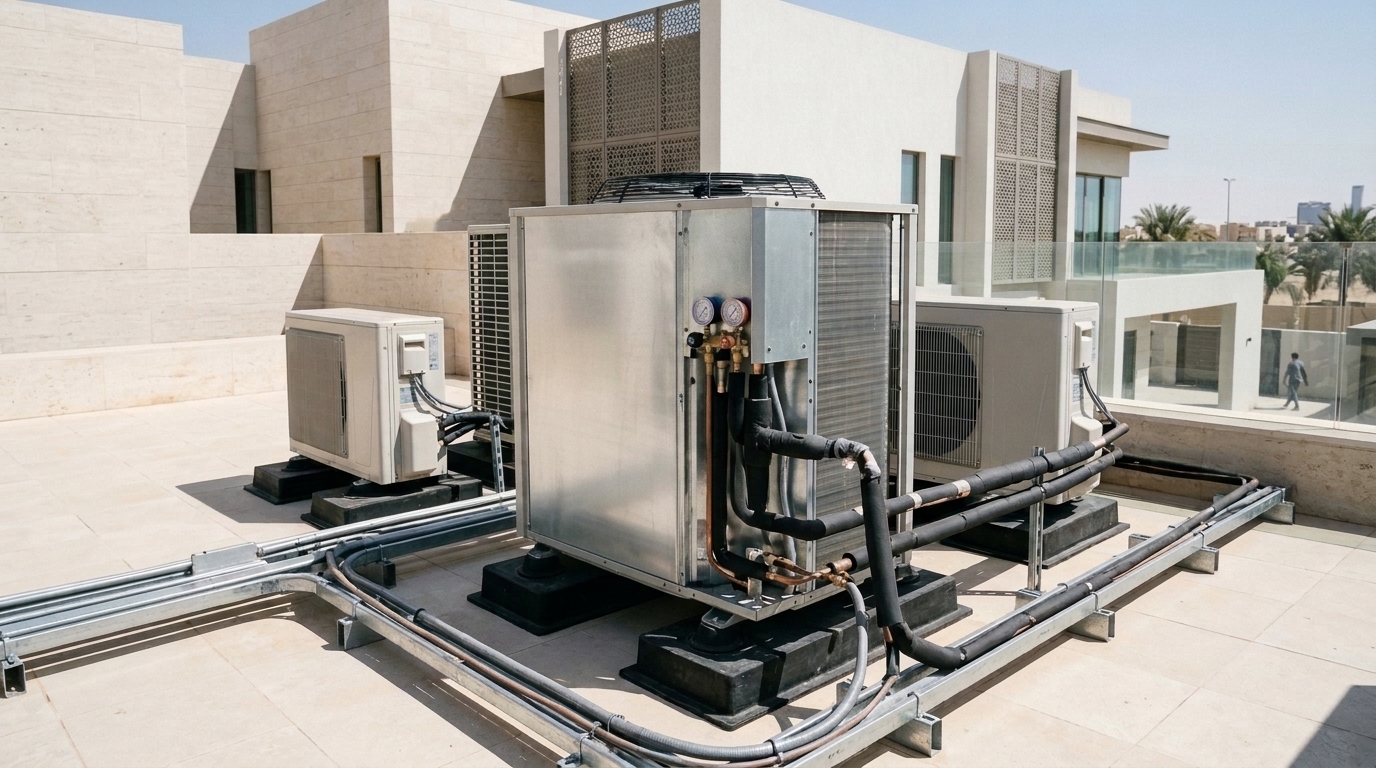
Residential air conditioning represents over 70 percent of household electricity consumption in Saudi Arabia during the summer, with On/Off split units serving as the dominant technology across the market. These units exhibit fixed power draws of 1.8 kilowatts, creating significant demand spikes when multiple units activate simultaneously within a home. These spikes not only threaten the stability of the local distribution grid but also push total monthly electricity consumption beyond the critical 6,000 kilowatt-hour threshold of the Saudi two-tier tariff, triggering a 67 percent increase in the marginal price of electricity from 0.18 to 0.30 Saudi Riyals per kilowatt-hour. The research team sought to mitigate these costs by designing a controller that learns to coordinate the operation of 18,500 BTU split units across multiple zones, effectively exploiting the thermal buffering potential of shared building walls to reduce the necessity for coincident compressor activation.
The evaluation environment was constructed using a lumped-parameter RC thermal simulation, a modeling approach chosen to capture the essential heat dynamics, including outdoor envelope conduction, internal gains, and inter-zone thermal coupling. This simulation provided a consistent, stable testbed for comparing the PI-PPO framework against several standard baselines, including independent hysteretic thermostatic control, a traditional lazy green-scheduling coordinator, and a standard reinforcement learning approach lacking physics-informed constraints. The study analyzed building performance across four representative months—January, April, July, and October—to capture the full seasonal range of cooling loads observed in Jeddah.
One of the primary findings of the study highlights the inherent limits of coordination under realistic comfort constraints in extreme climates. Under a strict operative comfort band of 23 to 25 degrees Celsius, the cooling demand in peak-summer months is so high that the buildings operate near thermal saturation. In this regime, the necessity of maintaining comfort forces compressor operation to remain largely constant, leaving little room for a scheduler to reduce coincident peak power. Consequently, the PI-PPO framework achieved modest but consistent cost reductions of approximately 4.3 percent for a five-zone villa in July, and roughly 1.0 percent for a larger 20-zone residential compound. The results underscore that in thermally saturated, high-heat scenarios, coordination acts more effectively as a tool for energy management than as a means of aggressive peak shaving.
The research also demonstrated that the true leverage for cost reduction lies in the strategic combination of comfort flexibility and tariff-tier awareness. When the comfort band was extended to a slightly wider 22 to 26 degrees Celsius, the achievable savings increased significantly, reaching approximately 13.4 percent for the villa and 7.8 percent for the 20-zone building in July. This improvement is driven by the physical reality that wider comfort bands allow for longer off-periods in each zone, providing the scheduler with greater temporal slack to stagger compressor starts across the building. Because the Saudi tariff is an inclining-block structure, reducing consumption near the 6,000 kilowatt-hour limit generates a tariff-multiplier effect where small energy savings translate into proportionally larger bill reductions as the building avoids the more expensive Tier-2 pricing.
To guide the agent’s decision-making process, the PI-PPO framework uses a physics-informed reward function that embeds the thermal heat-balance equations as a soft constraint. By penalizing physical inconsistencies in the predicted versus observed temperature evolution, the agent is directed toward schedules that are both thermally feasible and consistent with the building’s governing dynamics. This provides a measurable stability benefit over standard reinforcement learning, which, without such physical priors, can struggle to maintain comfort within strict bounds under high-load conditions. The neural network architecture used to approximate these dynamics was trained using Latin hypercube sampling across a broad parameter envelope, ensuring the surrogate could generate target concurrency limits for various building sizes in under a millisecond.
A critical component of the methodology involves the stationarity of the learned policy. Unlike model-predictive control strategies that solve a finite-horizon optimization problem at each control step, PI-PPO learns a time-invariant mapping from state inputs to compressor modes for each operating season. This stationarity eliminates the need for expensive per-step computations, enabling the trained policy to perform inference in well under a second of wall-clock time on standard hardware.
In the analysis of the 20-zone building, researchers observed that scale does not create scheduling slack, but rather alters the household’s position relative to the tariff threshold. The study indicates that the framework is particularly well-suited for larger multi-unit residential structures whose consumption pushes into the higher-rate tier. For these buildings, the ability of the scheduler to shift even a small amount of cooling from the high-rate tier to the lower-rate tier provides a direct financial benefit that is independent of total peak reduction. This finding suggests a clear deployment strategy: the PI-PPO method offers the highest economic value for buildings with sufficient thermal flexibility to accommodate wider comfort bands and total energy demands that straddle the primary tariff-tier boundary.
The study also included a thorough decomposition of the various contributions to the total cost savings. Through a waterfall analysis, the researchers found that while scheduling coordination, policy learning, tariff awareness, and physics-informed rewards each provided small incremental improvements to the overall efficiency, the dominant lever was the relaxation of comfort requirements. This decomposition serves as a necessary reality check, clearly delineating where the algorithm’s algorithmic innovations contribute value and where the primary mechanical leverage of the system design resides. By transparently reporting these small percentage-point contributions, the study avoids over-hyping the results while establishing a reproducible benchmark for future efforts in the field of intelligent building energy management.
Despite the positive outcomes observed in the simulation, the researchers noted several limitations that define the current scope of the framework. The use of a lumped-parameter model, while sufficient for the study’s objectives, does not capture the high-frequency radiative heat transfer, humidity effects, or occupancy-driven ventilation patterns found in real-world structures. Furthermore, the results represent a proof-of-concept rather than a ready-to-deploy system, as the model requires calibration against in-situ measurements to account for specific building material properties. Future research directions are aimed at bridging these gaps, including the integration of solar photovoltaic generation, the implementation of formal constrained policy optimization for improved safety guarantees, and field-validation studies to assess occupant acceptance of wider temperature bands in local households.
Ultimately, the researchers argue that the modest savings percentages reported should not be viewed as a sign of poor performance, but rather as an indicator of a highly rigorous and realistic evaluation design. By benchmarking the framework against a competent hysteresis-based baseline and operating under the actual Saudi electricity tariff, the study provides a robust reference point for what can be achieved in one of the most demanding cooling environments in the world. The study emphasizes that the practical value of physics-informed coordination is best realized through targeted applications—specifically, larger buildings where consumption patterns are sensitive to tiered pricing—rather than as a universal solution for all residential sectors. These findings provide actionable insights for building operators and policy designers seeking to improve energy efficiency in the Gulf region while maintaining occupant comfort.
Subject of Research: Physics-informed deep reinforcement learning for tariff-aware HVAC coordination in Saudi residential buildings.
Article Title: Cost-effective tariff-aware HVAC coordination in Saudi residential buildings using physics-informed deep reinforcement learning
Article References: Faraj, H. (2026). Cost-effective tariff-aware HVAC coordination in Saudi residential buildings using physics-informed deep reinforcement learning. Journal of King Saud University – Engineering Sciences, 38(7), Article 58. https://doi.org/10.1007/s44444-026-00131-0
Image Credits: AI Generated
DOI: 10.1007/s44444-026-00131-0
Keywords: HVAC optimization, Physics-Informed Neural Networks, Reinforcement Learning, Saudi Arabia energy, Building energy management, Demand-side management, Thermal dynamics, Proximal Policy Optimization, Tariff-aware scheduling, Residential electricity, Energy efficiency, Cooling loads, Sustainable buildings, Grid stability, Climate-adaptive control
News Source: Katie Riggs. (November 17, 2026). Physics-Informed AI Optimizes HVAC Energy Efficiency for Saudi Residential Buildings. Scienmag.