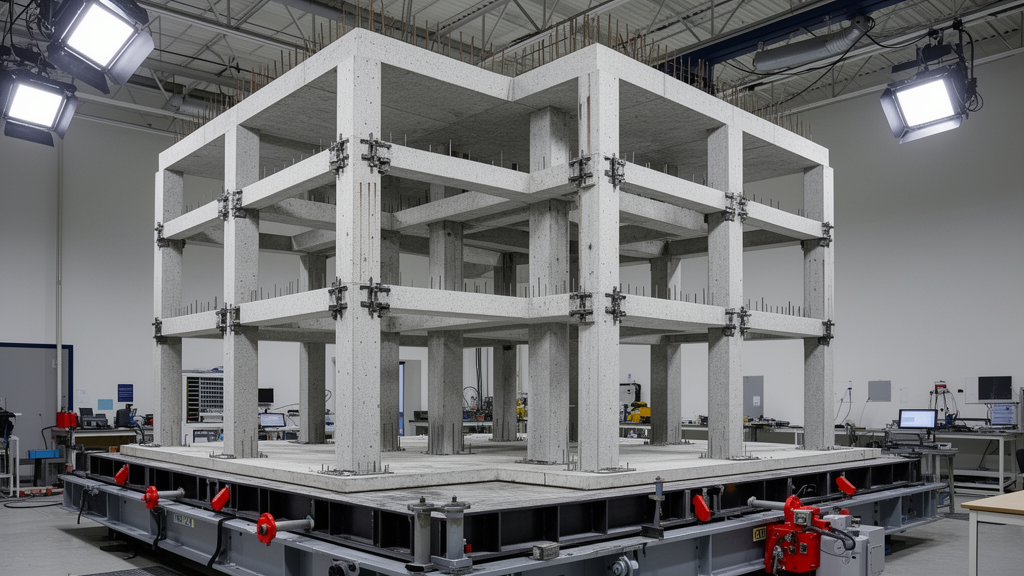
Reinforced concrete frame structures exhibit distinct performance attributes depending on column orientations and story levels when evaluated under nonlinear static analysis, according to findings published by researchers Mo Shi, Min-woo Choi, Yeol Choi, and Sanggoo Kang. The research applied nonlinear static pushover analysis, a method that has become increasingly prevalent over recent decades for evaluating structural responses to earthquakes, using both the SAP 2000 and ABAQUS computational platforms.
The investigation examined variations in structural performance observed across columns configured with various orientations and heights, covering levels ranging from the first floor up to the fifth floor. By tracking structural behavior across these successive story levels, the study summarized how vertical position and orientation together influence the overall seismic response of reinforced concrete building frames.
Earthquakes pose significant challenges to contemporary buildings, and the response of reinforced concrete frames during seismic events depends heavily on structural characteristics that include column section design and directional orientation. The specific cross-sectional designs of these columns directly impact the lateral stiffness of the entire structure, governing how lateral forces are resisted throughout the building framework.
Modifying column orientations within a reinforced concrete frame can create serious structural issues in both vertical stiffness and lateral stiffness, particularly when considering the presence of a weak story. These stiffness disruptions introduce weaknesses into the structural plan, thereby increasing the building’s overall vulnerability to seismic forces during earthquake ground motions.
Within seismic engineering, the most crucial objective is establishing an efficient structural system capable of satisfying defined seismic performance objectives under plastic hinge analysis. The analysis evaluates structures against key performance thresholds, specifically addressing considerations for immediate occupancy, life safety, and collapse prevention across the structural frame.
The researchers note that the observed variations across story heights and column alignments offer valuable insights for future structural analyses examining column orientation performance. Furthermore, the findings are intended to serve as a practical reference for the design and construction of new reinforced concrete structures, as well as for the seismic reinforcement of existing concrete frames.
Subject of Research: Seismic performance of reinforced concrete frames under nonlinear static analysis
Article Title: Influences of Column Orientations and Story Levels of the RC Frames under Nonlinear Static Analysis
Article References: Shi, M., Choi, M.-W., Choi, Y., & Kang, S. (2024). Influences of Column Orientations and Story Levels of the RC Frames under Nonlinear Static Analysis. Architectural Research, 26(4), 127–138. https://doi.org/10.5659/AIKAR.2024.26.4.127
Image Credits: AI Generated
DOI: 10.5659/AIKAR.2024.26.4.127
Keywords: reinforced concrete frames, nonlinear static analysis, pushover analysis, column orientation, story levels, lateral stiffness, vertical stiffness, weak story, seismic performance, plastic hinge analysis, immediate occupancy, life safety, collapse prevention, SAP 2000, ABAQUS, earthquake resilience, structural reinforcement, column section design
News Source: Denise Maddox. (November 16, 2026). Column Orientations Alter Concrete Frame Seismic Performance Across Multiple Story Levels. Scienmag.