A comprehensive systematic review and network meta-analysis evaluating non-invasive brain stimulation techniques has found that pairing neuromodulation with structured behavioral rehabilitation therapy yields measurable improvements in upper-limb motor function among individuals recovering from chronic stroke. The investigation, conducted by a clinical research team led by Huiwen Li and Yin Qin from institutions including Fujian University of Traditional Chinese Medicine and the 900th Hospital of PLA Joint Logistic Support Force, synthesized evidence from thirty-six randomized controlled trials published between 2010 and 2024. Across these investigations, which collectively examined 1,052 adult patients experiencing persistent arm impairments at least six months following an ischemic or hemorrhagic stroke, the combined protocol of brain stimulation and behavioral intervention stood out as the sole tested regimen demonstrating statistically significant superiority over conventional control conditions on standardized motor impairment testing.
Upper-limb motor dysfunction represents one of the most debilitating and persistent consequences of cerebrovascular accidents, affecting between fifty and eighty-five percent of stroke survivors. Six months or more after the initial vascular injury, spontaneous biological recovery plateaus, leaving many individuals with enduring functional limitations characterized by restricted joint mobility in the shoulder and elbow, decreased muscular strength, and compromised fine motor dexterity in the hand and fingers. These physical impairments frequently trigger abnormal flexion synergy movement patterns and compensatory trunk strategies, leading over time to secondary structural complications such as muscular atrophy, joint contractures, and chronic spasticity. Neuroimaging and electrophysiological research cited in the analysis highlights that chronic-phase patients frequently exhibit disrupted interhemispheric communication and compromised functional connectivity across motor networks, making targeted external neuromodulatory approaches a crucial focus for ongoing neurorehabilitation research.
To rigorously evaluate the relative merits of different neuromodulatory strategies, the investigators implemented a systematic review protocol registered in the PROSPERO international prospective register of systematic reviews under registration number CRD420261482727 and adhering strictly to the Preferred Reporting Items for Systematic Reviews and Meta-Analyses guidelines. The researchers performed comprehensive literature searches across five major medical databases, including PubMed, Embase, Web of Science, the Cochrane Central Register of Controlled Trials, and the China National Knowledge Infrastructure. The screening encompassed clinical trials testing non-invasive brain stimulation interventions against active rehabilitation, conventional therapy, or sham stimulation baseline controls. Two independent researchers executed trial screening, data extraction, and quality appraisal, utilizing standardized forms and resolving any methodological discrepancies through consensus consultations or adjudication by a third senior researcher.
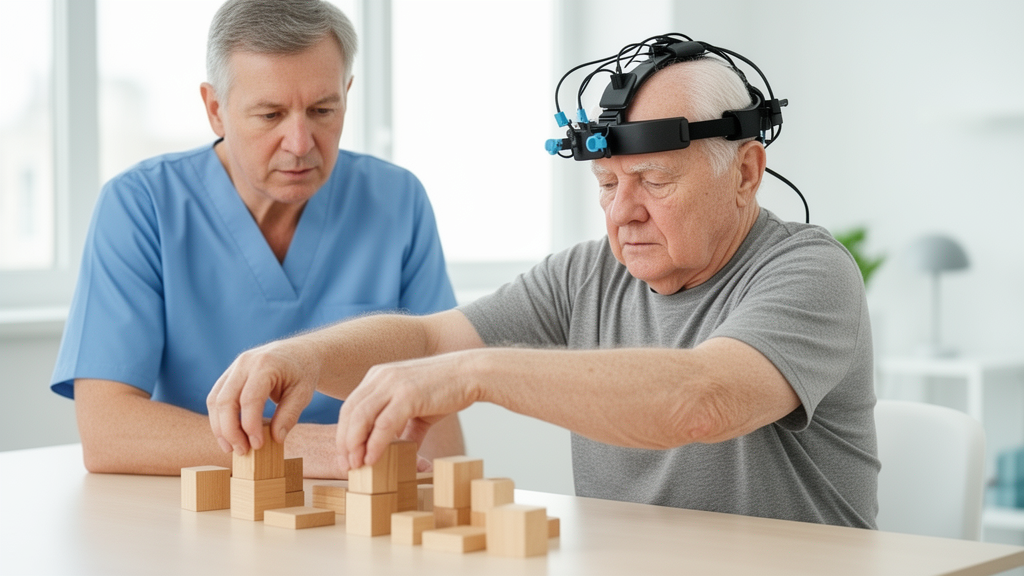
The therapeutic interventions evaluated across the thirty-six included trials represented diverse neurostimulation modalities and combined physical therapy regimens. Modalities encompassed transcranial magnetic stimulation protocols, such as high-frequency repetitive transcranial magnetic stimulation, low-frequency repetitive transcranial magnetic stimulation, intermittent theta burst stimulation, and continuous theta burst stimulation. Trials also evaluated transcranial direct current stimulation applied via anodal stimulation over the ipsilateral primary motor cortex, cathodal stimulation over the contralateral cortex, or dual-hemisphere montages. These electrical and magnetic neuromodulation techniques were tested either as standalone treatments or in combination with adjunct interventions, including behavioral rehabilitation therapy encompassing motor imagery, task-oriented functional training, and modified constraint-induced movement therapy, alongside smart rehabilitation therapies using robotics and virtual reality, as well as functional electrical stimulation delivering peripheral sensory-motor stimulation.
In the primary network meta-analysis of motor impairment, which synthesized data from thirty-one randomized trials comprising 931 chronic stroke patients who completed the Fugl-Meyer Upper Extremity Assessment Scale, the combination of non-invasive brain stimulation and behavioral rehabilitation therapy produced a statistically significant advantage over control regimens. The pooled standardized mean difference reached 0.831 with a 95 percent confidence interval extending from 0.322 to 1.340, corresponding to an unstandardized raw mean difference of 2.83 points on the 66-point Fugl-Meyer scale with a confidence interval between 0.45 and 5.20 points. In contrast, none of the other eleven evaluated non-invasive brain stimulation protocols demonstrated statistically significant differences when compared directly against control conditions in the primary consistency model.
The analytical team evaluated relative protocol performance across the network using the surface under the cumulative ranking curve metric, which calculates the cumulative probability of an intervention achieving superior placement within the comparative hierarchy. The combination of non-invasive brain stimulation and behavioral rehabilitation achieved the highest surface under the cumulative ranking curve value at 92.5 percent, followed by anodal direct current stimulation targeting the premotor cortex at 64.1 percent, bilateral direct current stimulation at 59.3 percent, and brain stimulation combined with smart rehabilitation robotics at 51.6 percent. However, the study authors emphasized that cumulative ranking curves reflect probabilistic tendencies within the specific statistical model and cannot alone substantiate clinical superiority in the absence of statistically significant between-group differences.
Secondary functional endpoints evaluated across the study network revealed selective improvements across specific outcome measures. An analysis of seven randomized controlled trials examining upper-limb task performance on the Wolf Motor Function Test demonstrated that high-frequency repetitive transcranial magnetic stimulation generated a statistically significant beneficial effect relative to control conditions, exhibiting a standardized mean difference of 0.995 with a 95 percent confidence interval from 0.271 to 1.719 and a surface under the cumulative ranking curve score of 92.5 percent. Conversely, across ten studies assessing dexterity with the Action Research Arm Test, no single brain stimulation protocol achieved statistically significant superiority over conventional rehabilitation, although intermittent theta burst stimulation ranked highest among the comparative arms with a ranking metric of 79.8 percent.
The systematic review detected no significant overall improvements when analyzing clinical scales measuring post-stroke spasticity and general independence in activities of daily living. Eight randomized controlled trials utilizing the Modified Ashworth Scale to quantify passive muscle resistance revealed no statistically meaningful reduction in upper-limb muscle tone across five distinct stimulation regimens, indicating that non-invasive cortical stimulation does not consistently diminish established muscular spasticity in chronic stroke cohorts. Similarly, five trials evaluating performance on activities of daily living measures, including the Barthel Index, Modified Barthel Index, and Functional Independence Measure, demonstrated negligible and non-significant pooled effects for both low-frequency repetitive transcranial magnetic stimulation and stimulation paired with smart robotic training.
Methodological appraisals revealed critical structural vulnerabilities and statistical inconsistencies that temper the clinical interpretation of the primary findings. Using the Cochrane Risk of Bias Assessment Tool 2.0, the reviewers categorized nineteen trials as having a low risk of bias, fifteen as presenting some concerns, and two as demonstrating a high risk of bias stemming from inadequate reporting of randomization sequence generation and blinding procedures. Furthermore, an assessment employing the Confidence in Network Meta-Analysis framework rated the overall certainty of evidence supporting the combination of brain stimulation and behavioral rehabilitation as low, driven by imprecision, small-sample outliers, and publication bias identified by Egger regression testing indicating a significant small-sample effect.
Node-splitting analyses performed to examine local mathematical consistency within the evidence loops identified significant discordance between direct and indirect trial comparisons specifically surrounding continuous theta burst stimulation. In comparisons between continuous theta burst stimulation and sham controls, direct evidence pointed to an effect size of 1.028 whereas indirect evidence produced an estimate of negative 3.057, yielding a statistically significant discrepancy of 4.085. A corresponding directional contradiction emerged when comparing continuous theta burst stimulation against low-frequency repetitive transcranial magnetic stimulation, reflecting differing baseline trial designs, divergent sham procedures, and differing temporal physiological dynamics between rapid burst protocols and protracted low-frequency pulse trains.
The authors also conducted sensitivity analyses to isolate the specific therapeutic contribution of brain stimulation when paired with physical training regimens. When the analytical framework was restricted exclusively to clinical trials comparing active brain stimulation plus rehabilitation directly against sham stimulation plus identical rehabilitation, the apparent superiority of the combined intervention lost statistical significance, yielding a standardized mean difference of 0.78 with a wide 95 percent confidence interval ranging from negative 0.48 to positive 2.04. This loss of statistical significance suggests that the beneficial motor improvements observed in the primary pooled analysis may be largely attributable to the intensive behavioral rehabilitation component itself rather than an independent additive effect conferred by the neuromodulatory stimulation.
A critical consideration identified in the systematic review is the marked scarcity and inconsistency of long-term post-intervention follow-up data. Although sixteen included trials incorporated monitoring intervals spanning one to six months following the conclusion of stimulation protocols, reported outcomes varied widely across research centers. While select trials noted sustained improvements in motor task performance at four weeks post-treatment, other investigations documented a decay in muscular grip strength or failed to demonstrate enduring functional divergence between active stimulation and control groups at three- and six-month checkpoints, highlighting the need for future multicenter trials with standardized long-term follow-up protocols.
Subject of Research: Non-invasive brain stimulation protocols and behavioral rehabilitation for post-stroke upper limb motor recovery
Article Title: Effects of non-invasive brain stimulation on upper-limb motor dysfunction in chronic stroke patients: a systematic review and network meta-analysis
Article References: Li, H., Lai, H., Chen, P., Zhuang, X., & Qin, Y. (2026). Effects of non-invasive brain stimulation on upper-limb motor dysfunction in chronic stroke patients: a systematic review and network meta-analysis. Frontiers in Neurology, 17, Article 1991200. https://doi.org/10.3389/fneur.2026.1991200
Image Credits: AI Generated
DOI: 10.3389/fneur.2026.1991200
Keywords: stroke rehabilitation, non-invasive brain stimulation, transcranial magnetic stimulation, transcranial direct current stimulation, upper limb motor dysfunction, chronic stroke, network meta-analysis, Fugl-Meyer Assessment, behavioral rehabilitation therapy, Wolf Motor Function Test, neuroplasticity, motor recovery, repetitive transcranial magnetic stimulation, theta burst stimulation, rehabilitation medicine, spasticity
News Source: Cassandra Pierce. (November 16, 2026). Brain Stimulation Paired With Behavioral Therapy Improves Chronic Stroke Arm Function. Scienmag.